Facts
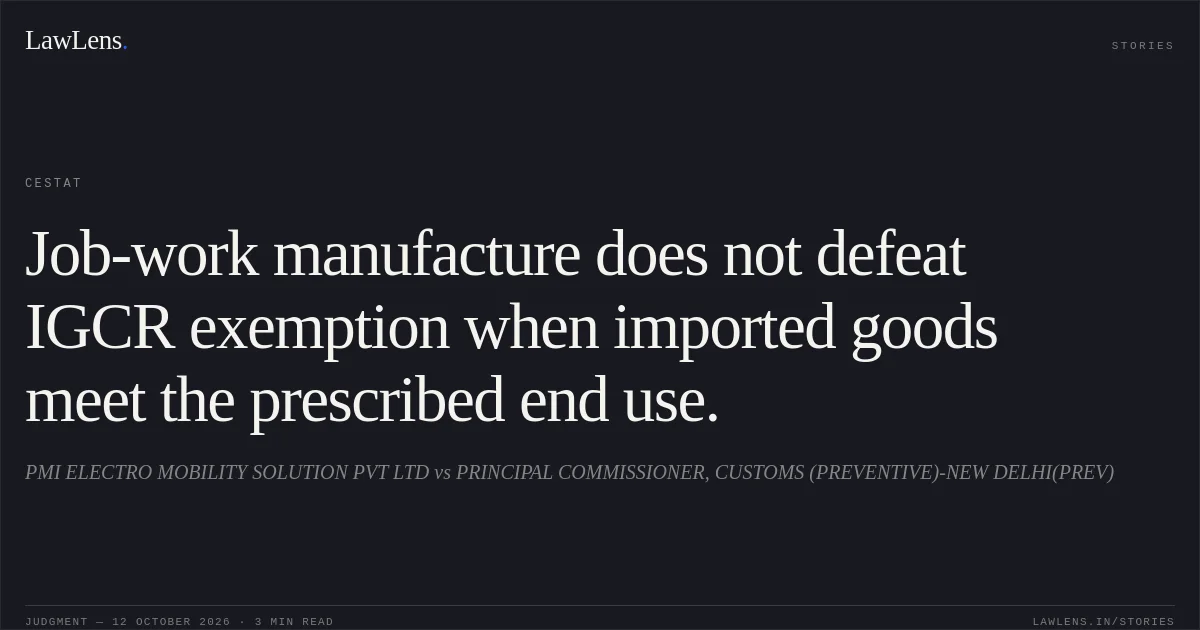
The appellant imported components for electric buses at concessional rates under Serial Nos. 528 and 528A of Notification No. 50/2017-Cus., subject to Condition No. 9 and compliance with the Customs (Import of Goods at Concessional Rate of Duty) Rules, 2017 (“IGCR Rules”).
Source reference: pp. 2–3, 16It filed import intimations, furnished a continuity bond and submitted returns.
Source reference: p. 13Under an MOU, its sister concern, PMI Coaches Pvt. Ltd., fabricated 20 buses using the imported components.
Source reference: pp. 3, 9–11The Department treated tax invoices issued to PMI Coaches as evidence that the components had been sold or cleared “as such,” and alleged breach of the IGCR Rules.
Source reference: pp. 3, 9–11The Principal Commissioner denied the exemption, confirmed differential duty of Rs. 1,06,69,156 under Section 28(4) read with Rule 8, ordered interest under Section 28AA, appropriated Rs. 25,00,000 already deposited and imposed a penalty under Section 114A.
Source reference: p. 3Issues
1. Whether the appellant violated the IGCR Rules or the conditions of Notification No. 50/2017-Cus. by having PMI Coaches fabricate the buses using the imported components.
Source reference: pp. 12–162. Whether the transaction constituted an impermissible sale or clearance of the imported components, rather than their use in manufacture on a job-work basis.
Source reference: pp. 15–163. Whether the demand, interest and penalty imposed by the impugned order could be sustained.
Source reference: pp. 2–3, 24–25Law Applied
Condition No. 9 of Serial Nos. 528 and 528A of Notification No. 50/2017-Cus. required compliance with the IGCR Rules, which prescribe procedures for import, receipt, end use, reporting and clearance or re-export of unutilised or defective goods.
Source reference: pp. 2, 16Rule 7 addresses re-export or home-consumption clearance of unutilised or defective goods; Rule 8 provides for recovery where the applicable obligations are not met.
Source reference: pp. 14–15The Tribunal relied on *Tamil Trading Corporation v. Commissioner of Central Excise*, *FDC Limited v. Commissioner of Central Excise* and *Intas Pharmaceuticals Limited v. Commissioner of Customs* for the principle that end-use conditions may be satisfied where imported goods are used through a job worker on the importer’s behalf; the importer need not necessarily undertake manufacture in a factory it owns.
Source reference: pp. 17–24It also relied on *Godrej Consumer Products Ltd. v. Commissioner of Customs (Air)* in support of permitting job-work manufacture where the exemption condition does not prohibit it.
Source reference: pp. 20–21Reasoning
The Tribunal found that the appellant had filed the prescribed intimations, furnished the bond and filed returns, and that the imported components were used to manufacture electric buses that were supplied to HRTC.
Source reference: p. 13; pp. 16, 24–25Although tax invoices had been issued to PMI Coaches, the Tribunal treated the arrangement as job-work manufacture under an MOU, not as a sale or clearance of unused components.
Source reference: pp. 15–16, 24–25It noted that the two concerns shared the manufacturing premises and that the components were not physically removed from the appellant’s premises.
Source reference: pp. 15–16, 24–25Since the Department did not allege that the components had been diverted from the specified end use, the Tribunal held that the arrangement did not defeat the substantive purpose of the exemption; any procedural lapse did not justify denying the benefit.
Source reference: pp. 16–17, 24–25Holding
The Tribunal held that the appellant had substantially complied with Notification No. 50/2017-Cus. and the IGCR Rules, and that the job-work arrangement did not establish an impermissible clearance of the imported components.
It set aside the impugned order and allowed the appeal.
Source reference: p. 25Acts & Sections Cited
4 provisions across 2 statutes referred to in this judgment. Each provision opens on LawLens.
Customs Act,19623
Central Excise Act, 19441
Original Court PDF
PMI ELECTRO MOBILITY SOLUTION PVT LTDvsPRINCIPAL COMMISSIONER, CUSTOMS (PREVENTIVE)-NEW DELHI(PREV)
Click to open original judgment
Original judgment, available to read, download and summarize on LawLens.in