01Facts
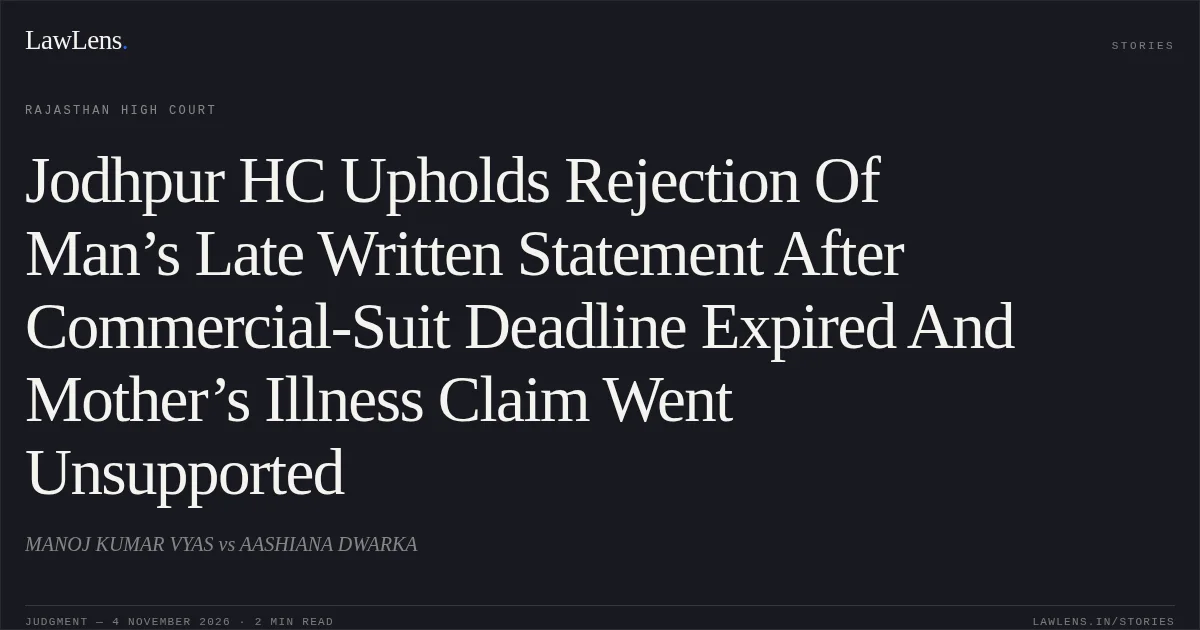
The petitioner, a defendant in a commercial suit seeking mandatory and permanent injunction, was served with summons and appeared through counsel but did not file a written statement within 120 days.
¶ 1–2.4He later sought permission under Order VIII Rule 1 CPC to place his written statement on record, attributing the delay to his mother’s prolonged illness and consequent difficulty communicating with counsel.
¶ 1–2.4The Commercial Court rejected the application and closed his opportunity to file the written statement.
¶ 1–2.4The petitioner challenged that order under Article 227 of the Constitution.
¶ 1–2.402Issues
i.Whether the Commercial Court erred in refusing to take the petitioner’s written statement on record after expiry of the 120-day period prescribed for commercial disputes
¶ 1, 8–10ii.Whether the Commercial Court’s order disclosed an illegality or jurisdictional error warranting interference under Article 227 of the Constitution
¶ 2.4, 10–1203Law Applied
Order V Rule 1, Order VIII Rules 1 and 10 CPC, as amended by the Commercial Courts Act, 2015, prescribe a mandatory outer limit of 120 days from service of summons for filing a written statement in a commercial dispute; on expiry of that period, the defendant forfeits the right to file it, and the court cannot take it on record.
¶ 8The Court relied on SCG Contracts India Private Limited v. K.S. Chamankar Infrastructure Private Limited and Others, (2019) 12 SCC 210, for this rule.
¶ 8Article 227 supervisory jurisdiction does not warrant interference absent an illegality, perversity or jurisdictional error.
¶ 10, 1204Reasoning
The petitioner’s explanation—that his mother’s illness impaired communication with his counsel—was unsupported by cogent material and did not satisfactorily show how it prevented timely filing.
¶ 6–11The petitioner had also received prior opportunities but failed to file within the statutory period.
¶ 6–11Applying SCG Contracts, the Court held that the written statement could not be accepted after the 120-day limit and that the principle of deciding disputes on their merits could not override the statutory bar.
¶ 6–11The Commercial Court therefore committed no reviewable error.
¶ 6–1105Holding
The Commercial Court properly refused to accept the written statement after expiry of the mandatory 120-day period, and no ground for intervention under Article 227 was established.
¶ 12–13The writ petition was dismissed, and any pending applications were disposed of.
¶ 12–13Original Court PDF
MANOJ KUMAR VYASvsAASHIANA DWARKA
Click to open original judgment
Original judgment, available to read, download and summarize on LawLens.in