01Facts
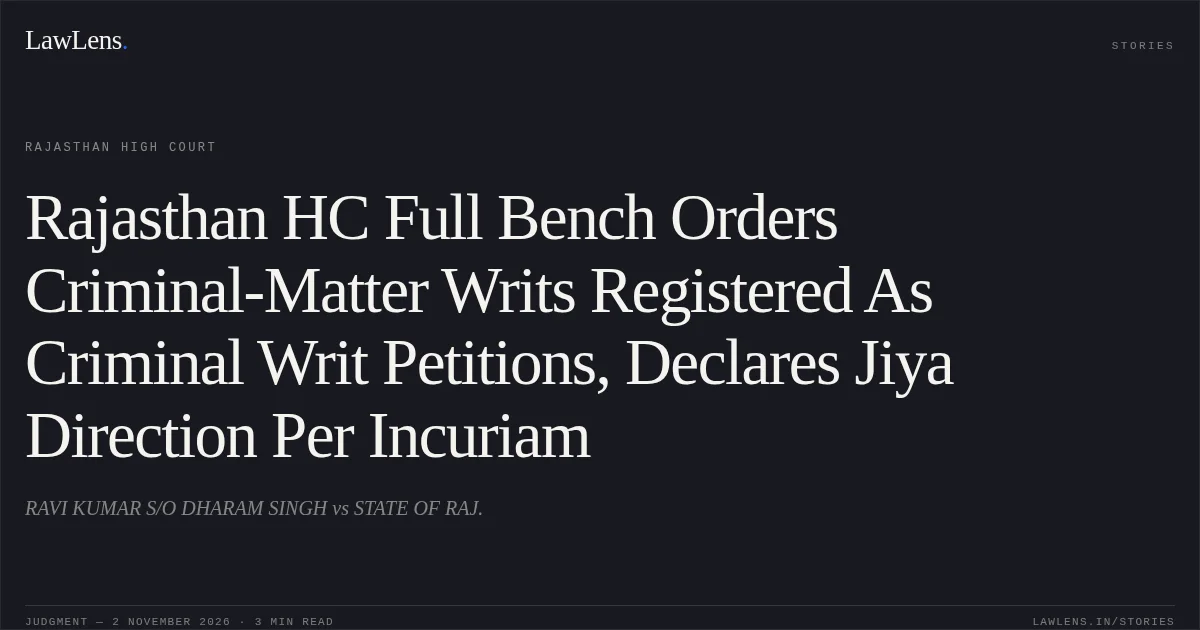
A Single Judge, Anand Sharma, J., referred questions concerning the registration and classification of writ petitions arising from criminal matters after identifying a conflict between Rule 315(1)(h) of the Rajasthan High Court Rules, 1952 and a Division Bench order in Jiya & Others v. Government of Rajasthan & Others.
pp. 3–5 · ¶ 1–3The Jiya order directed the Registry not to register cases as “Criminal Writ Petitions” and to treat the petition before it as a “Civil Writ Petition”.
pp. 3–5 · ¶ 1–3Rule 315(1)(h), however, provides for applications under Article 226 “in a criminal matter” to be registered and numbered as criminal miscellaneous cases. The reference arose in Ravi Kumar’s pending writ petition.
p. 6 · ¶ 5–6 · p. 302Issues
i.1. Whether an Article 226 petition concerning a criminal matter must be registered separately as a Criminal Writ Petition, or as a Civil Writ Petition.
p. 4 · ¶ 1(i)ii.2. Whether “Criminal Writ Petition” is merely a Registry label or reflects the substantive character of the proceeding.
p. 4 · ¶ 1(ii)iii.3. Whether Rule 315(1)(h) may be rendered inoperative or ignored by judicial direction without being held invalid.
p. 4 · ¶ 1(iii)iv.4. Whether the Jiya direction prohibiting registration as a Criminal Writ Petition is reconcilable with Rule 315(1)(h).
p. 4 · ¶ 1(iv)v.5. Whether, if irreconcilable, the Jiya order required reconsideration by a Larger Bench.
p. 4 · ¶ 1(v)03Law Applied
Rule 315(1)(h) of the Rajasthan High Court Rules, 1952 expressly provides that an application under Article 226 in a criminal matter is to be registered and numbered as a criminal miscellaneous case; Rule 123(1) gives precedence to Part III where it conflicts with rules in other Parts.
pp. 6–7 · ¶ 5–9Rule 54 vests allocation of judicial work in the Chief Justice, while roster allocation does not itself repeal or invalidate a procedural rule [State of Rajasthan v. Prakash Chand, (1998) 1 SCC 1].
pp. 7–8 · ¶ 10–11, 27–28Under Ram Kishan Fauji v. State of Haryana, (2017) 5 SCC 533, the character of a proceeding depends on the right asserted and relief sought; criminal proceedings ordinarily include proceedings that may result in a sentence or preventive orders.
pp. 8–10 · ¶ 13–15A decision rendered without due regard to a governing statutory provision may be per incuriam [State of U.P. v. Synthetics and Chemicals Ltd., (1991) 4 SCC 139].
pp. 21, 24–25 · ¶ 37, 44–46The “Criminal Writ Petition” designation does not create a distinct constitutional jurisdiction, but the classification may affect registration and roster placement under the Rules.
pp. 14–16 · ¶ 21–25Provisions in the judgment · 2
Rajasthan High Court Ordinance 1949 Section 46
Code of Criminal Procedure, 1898 Section 491
04Reasoning
The Full Bench held that Rule 315(1)(h) expressly covers Article 226 applications in criminal matters and mandates their registration within the criminal-side procedural framework; treating such matters as civil writ petitions would deny effect to that provision.
pp. 13–14 · ¶ 18–19The constitutional source remains Article 226, but the Registry classification is not necessarily a merely clerical matter because it may determine placement before the appropriate roster Bench.
pp. 14–16 · ¶ 21–25The Court distinguished roster allocation from rule-making and concluded that a judicial direction cannot silently displace an operative rule.
pp. 17–18 · ¶ 27–30It therefore held the Jiya direction per incuriam to the extent that it barred criminal-side registration contrary to Rule 315(1)(h).
pp. 19–21 · ¶ 33–3705Holding
The reference was answered in favour of criminal-side registration: writ petitions within Rule 315(1)(h) must be registered as “Criminal Writ Petitions” and placed before the appropriate Bench under the roster.
pp. 23–25 · ¶ 43–47The Jiya direction was held per incuriam insofar as it prohibited such registration.
pp. 21, 23–25 · ¶ 37, 44–47The declaration operates prospectively; concluded matters remain undisturbed, while pending criminal-matter writ petitions registered under another nomenclature are to be re-registered and reclassified within two weeks.
pp. 26–27 · ¶ 48.1–48.5The Registry was directed to implement the ruling and issue necessary administrative instructions.
pp. 26–27 · ¶ 48.1–48.5Original Court PDF
RAVI KUMAR S/O DHARAM SINGHvsSTATE OF RAJ.
Click to open original judgment
Original judgment, available to read, download and summarize on LawLens.in