Facts
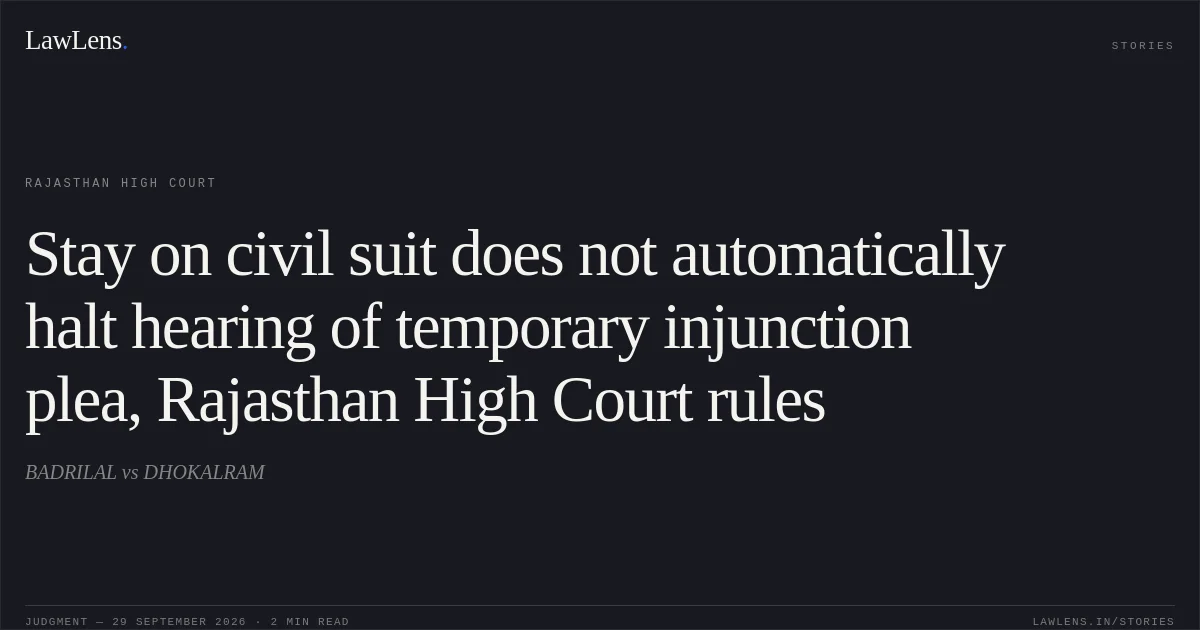
The petitioner filed a partition suit and an application for temporary injunction under Order XXXIX Rules 1 and 2 CPC.
Source reference: para. 6.1–6.2In a separate writ petition, the High Court directed the trial court to decide the injunction application expeditiously, preferably within 30 days.
Source reference: para. 6.1–6.2In another writ petition, the High Court stayed further proceedings in the suit, without expressly staying the injunction application.
Source reference: para. 6.3–6.4, 7The trial court rejected the petitioner’s application under Section 151 CPC to stay proceedings on the injunction application.
Source reference: para. 2.4–2.7The petitioner challenged that rejection under Articles 226 and 227 of the Constitution.
Source reference: para. 1, 2.4–2.7Issues
Whether an order staying “further proceedings” in a civil suit, without more, stays or deprives the trial court of jurisdiction to decide a pending application for temporary injunction under Order XXXIX Rules 1 and 2 CPC
Source reference: para. 6Whether the later stay order displaced the earlier direction to decide the injunction application expeditiously
Source reference: para. 3.2, 10–11Law Applied
Under Order XXXIX Rules 1 and 2 CPC, temporary injunction proceedings are interlocutory and protective, aimed at preserving the subject matter and protecting parties’ rights pending final adjudication.
Source reference: para. 6.15–6.25A general order staying further proceedings in a suit does not, by itself, bar the trial court from deciding collateral or protective interlocutory applications; the effect depends on the stay order’s terms and purpose, the proceedings before the superior court, and the nature and effect of the interlocutory matter.
Source reference: para. 6.15–6.25The court relied on Madanlal Agarwal v. Kamlesh Nigam, Khemraj Ratanlal Sancheti v. Vasant Madhaosa Vyavhare, Bijay Kumar Agarwalla v. Ramakanta Das, Basanta Manjari Sawal v. Rupakanta Sahu, Rameshwar v. Vth Additional District Judge, Basti, Surendra Sawhney v. Murlidhar and Amita Kaushish v. Sanjay Kaushish for the distinction between trial on the merits and collateral or protective interlocutory proceedings.
Source reference: para. 6.15–6.22The court also noted that its supervisory jurisdiction under Articles 226 and 227 is not appellate and warrants interference only for jurisdictional error, patent illegality, perversity or manifest error causing failure of justice.
Source reference: para. 12Reasoning
The stay order concerned further proceedings in the suit and contained no express direction staying the temporary-injunction application.
Source reference: para. 6.3–6.4, 7Deciding that application would be an interlocutory, protective step, not a continuation of the trial on the merits or an adjudication of the parties’ ultimate rights.
Source reference: para. 6.25, 8The earlier direction to decide the application within 30 days concerned that application specifically; because it had not been recalled or stayed, it remained operative and was not nullified by the later order in a different writ petition.
Source reference: para. 10–11The trial court therefore did not err in refusing to stay the injunction proceedings.
Source reference: no citationHolding
The Court held that a general stay of further proceedings in a suit does not automatically stay a pending application under Order XXXIX Rules 1 and 2 CPC; the effect must be assessed by reference to the terms and scope of the stay and the nature of the interlocutory proceeding.
Finding no ground for supervisory interference, it dismissed the writ petition and dismissed the pending stay application and other pending applications, if any.
Source reference: para. 13–15Acts & Sections Cited
6 provisions across 2 statutes referred to in this judgment. Each provision opens on LawLens.
Code of Civil Procedure, 19085
Bharatiya Nyaya Sanhita, 20231
Original Court PDF
BADRILALvsDHOKALRAM
Click to open original judgment
Original judgment, available to read, download and summarize on LawLens.in