Facts
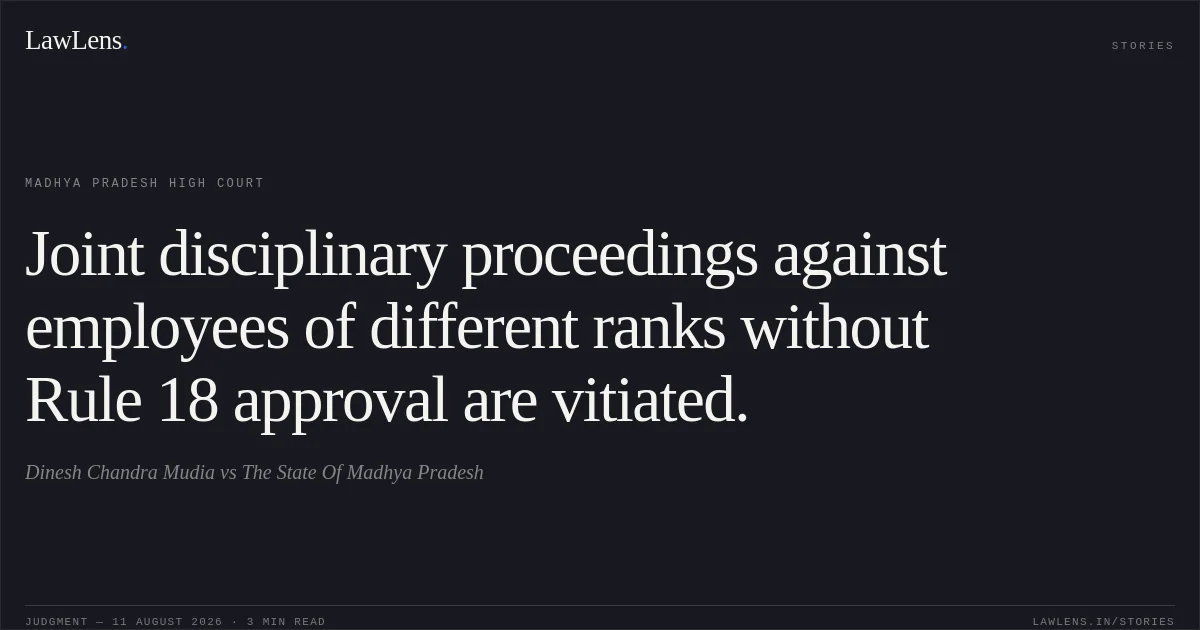
The petitioner, Dinesh Chandra Mudiya, challenged the punishment order dated 2 May 2015 imposing withholding of two annual increments with cumulative effect, along with the consequential appellate order affirming the punishment.
Source reference: para. 2The punishment arose from a joint departmental enquiry conducted pursuant to a common charge-sheet against several officers, including the petitioner, C.M. Mishra, Executive Engineer, and Arun Kumar Dixit.
Source reference: paras. 2, 5The petitioner contended that the joint proceedings were conducted without obtaining the competent authority’s approval mandated by Rule 18 of the Madhya Pradesh Civil Services (Classification, Control and Appeal) Rules, 1966 (“CCA Rules”).
Source reference: paras. 2, 6The punishments imposed on C.M. Mishra and Arun Kumar Dixit in the same proceedings had previously been quashed by the High Court for non-compliance with Rule 18.
Source reference: paras. 2, 5The State opposed the petition on the ground of delay and laches, noting that the punishment order was passed in 2015, the appeal was rejected in 2016, and the writ petition was filed on 20 November 2025.
Source reference: para. 3Issues
Whether the joint departmental enquiry and consequential punishment were invalid because no order permitting common proceedings was passed under Rule 18 of the CCA Rules, 1966?
Source reference: paras. 5–7Whether the writ petition was liable to be dismissed on the ground of delay and laches, despite the punishment having a continuing and recurring financial effect?
Source reference: paras. 3, 8–9Whether the petitioner was entitled to consequential service, monetary, pensionary, and retiral benefits following quashing of the punishment?
Source reference: paras. 10–12Law Applied
Rule 18 of the Madhya Pradesh Civil Services (Classification, Control and Appeal) Rules, 1966 provides that where two or more Government servants are concerned in the same case, common disciplinary proceedings may be ordered only by the Governor or an authority competent to impose the penalty of dismissal on all such employees.
Source reference: para. 6As the Rules are framed under the proviso to Article 309 of the Constitution, compliance with Rule 18 is statutory and mandatory; a joint enquiry involving employees of different ranks without the requisite order is legally vitiated.
Source reference: para. 6The Court relied on C.M. Mishra v. State of Madhya Pradesh (W.P. No. 6112/2015), affirmed in W.A. No. 2103/2026, and State of M.P. v. Arun Kumar Dixit (W.A. No. 1358/2025), which held that joint proceedings against officers of different ranks without an order under Rule 18 cannot be sustained.
Source reference: paras. 6–7The Court also applied Pankaj Yadav v. State of Madhya Pradesh, W.A. No. 117/2015, holding that withholding increments with cumulative effect has continuing consequences because it reduces salary during service and pension after retirement; therefore, delay alone does not necessarily defeat the challenge.
Source reference: para. 8Reasoning
The petitioner was proceeded against in the same common departmental enquiry and under the same charge-sheet as employees holding different posts and ranks.
Source reference: para. 5No order authorising common proceedings under Rule 18 was produced or shown to have been passed.
Source reference: paras. 5–7Applying the binding reasoning in the cases of C.M. Mishra and Arun Kumar Dixit, the Court held that the enquiry suffered from a statutory defect and that the consequential punishment could not stand.
Source reference: paras. 5–7The State’s inability to distinguish those cases established that the petitioner stood on an identical footing with the employees whose punishments had already been quashed.
Source reference: para. 5The objection of delay and laches was rejected because withholding increments with cumulative effect produces recurring effects on salary and pension, thereby giving rise to a continuing cause of action.
Source reference: paras. 8–9Since the proceedings were invalid for non-compliance with Rule 18, the Court found it unnecessary to examine the merits of the disciplinary allegations.
Source reference: para. 6Holding
The High Court allowed the writ petition and quashed the punishment order dated 2 May 2015 insofar as it related to the petitioner, as well as the appellate order affirming it.
The respondents were directed to extend all consequential service and monetary benefits, issue a revised PPO/GPO, and revise the petitioner’s pension and other retiral benefits within four months from receipt of the certified order.
Source reference: para. 11If the exercise was not completed within that period, the petitioner would be entitled to interest at 6% per annum on the delayed monetary benefits from the date of filing of the writ petition until actual payment.
Source reference: para. 11The petition was accordingly allowed and disposed of.
Source reference: para. 12Acts & Sections Cited
1 provisions across 1 statute referred to in this judgment. Linked provisions open on LawLens.
M.P. Uchcha Nyayalaya (Khand Nyayapeeth Ko Appeal) Adhiniyam, 20051
Original Court PDF
Dinesh Chandra MudiavsThe State Of Madhya Pradesh
Click to open original judgment
Original judgment, available to read, download and summarize on LawLens.in