Facts
The petitioner-landlord instituted Ejectment Suit No. 60 of 2025 before the Presidency Small Causes Court, Calcutta, seeking eviction on the grounds of default, unauthorised construction, change of user and reasonable requirement.
Source reference: paras. 2–4Summons were issued to both defendants on 25 March 2025 through the court bailiff and by Speed Post with acknowledgement due. The postal records indicated service upon Defendant No. 1 through his daughter-in-law, “Moumita,” and delivery of the article addressed to Defendant No. 2 to the same person, although the article was subsequently returned with the endorsement “addressee left without instruction”.
Source reference: paras. 2–4Defendant No. 1’s applications under Sections 7(1) and 7(2) of the West Bengal Premises Tenancy Act, 1997 (“WBPT Act”) were rejected as time-barred.
Source reference: para. 4Nevertheless, by Order No. 3 dated 29 April 2025, the Trial Court directed the landlord to take fresh steps for service upon Defendant No. 2.
Source reference: para. 4After fresh service, Defendant No. 2 filed applications under Sections 7(1) and 7(2) on 9 June 2025, which were allowed by Order No. 9 dated 11 September 2025.
Source reference: paras. 1, 4–5The landlord challenged both orders under Article 227 of the Constitution.
Source reference: paras. 1, 4–5The defendants were treated as joint tenants in respect of the premises.
Source reference: para. 15Issues
Whether joint tenants in an eviction suit can file separate applications under Sections 7(1) and 7(2) of the WBPT Act when an earlier application filed by one joint tenant has been rejected as time-barred.
Source reference: paras. 15–20Whether the statutory period under Section 7 of the WBPT Act can be circumvented by relying on fresh service upon, or a separate appearance by, another joint tenant.
Source reference: paras. 18–20Whether the Trial Court acted illegally or with material jurisdictional irregularity in allowing Defendant No. 2’s belated applications under Sections 7(1) and 7(2).
Source reference: para. 23Law Applied
Section 7(1)(b) of the WBPT Act requires the tenant to pay or deposit arrears of rent, together with applicable interest, within one month of service of summons or, where the tenant appears without service, within one month of appearance; Section 7(2) prescribes the corresponding procedure where there is a dispute regarding the rent payable, and Section 7(3) mandates striking out the defence if the statutory payment or deposit is not made within time.
Source reference: para. 16The statutory period is mandatory and cannot be enlarged by invoking Section 5 of the Limitation Act, 1963, or Section 151 of the CPC.
Source reference: paras. 18–22The Court relied on Arsala Khan v. Land & Bricks & Entertainment Ltd., which recognised that Section 7 does not permit recourse to the Limitation Act for belated deposit; Bijay Kumar Singh v. Amit Kumar Chamariya, (2019) 10 SCC 660, which held that simultaneous deposit of admitted rent with an application for determination is a condition precedent; and Debasish Paul v. Amal Boral, (2024) 2 SCC 169, which reaffirmed that Section 5 cannot enlarge a shorter limitation period prescribed by the WBPT Act.
Source reference: paras. 21–22The Court further applied the principle that the obligation under Section 7 constitutes a unified defence available to joint tenants, so that one joint tenant cannot revive or bypass the statutory defence after another joint tenant’s non-compliance.
Source reference: paras. 18–20Reasoning
The Court held that Defendants Nos. 1 and 2 were joint tenants and that the rent and defence concerning the premises were common and identical.
Source reference: paras. 14–15, 18Once Defendant No. 1’s applications under Sections 7(1) and 7(2) had been rejected as delayed, Defendant No. 2 could not create a fresh statutory opportunity by filing separate applications after the Trial Court directed fresh service.
Source reference: paras. 18–20The obligation to deposit arrears and seek determination under Section 7 was a unified obligation of the joint tenants; consequently, the period could not be recalculated from Defendant No. 2’s alleged subsequent receipt of summons.
Source reference: paras. 18–20The Trial Court’s reliance on the fresh-service order to allow Defendant No. 2’s applications therefore bypassed the mandatory statutory period and amounted to jurisdictional error, perversity and palpable illegality.
Source reference: para. 23The High Court nevertheless preserved the portion of the earlier order directing fresh service so that Defendant No. 2 could contest the suit in accordance with law, if advised.
Source reference: para. 25Holding
The High Court allowed the revision under Article 227.
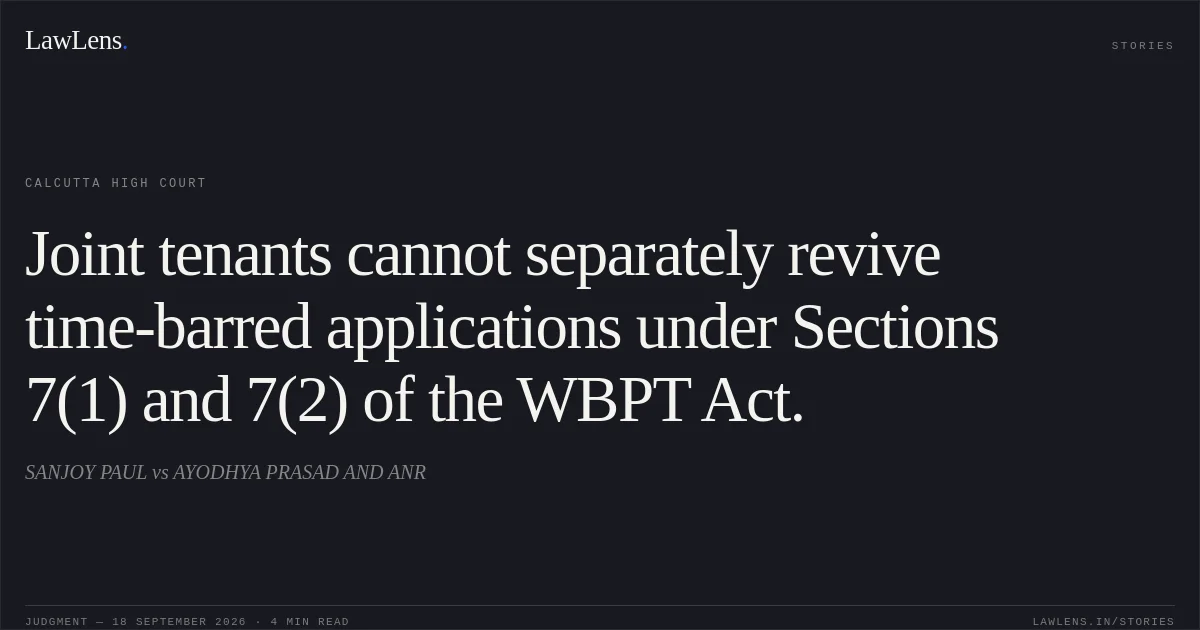
It held that a second or separate application under Sections 7(1) and 7(2) of the WBPT Act by another joint tenant cannot be entertained after an earlier tenant’s applications on the same tenancy and defence have been rejected as time-barred.
Source reference: paras. 18–20, 23Order No. 9 dated 11 September 2025 was set aside, and Order No. 3 dated 29 April 2025 was also set aside except for the direction requiring fresh service upon Defendant No. 2.
Source reference: para. 25Defendant No. 2 was permitted to contest the ejectment suit in accordance with law, but could not obtain the benefit of belated applications under Sections 7(1) and 7(2).
Source reference: para. 25Acts & Sections Cited
4 provisions across 3 statutes referred to in this judgment. Each provision opens on LawLens.
Code of Civil Procedure, 19081
Limitation Act, 19631
Original Court PDF
SANJOY PAULvsAYODHYA PRASAD AND ANR
Click to open original judgment
Original judgment, available to read, download and summarize on LawLens.in