Facts
The petitioner/plaintiff filed a suit (O.S. No. 676/2006) for specific performance of a registered sale agreement involving a consideration of ₹12,75,000/-
Source reference: p. 3Although the defendants appeared, they failed to file a written statement, leading to an ex-parte judgment and decree on 17.12.2008
Source reference: p. 3In the execution proceedings (Ex. P. No. 98/2009), the court allowed the petition on 23.08.2012, and a sale deed was registered on 23.09.2012
Source reference: p. 3Subsequently, the respondents filed Misc. P. No. 3/2013 under Order IX Rule 9 read with Section 151 of the CPC to set aside the decree, citing negligence by their advocate
Source reference: p. 4The Trial Court allowed the miscellaneous petition on 18.03.2026
Source reference: p. 3The petitioner challenged this order, contending that the Trial Court recorded the existence of the petitioner’s citations and synopsis in the docket but failed to discuss or consider them in the final impugned order
Source reference: p. 4-5Issues
1. Whether the Trial Court’s failure to consider the citations and written arguments submitted by a party while passing an order in a miscellaneous petition vitiates the judicial process
Source reference: p. 72. Whether the impugned order satisfies the legal requirement of being a "reasoned order"
Source reference: p. 8Law Applied
The court applied the fundamental principle of the "Fair Judicial Process," which dictates that reasoning is the "heartbeat" of every judicial order
Source reference: p. 8The court emphasized the duty of courts to consider the contentions and precedents cited by both parties.
Source reference: no citationThe court referred to the discretionary powers under Order IX of the CPC regarding setting aside ex-parte decrees, noting that such discretion must be exercised reasonably and transparently
Source reference: p. 5-8Precedents cited by the respondents included A. Murugesan v. Jamuna Rani, G.P. Srivastava v. R.K. Raizada, and Robin Thapa v. Rohit Dora, which deal with "sufficient cause" for non-appearance
Source reference: p. 6Reasoning
The High Court observed that while the Trial Court acknowledged the petitioner’s submission of citations and synopsis in its docket orders dated 12.11.2025, the final impugned order only reflected the judgments relied upon by the respondents
Source reference: p. 5, 7The High Court held that a court is duty-bound to disclose its mental process and demonstrate that it has given thoughtful consideration to the submissions of both sides
Source reference: p. 8It reasoned that failure to address the petitioner’s specific contentions—including the impact of the Supreme Court’s decision regarding the suspension of the respondents' advocate—rendered the order arbitrary
Source reference: p. 4, 8The Court emphasized that even interim or miscellaneous orders must be grounded in legal principles and evidence rather than subjective opinion to safeguard against arbitrariness
Source reference: p. 8-9Holding
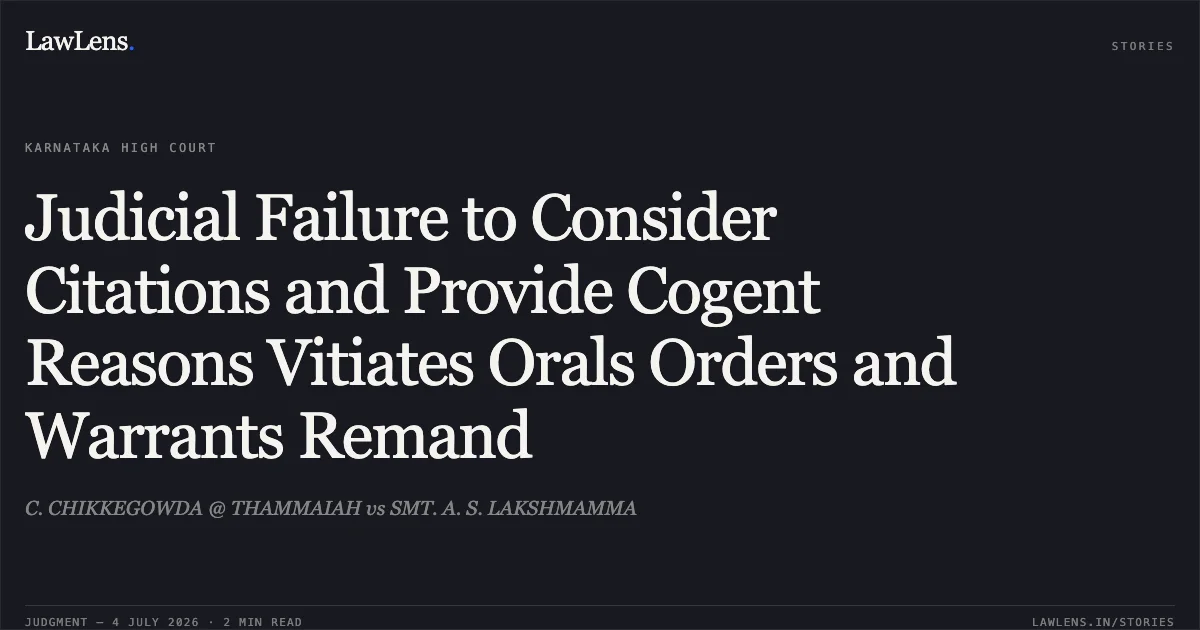
The Trial Court had failed to record cogent reasons or consider the petitioner’s case, thereby violating the requirements of a fair judicial process
The High Court allowed the Civil Revision Petition, set aside the impugned order dated 18.03.2026 passed in Misc. No. 3/2013 and remanded the matter back to the I Additional Senior Civil Judge, Ramanagara with a direction to pass a fresh, reasoned order within four weeks
Source reference: p. 9-10Acts & Sections Cited
3 provisions across 1 statute referred to in this judgment. Each provision opens on LawLens.
Code of Civil Procedure, 19083
Original Court PDF
C. CHIKKEGOWDA @ THAMMAIAHvsSMT. A. S. LAKSHMAMMA
Click to open original judgment
Original judgment, available to read, download and summarize on LawLens.in