Facts
The matter involves a long-standing partition suit initiated in 2011 regarding family property.
Source reference: p. 2A final decree was passed on January 17, 2018, declaring four shares and ordering partition by sale through inter-se bidding.
Source reference: p. 2-3In February 2024, during execution, it was revealed that one party had encumbered the property with a bank loan.
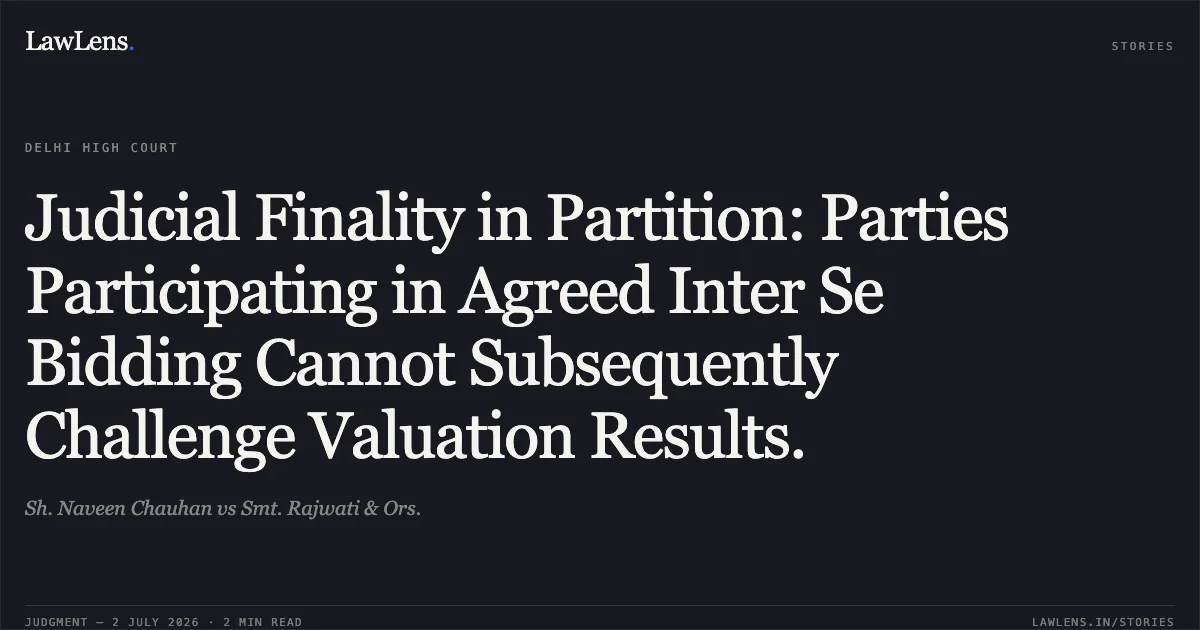
Source reference: p. 5Following the appointment of a Local Commissioner (LC) in December 2023, an inter-se bidding process was conducted where Decree Holder No. 3 emerged as the highest bidder at ₹84,00,000, while the Petitioner bid ₹71,00,000.
Source reference: p. 5, 9After the bidding concluded and title documents were secured, the Petitioner filed the current application in 2026 seeking a re-valuation of the property based on current market rates and circle rates, alleging the successful bid was undervalued.
Source reference: p. 5-6, 10Issues
1. Whether a party who participated in and lost an agreed inter-se bidding process can subsequently seek a re-determination of the property's value during the final stages of execution.
Source reference: p. 10 / para. 132. Whether the execution court should entertain new valuation reports to protract proceedings after the decree has reached the stage of culmination.
Source reference: p. 11 / para. 15Law Applied
The court applied Section 151 and Order XXI of the Code of Civil Procedure (CPC) regarding the execution of decrees.
Source reference: p. 1The court relied on the settled legal principle that executing courts must prevent tactics intended to deny a decree holder the fruits of their decree.
Source reference: p. 11The court emphasized the judicial policy that execution petitions should be disposed of expeditiously without unessential evidence-gathering, except in rare circumstances.
Source reference: p. 11Furthermore, it affirmed that inter-se bidding is a legally recognized and valid method for determining the fair market value of a property in partition suits.
Source reference: p. 12Reasoning
The court found the Petitioner's application to be an unsubstantiated attempt to delay a decree passed eight years prior.
Source reference: p. 11, 13It noted that the Petitioner had multiple opportunities to object—during the appointment of the LC, the submission of bids, and the opening of the sealed covers—but remained silent throughout the process.
Source reference: p. 12By participating in the bidding and only challenging the valuation after failing to be the highest bidder, the Petitioner was deemed to have waived any right to object to the methodology.
Source reference: p. 12-13The court reasoned that since inter-se bidding was an agreed-upon procedure, the resulting highest bid serves as a fair reflection of the market value, superseding the need for external valuation reports at such a late stage.
Source reference: p. 12-13Holding
The court dismissed the application, holding that the Petitioner could not be permitted to frustrate a final decree through a lacks-of-bona-fides request for re-valuation.
The court affirmed the inter-se bid of ₹84,00,000 as final and imposed a cost of ₹25,000 on the Petitioner while scheduling the matter for further execution proceedings on September 7, 2026.
Source reference: p. 12, 13Acts & Sections Cited
2 provisions across 1 statute referred to in this judgment. Each provision opens on LawLens.
Code of Civil Procedure, 19082
Original Court PDF
Sh. Naveen ChauhanvsSmt. Rajwati & Ors.
Click to open original judgment
Original judgment, available to read, download and summarize on LawLens.in