Facts
The petitioner married Rajeshwari Tiwari in 2006, with whom he has two surviving children.
Source reference: para. 3He alleged that his wife entered into an illicit relationship with one Pawan Tripathi and subsequently left the matrimonial home.
Source reference: para. 3Although a missing person report led to her recovery, she allegedly continued the relationship, and her current whereabouts are unknown to the petitioner.
Source reference: para. 3The petitioner claims his wife executed an affidavit on August 27, 2025, stating she left voluntarily and transferred control of certain assets to him. However, the petitioner expressed apprehension that he might face false criminal charges regarding these financial transactions.
Source reference: para. 3Dissatisfied with the police's issuance of a notice under Section 174 of the BNSS, the petitioner alleged the investigation was perfunctory, biased, and aimed at shielding a local police official.
Source reference: para. 3-4He approached the High Court seeking a writ for a fair inquiry and the transfer of the investigation to a special agency.
Source reference: para. 2Issues
Whether the respondent authorities failed to conduct a fair and impartial investigation, thereby warranting a court-directed inquiry or a transfer of the case to a special investigation agency.
Source reference: para. 2, 7Law Applied
The court's decision was governed by the procedural requirements of Section 174 of the Bharatiya Nagarik Suraksha Sanhita (BNSS) regarding police inquiries.
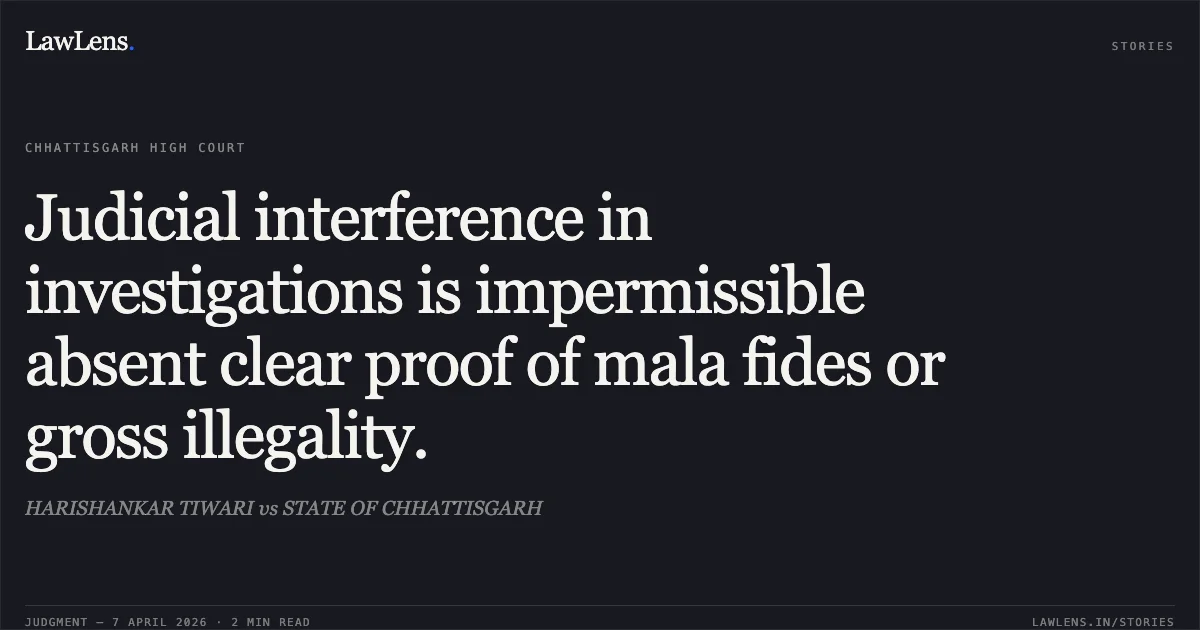
Source reference: para. 3, 5The court applied the established judicial principle that the High Court should not interfere with the investigative process of the police unless there is a demonstrable case of mala fide (bad faith) or gross illegality.
Source reference: para. 7Reasoning
The court examined the petitioner’s claims of investigative bias and found them to be largely unsubstantiated.
Source reference: para. 7It noted that the respondent authorities had already initiated the legal process by undertaking preliminary steps, including the issuance of notices under Section 174 of the BNSS.
Source reference: para. 7The court observed that the investigation was still at a preliminary stage and that the petitioner’s grievances were founded on subjective apprehensions rather than objective, cogent material.
Source reference: para. 7Connecting the facts to the rule of law, the court reasoned that because the authorities were acting in accordance with statutory procedures and no clear evidence of gross illegality or mala fide intent was produced, judicial intervention into the police’s executive function was inappropriate.
Source reference: para. 7Holding
The court held that the investigation could not be characterized as tainted or biased based on the current record.
Consequently, the court declined to grant the relief for a special inquiry or transfer of investigation.
Source reference: para. 8The petition was dismissed as being devoid of merit.
Source reference: para. 8Acts & Sections Cited
1 provisions across 1 statute referred to in this judgment. Each provision opens on LawLens.
Bharatiya Nagarik Suraksha Sanhita, 20231
Original Court PDF
HARISHANKAR TIWARIvsSTATE OF CHHATTISGARH
Click to open original judgment
Original judgment, available to read, download and summarize on LawLens.in


