Facts
The Steel Authority of India Limited (SAIL) floated a tender for the supply of 92,500 MT of coke breeze for its plants in West Bengal and Odisha
Source reference: para. 3Clause 5(2)(b) of the tender required bidders to have prior experience in supplying minimum quantities of the material specifically via Railway Rakes
Source reference: para. 4The writ petitioners (respondents herein) challenged this condition before a Single Judge, alleging it was "tailor-made" to favor a specific supplier and excluded MSMEs
Source reference: para. 7, 18The Single Judge allowed the writ petition, holding that the "rail-only" experience was unjustifiable as quality/quantity could be checked at the delivery point
Source reference: para. 9SAIL appealed, arguing the condition was a strategic logistical and quality-control requirement
Source reference: para. 11Issues
1. Whether the High Court has territorial jurisdiction to entertain the writ petition when the tender was issued from Rourkela but delivery was in West Bengal
Source reference: para. 102. Whether the eligibility criterion requiring prior experience of supply by rail is arbitrary, discriminatory, or "tailor-made" under Article 14 of the Constitution
Source reference: para. 113. Whether the court can interfere with the technical/logistical terms of a commercial tender set by an expert authority
Source reference: para. 11, 25Law Applied
The court applied the principle of limited judicial review in contractual matters, emphasizing that the author of the tender is the best judge of its requirements
Source reference: para. 26It relied on Silppi Constructions Contractors v. Union of India, which mandates judicial restraint unless the decision is palpably arbitrary
Source reference: para. 26The court followed Michigan Rubber (India) Ltd. v. State of Karnataka and Jagdish Mandal v. State of Orissa, establishing that tender conditions are amenable to review only if they are malicious, intended to favor someone, or so irrational that no responsible authority could reach them
Source reference: para. 27(a)-(c)It further applied the "Wednesbury principle" of reasonableness and noted that Article 19(1)(g) is subject to reasonable restrictions in public interest
Source reference: para. 27(d), 29Reasoning
The Court found that the Single Judge erred by substituting his own logic for that of the expert authority
Source reference: para. 25SAIL provided detailed justifications for the rail-transport experience, including the prevention of pilferage, cost-effectiveness, and preservation of material quality (avoiding "fines" caused by truck vibrations)
Source reference: para. 24The Court reasoned that eligibility criteria are prospective filters to ensure capacity and cannot be replaced by the mere right to reject poor quality at the delivery point, especially when continuous supply is vital for plant production
Source reference: para. 25The Court rejected the "tailor-made" allegation, noting that six different firms had participated in a previous tender with the same condition, proving it was not designed for a single entity
Source reference: para. 26, 30The Court held that a shift from past practices is a legitimate exercise of operational learning and does not equate to arbitrariness
Source reference: para. 28Holding
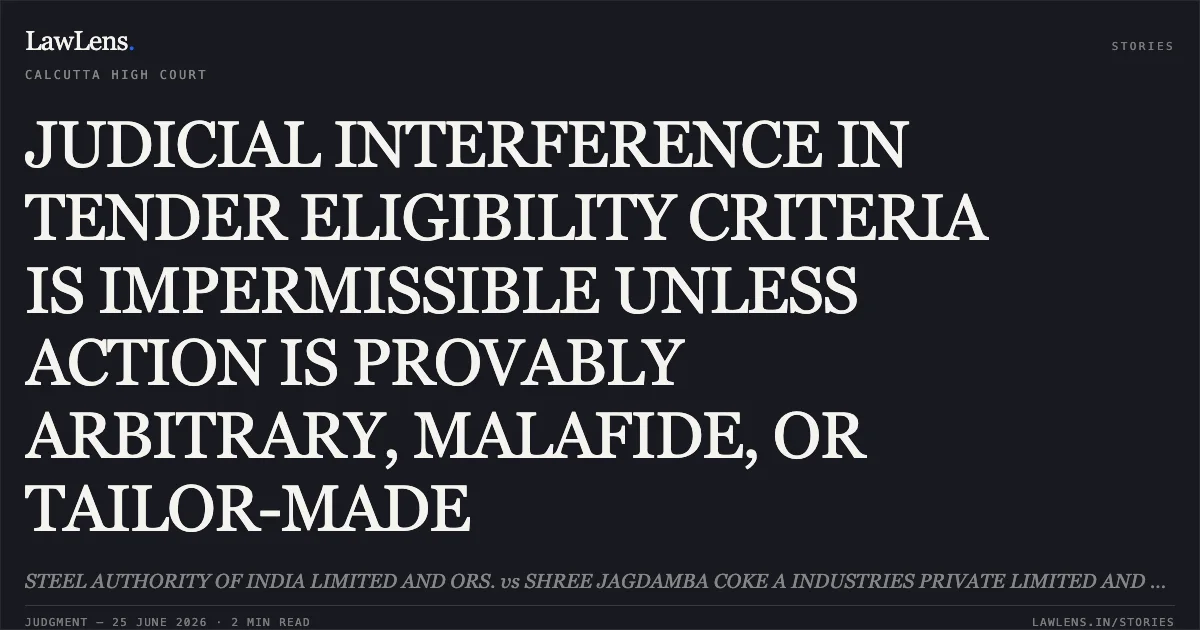
The Division Bench allowed the appeal and set aside the Single Judge’s order
The Court held that the "rail-only" experience criterion was a reasonable, non-discriminatory condition linked to the objective of efficient industrial procurement
Source reference: para. 29-30The court upheld the legality of Clause 5(2)(b) and directed the tender process to proceed based on the original terms; the question of territorial jurisdiction was left open as the matter was decided on merits
Source reference: para. 36, 34Acts & Sections Cited
3 provisions across 1 statute referred to in this judgment. Linked provisions open on LawLens.
Tender Document3
Original Court PDF
STEEL AUTHORITY OF INDIA LIMITED AND ORS.vsSHREE JAGDAMBA COKE A INDUSTRIES PRIVATE LIMITED AND ORS.
Click to open original judgment
Original judgment, available to read, download and summarize on LawLens.in