Facts
The applicant, a Social Security Officer (SSO) with the Employees' State Insurance Corporation (ESIC) in New Delhi, challenged a transfer order dated 10.04.2026, which moved him to SRO Mumbai, Maharashtra in "public interest"
Source reference: para. 2The applicant sought to quash the order on grounds of extreme personal hardship, including recent heart surgery (PTCA with stent placement) for a 100% LAD blockage, requiring specialized post-operative care in Delhi
Source reference: para. 3(i)-(ii)He further cited his spouse's employment as a teacher in Delhi, his children’s schooling, and his 70-year-old mother’s medical needs
Source reference: para. 3(iii)-(iv)The respondents opposed the application, stating that the transfer was based on the recommendations of a Transfer Committee, that no SSO vacancies exist in Delhi NCR, and that administrative guidelines do not confer enforceable rights
Source reference: para. 4Issues
1. Whether an administrative transfer order can be interfered with by the Tribunal solely on the grounds of personal hardship or violation of non-statutory transfer guidelines
Source reference: para. 4, 102. Whether the applicant is entitled to interim protection (stay of transfer) based on medical grounds and family circumstances
Source reference: para. 6, 13Law Applied
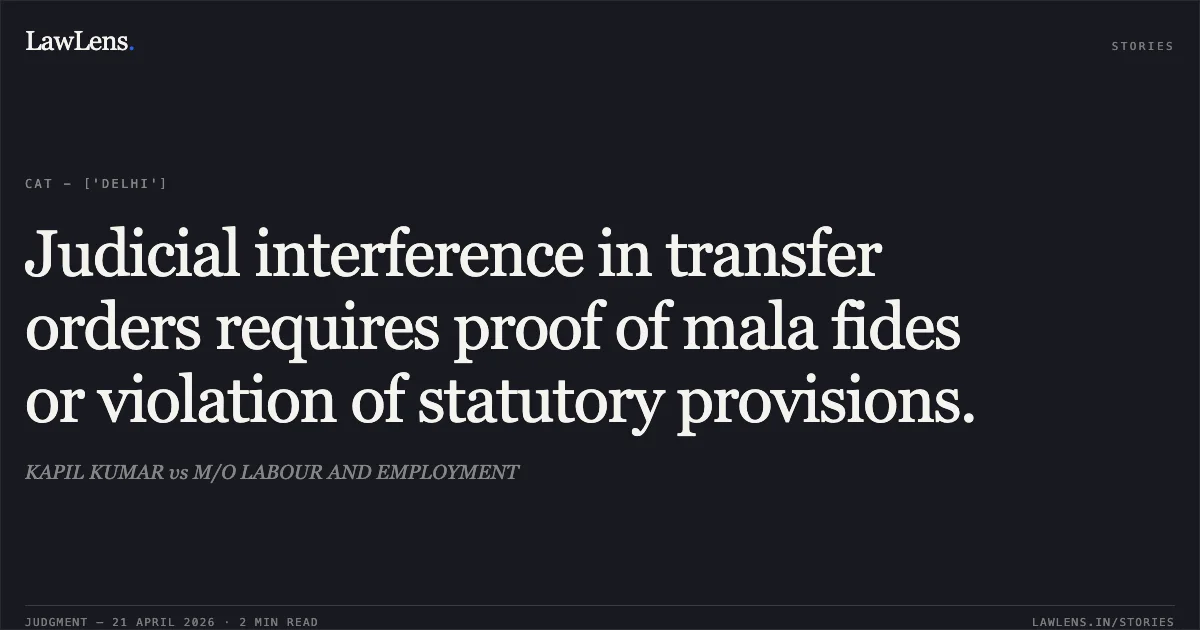
The Tribunal applied the settled principle that transfer is an incidence of service and not to be interfered with unless it is mala fide or violates statutory provisions, as established in Union of India v. S.L. Abbas (1993)
Source reference: para. 4, 10It followed Namrata Verma v. State of U.P. (2021), which held that an employee cannot insist on a specific place of posting
Source reference: para. 10Furthermore, per Rajendra Roy v. Union of India (1993), the court noted that personal hardships are matters for the department to consider rather than the judiciary
Source reference: para. 11Lastly, it applied the rule from Dr. Subramanian Swamy v. State of Tamil Nadu that the ratio of a decision must be understood in the background of its specific facts
Source reference: para. 8Reasoning
The Tribunal reasoned that the applicant failed to demonstrate that the transfer order was vitiated by mala fides or a violation of statutory law
Source reference: para. 10, 14While acknowledging the applicant's medical condition, the Tribunal distinguished this case from previous ESIC matters where interim relief was granted, noting that those cases involved different cadres, policies, or concessions from the respondents which were absent here
Source reference: para. 7-8, 13The Tribunal emphasized that under Alok Kumar Verma v. Union of India, the primary ground for challenging a transfer is mala fides, for which no evidence was provided
Source reference: para. 14However, the court maintained that the department has an obligation to objectively consider representations regarding personal hardship as per R.S. Chaudhary v. State of M.P.
Source reference: para. 11-12Holding
The Tribunal declined to stay the transfer order or grant interim protection
It held that the appropriate remedy is for the administration to review the applicant’s grievances
Source reference: para. 12Consequently, the Tribunal directed the respondents to decide the applicant’s pending representation dated 15.04.2026 by passing a reasoned and speaking order within two weeks from the receipt of the judgment
Source reference: para. 15The O.A. was disposed of with no order as to costs
Source reference: para. 16Original Court PDF
KAPIL KUMARvsM/O LABOUR AND EMPLOYMENT
Click to open original judgment
Original judgment, available to read, download and summarize on LawLens.in