Facts
Following an arbitral award in favor of the Opposite Party (DHr) for Rs. 35,63,278/- plus interest, the Petitioner (JDr) challenged the award unsuccessfully under Sections 34 and 37 of the Arbitration & Conciliation Act, 1996.
Source reference: p. 1-2During execution, disputes arose regarding the calculation of interest and the appropriation of two interim payments: Rs. 10,00,000/- (paid toward the principal by court order) and Rs. 25,00,000/- (deposited without specific appropriation).
Source reference: p. 3-4The High Court previously quashed an execution order on 16.05.2025, directing a fresh computation keeping these payments in mind.
Source reference: p. 3The Executing Court subsequently issued a new order on 13.08.2025, calculating total dues at Rs. 45,65,041.77/-.
Source reference: p. 5The JDr filed the present writ petition challenging the calculation method, alleging patent illegality and seeking a reduction based on simple interest.
Source reference: p. 5-6Issues
1. Whether the Impugned Order dated 13.08.2025 warrants interference by the High Court in its writ jurisdiction under Article 227 of the Constitution of India.
Source reference: p. 8 / para. 17Law Applied
Section 36 of the Arbitration and Conciliation Act, 1996, which creates a legal fiction treating an arbitral award as a decree of the civil court for enforcement purposes.
Source reference: p. 8 / para. 20Section 47 and Order XXI of the Code of Civil Procedure (CPC) for execution proceedings.
Source reference: p. 9 / para. 22The landmark precedents of Radhey Shyam v. Chhabi Nath and Naresh Shridhar Mirajkar v. State of Maharashtra, establishing that judicial orders of civil courts are not amenable to a writ of certiorari under Article 226 and can only be reviewed under the limited supervisory jurisdiction of Article 227.
Source reference: p. 9-13, p. 16 / para. 30The principle that payments made during litigation shall be appropriated first towards accrued interest unless specifically directed otherwise.
Source reference: p. 21 / para. 41Reasoning
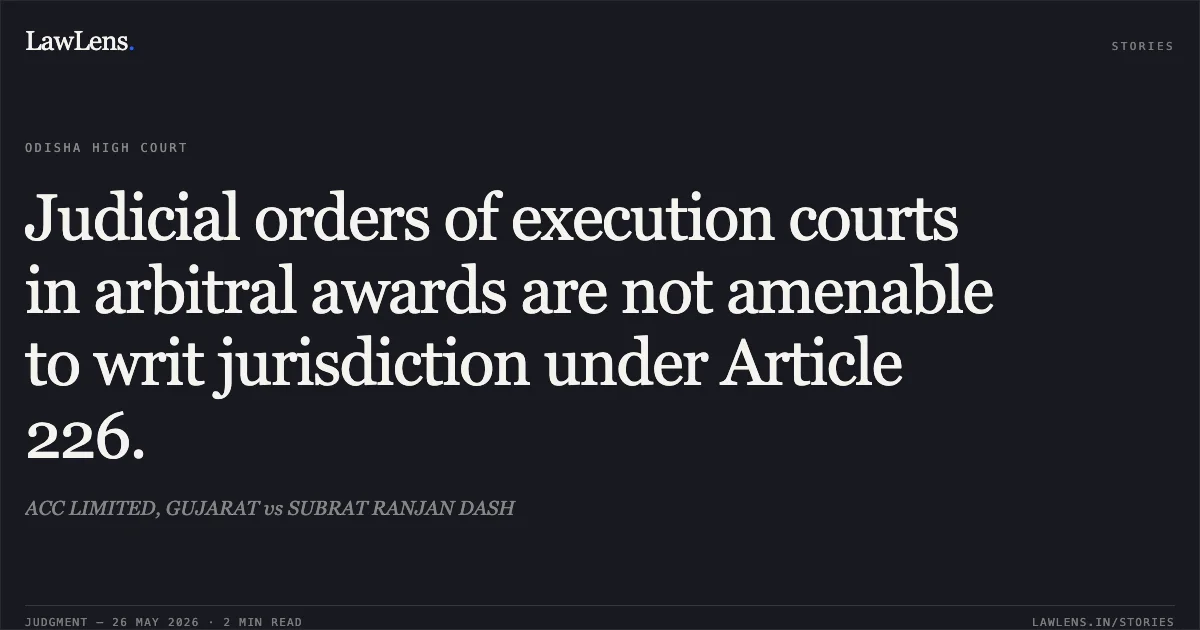
The Court reasoned that the executing court acts as a civil court of plenary jurisdiction; therefore, its orders are judicial and cannot be challenged under Article 226.
Source reference: p. 16 / para. 31Under Article 227, the High Court’s role is purely supervisory and sparingly exercised only to correct jurisdictional errors or manifest injustice, not to re-evaluate factual arithmetic or legal mistakes.
Source reference: p. 17 / para. 33Upon reviewing the Executing Court’s computation, the High Court found that the Judge correctly applied the law by deducting the first Rs. 10 Lakhs from the principal (as ordered by the court) and appropriating the subsequent Rs. 25 Lakhs towards the total outstanding amount (interest + principal).
Source reference: p. 20The Court observed that the Petitioner’s disagreement over the final figure constituted a factual dispute rather than a jurisdictional defect.
Source reference: p. 18 / para. 36It concluded that the JDr was attempting to use writ jurisdiction to further delay the satisfaction of an award that attained finality in 2017.
Source reference: p. 21 / para. 42-43Holding
The Court answered the issue in the negative, holding that the impugned order suffered from no perversity or jurisdictional error.
The High Court dismissed the Writ Petition and upheld the Executing Court’s calculation requiring the Petitioner to pay Rs. 45,65,041.77/- and directed payment within four weeks.
Source reference: p. 20-22, p. 22 / para. 45Acts & Sections Cited
4 provisions across 2 statutes referred to in this judgment. Each provision opens on LawLens.
Arbitration and Conciliation Act, 19963
Code of Civil Procedure, 19081
Original Court PDF
ACC LIMITED, GUJARATvsSUBRAT RANJAN DASH
Click to open original judgment
Original judgment, available to read, download and summarize on LawLens.in


