01Facts
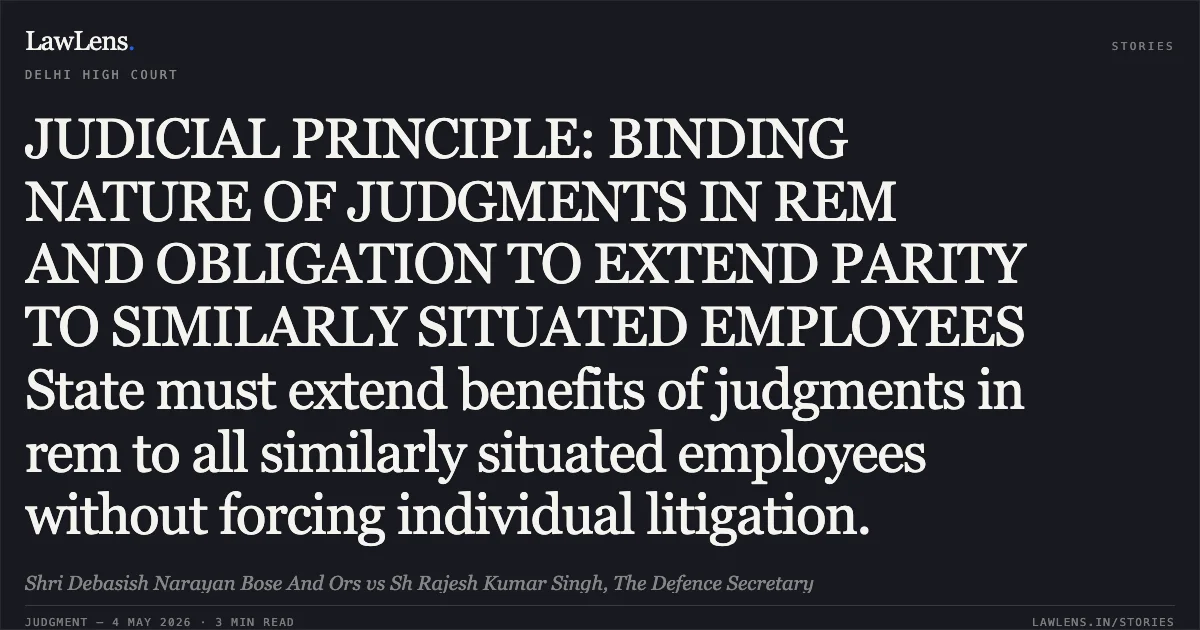
The Petitioners, Assistants and Personal Assistants working in Ordnance Factories and the Ordnance Factory Board (OFB) Headquarters, filed contempt petitions alleging willful disobedience of a judgment dated 14.10.2014 passed in W.P.(C) 4606/2013.
¶ 1, 3The original judgment directed the Respondents to fix the pay scales of Assistants in Ordnance Factories at par with similarly placed Assistants in the Central Secretariat Service (CSS) and Army Headquarters (AFHQ), citing historical parity.
¶ 1The Respondents had failed to extend this benefit to the current Petitioners, arguing that the Petitioners were not parties to the original suit and that no historical pay parity existed for this specific group.
¶ 10, 1202Issues
i.1. Whether the directions issued in the judgment dated 14.10.2014 are in rem and thus applicable to all similarly situated employees regardless of whether they were parties to the original litigation.
¶ 5, 7ii.2. Whether the Petitioners are barred from relief by the doctrine of "fence-sitters" due to laches and delay.
¶ 10, 11iii.3. Whether the Respondents’ denial of pay parity to the Petitioners constitutes a violation of the previously settled legal rationale regarding historical parity.
¶ 13, 1403Law Applied
The Court applied the principle that judgments in rem in service matters must be extended to all similarly placed employees to avoid discrimination under Article 14 of the Constitution.
¶ 7The Court relied on Girish Mittal v. Parvati V. Sundaram (2019) regarding the maintainability of contempt by non-parties.
¶ 6The Court relied on U.P. Power Corp. Ltd. v. Ram Gopal (2021) and State of U.P. v. Arvind Kumar Srivastava (2015) regarding the duty of the State to extend judicial benefits to similarly situated persons without forced litigation.
¶ 7, 10The Court relied on Lt. Col. Suprita Chandel v. Union of India (2024), which emphasizes that "what is sauce for the goose ought to be sauce for the gander" in administrative parity.
¶ 8Provisions in the judgment · 1
Central Civil Services (Revised Pay) Rules, 2008 Section 2
04Reasoning
The Court reasoned that the 2014 judgment's operative directions were framed in "overarching terms" covering all "similarly placed persons," not just the specific association members in that suit.
¶ 2, 5It rejected the Respondents' argument on "fence-sitters," noting that the denial of pay parity constitutes a "continuing cause of action" and that the Petitioners had been diligently pursuing their claims with the department.
¶ 11Regarding the Respondents' claim of a lack of historical parity, the Court held that this was already negated by the rationale in paragraph 19 of the 2014 judgment, which established that the mention of specific departments (like CSS or AFHQ) was illustrative, not exhaustive.
¶ 9, 13Consequently, refusing the same benefit to the Petitioners while granting it to others in the same cadre would be discriminatory and violative of the court’s intent.
¶ 1405Holding
The Court held that the Respondents must provide the same pay fixation and fitment benefits to the Petitioners as afforded to other Assistants in Ordnance Factories and OFB Headquarters.
¶ 16The Respondents were directed to comply within 12 weeks and file a compliance affidavit within 8 weeks thereafter. The Court clarified that any further non-compliance would be treated as an "egregious breach" of its orders, entailing action under the Contempt of Courts Act, 1971. The petitions were disposed of with liberty to revive in case of default.
¶ 17, 18, 19Original Court PDF
Shri Debasish Narayan Bose And OrsvsSh Rajesh Kumar Singh, The Defence Secretary
Click to open original judgment
Original judgment, available to read, download and summarize on LawLens.in