Facts
The deceased, a homemaker and wife of the first appellant, died in a motor vehicle accident on November 25, 2001, caused by the respondent's rash and negligent driving
Source reference: para 3The Motor Accident Claims Tribunal (MACT) awarded ₹2,42,000/- in 2003
Source reference: para 3On appeal, the High Court of Punjab & Haryana enhanced the compensation to ₹8,43,400/- in 2024, after a 20-year pendency partly caused by a 2011 fire that destroyed case records
Source reference: paras 3, 5-6Dissatisfied with the quantum and the systemic delay, the claimants approached the Supreme Court
Source reference: para 4Issues
1. Whether the contribution of a homemaker (described as a 'Nation Builder') is adequately valued by current judicial filters of 'notional income'
Source reference: paras 2, 10, 162. Whether the inordinate delay in adjudicating beneficial legislation (MACT claims) requires institutional directions to the High Courts and Tribunals
Source reference: paras 2, 8, 23Law Applied
The Court relied on the principles of "just and fair compensation" under the Motor Vehicles Act, 1988
Source reference: para 7It applied the multiplier method and consortium rates established in National Insurance Co. Ltd. v. Pranay Sethi
Source reference: paras 17, 23.5Regarding the valuation of homemakers, it expanded upon Lata Wadhwa v. State of Bihar, which recognized housewives' services in monetary terms
Source reference: para 14.1Arun Kumar Agrawal v. National Insurance Co. Ltd., which emphasized that a homemaker/mother’s selfless service cannot be equated to a mere housekeeper
Source reference: para 14.2It also integrated findings from the Ministry of Statistics’ "Time Use in India-2019" report to recognize the economic value of unpaid care work
Source reference: para 11Reasoning
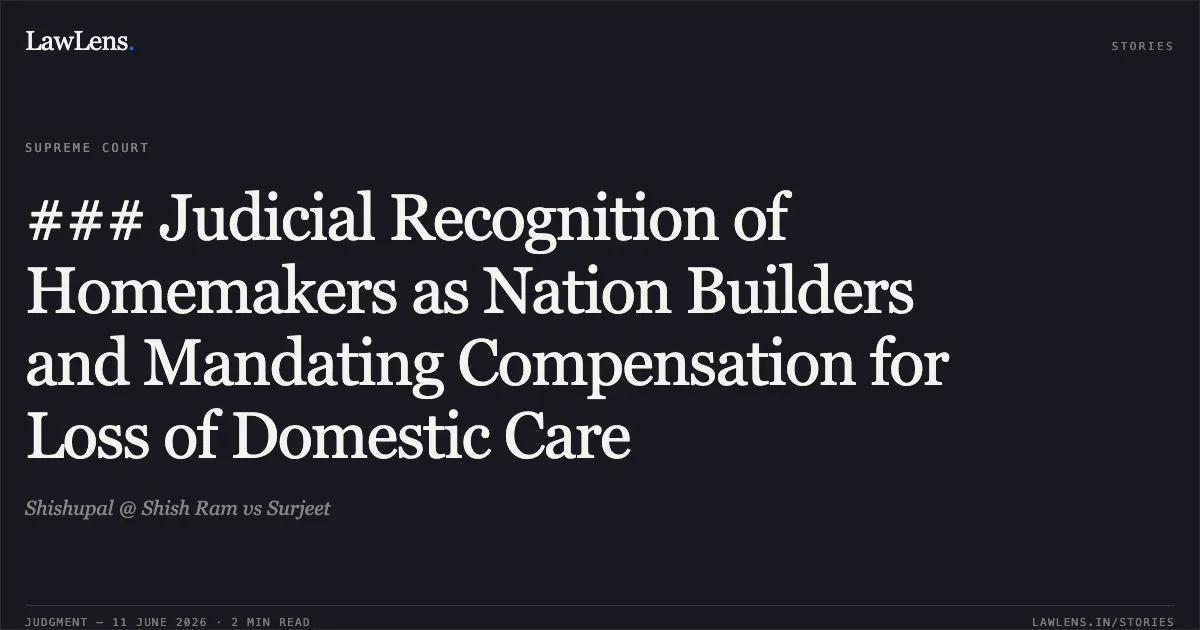
The Court critiqued the systematic undervaluing of homemakers, characterising them as "Nation Builders" whose labor supports the entire economic human capital of the country
Source reference: paras 13, 19It found that traditional "notional income" calculations are overly conservative and fail to account for the multifaceted managerial, emotional, and social roles women perform
Source reference: paras 16, 19The Bench observed that while "consortium" under Pranay Sethi covers emotional loss, it does not address the economic vacuum left by the loss of domestic management
Source reference: para 21Furthermore, the Court analyzed 123 recent cases to highlight a "regular feature" of 6–8 year delays in MACT adjudications, which contradicts the "beneficial" intent of the statute
Source reference: paras 8-9To bridge the valuation gap, the Court introduced a new pecuniary head to capture the economic impact of domestic labor
Source reference: para 20Holding
The Court allowed the appeal, significantly enhancing the compensation to ₹62,77,900/-
It introduced the head of "Loss of Domestic Care" with a base monthly sum of ₹30,000 (standardized for cases where all domestic roles are met), to be revised by 10% every three years
Source reference: para 20The Court issued administrative directions to all High Courts to prioritize appeals pending over four years and mandated that Tribunals record reasons for not adopting summary procedures
Source reference: paras 23.2-23.3Finally, it directed that the term "homemaker" be recognized as "Nation Builder" in future judicial discourse
Source reference: para 23.6Acts & Sections Cited
1 provisions across 1 statute referred to in this judgment. Each provision opens on LawLens.
Motor Vehicles Act, 19881
Original Court PDF
Shishupal @ Shish RamvsSurjeet
Click to open original judgment
Original judgment, available to read, download and summarize on LawLens.in