Facts
The petitioner, a driver-cum-conductor employed by the respondent Corporation, was charged after a ticket inspection found three passengers travelling without tickets and alleged that he had failed to collect their fares.
Source reference: paras. 1–3, 7Following a departmental enquiry, the charges were held proved and his basic pay was reduced by two stages with cumulative effect.
Source reference: paras. 1–3, 7The Industrial Tribunal rejected his reference, and he challenged that award under Articles 226 and 227, seeking its quashing and restoration of increments.
Source reference: paras. 1–3, 7The petitioner maintained that he had issued tickets which the passengers had lost, disputed the passenger count, and challenged the adequacy of the inspection.
Source reference: para. 4Issues
1. Whether the Tribunal’s finding that the charges were proved was unsupported by evidence or otherwise perverse, warranting interference under Articles 226 and 227.
Source reference: paras. 4, 7–10, 142. Whether the petitioner established any procedural irregularity, breach of natural justice, or other ground permitting the High Court to interfere with the Tribunal’s award.
Source reference: paras. 11–14Law Applied
Under Articles 226 and 227, the High Court does not sit as an appellate court over findings in departmental proceedings or Industrial Tribunal awards. Judicial review is directed to the decision-making process and permits interference where, for example, the enquiry violates natural justice or prescribed procedure, the finding is based on no evidence, or it is perverse or so unreasonable that no reasonable person could have reached it.
Source reference: para. 11Where some relevant evidence supports the finding, the adequacy or reliability of that evidence, or the possibility of another view, is not ordinarily open to reappraisal. The Court applied State of Andhra Pradesh v. Chitra Venkata Rao, (1975) 2 SCC 557; SBI v. Ajai Kumar Srivastava, (2021) 2 SCC 612; and Indian Overseas Bank v. I.O.B. Staff Canteen Workers’ Union, (2000) 4 SCC 245.
Source reference: paras. 11–13Reasoning
The Court found that the petitioner had not substantiated his claim about the passenger count, while the three passengers had not produced tickets during inspection and were fined for failing to do so.
Source reference: para. 8Evidence from the Corporation’s witness, including testimony before the Tribunal, supported the finding that the passengers were travelling without tickets.
Source reference: para. 9The Court concluded that the Tribunal had considered the evidence, the enquiry was fair, and the finding was supported by material on record. The petitioner’s objections principally invited reassessment of evidence, which was outside the permissible scope of writ review absent procedural unfairness, perversity, or a no-evidence finding.
Source reference: paras. 10, 14Holding
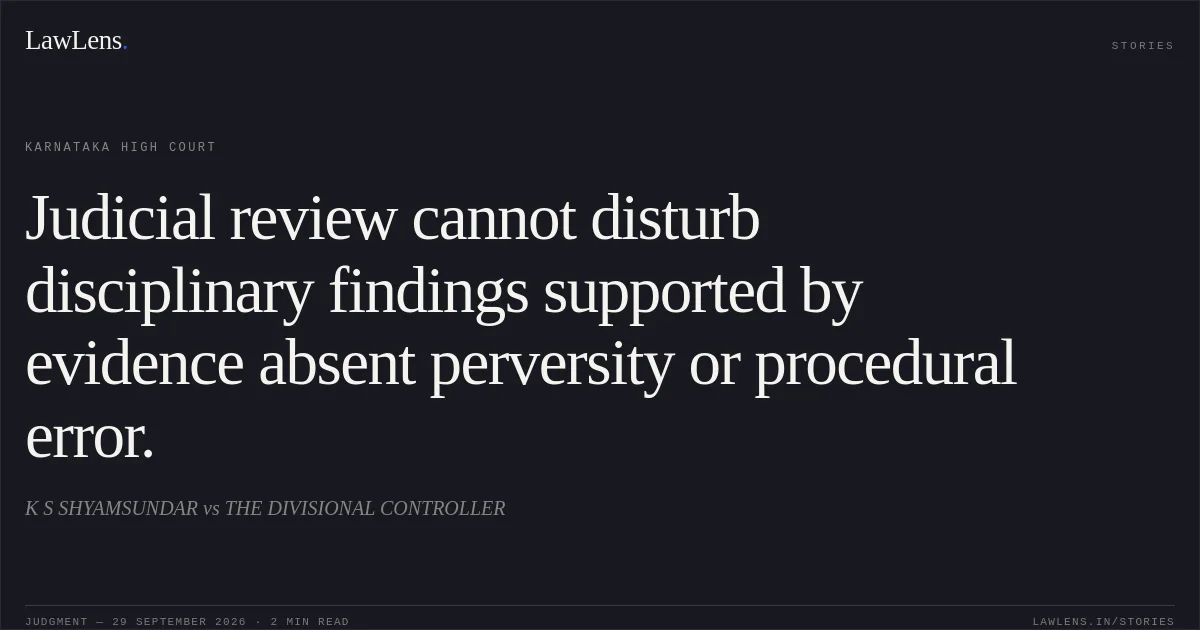
The Court held that the petitioner had demonstrated no procedural irregularity, violation of natural justice, or perversity warranting interference with the Tribunal’s award.
It dismissed the writ petition, leaving the award rejecting the reference undisturbed.
Source reference: para. 16Original Court PDF
K S SHYAMSUNDARvsTHE DIVISIONAL CONTROLLER
Click to open original judgment
Original judgment, available to read, download and summarize on LawLens.in