Facts
The appellant, a Technical Officer with the Export Inspection Agency, Delhi, was temporarily posted to the Tuticorin Sub-Office of the Export Inspection Agency, Chennai, by order dated 11 April 2014, owing to administrative exigencies.
Source reference: p.2, para.3He did not join at Tuticorin despite repeated directions and instead sought voluntary retirement and leave, both of which were rejected.
Source reference: pp.2–3, paras.5–6A charge-sheet dated 5 June 2014 alleged wilful disobedience of the transfer/posting order and unauthorised absence. Following a departmental inquiry, both charges were found proved, and the appellant was dismissed from service on 5 April 2016; his statutory appeal was dismissed on 21 February 2017.
Source reference: p.3, paras.6–7His challenge in W.P.(C) 4788/2017 was dismissed by the learned Single Judge on 10 March 2026. The present intra-Court appeal challenged that decision.
Source reference: p.3, para.7Earlier, the appellant’s challenge to the posting order on grounds including mala fides had been rejected, and the appellate proceedings had affirmed that temporary posting was legally permissible. His challenge to the appointment of the Inquiry Officer had also failed in LPA 313/2024.
Source reference: pp.4, 6, paras.8, 11Issues
1. Whether the disciplinary proceedings were invalid because they were conducted under the nomenclature “Export Inspection Council of India” rather than “Export Inspection Council” as constituted under Section 3 of the Export (Quality Control and Inspection) Act, 1963.
Source reference: p.4, para.92. Whether the temporary posting order dated 11 April 2014 was vitiated by mala fides or retaliatory motive and could therefore justify the appellant’s non-compliance.
Source reference: pp.5–6, para.103. Whether the disciplinary inquiry violated natural justice, including the alleged denial of a personal hearing under Rule 11(4) of the CCS (CCA) Rules.
Source reference: p.6, para.124. Whether the findings of wilful disobedience and unauthorised absence were sustainable, particularly in light of Krushnakant B. Parmar v. Union of India.
Source reference: pp.7–8, para.145. Whether dismissal from service was disproportionate to the misconduct under the doctrine of proportionality, in light of Raghubir Singh v. General Manager, Haryana Roadways.
Source reference: pp.7–8, paras.15–166. Whether the High Court ought to interfere in judicial review where no procedural prejudice or perversity in the disciplinary findings was established.
Source reference: p.8, para.17Law Applied
The Court applied Sections 3 and 7 of the Export (Quality Control and Inspection) Act, 1963, under which the Export Inspection Council and Export Inspection Agencies form the statutory framework for export inspection and quality control.
Source reference: pp.2, 4, paras.4, 9It applied Rule 11(4) of the CCS (CCA) Rules concerning the disciplinary process and the broader principles of natural justice, holding that procedural interference requires demonstration of prejudice.
Source reference: p.6, para.12Under Krushnakant B. Parmar v. Union of India, unauthorised absence ordinarily requires proof that the absence was wilful; the Court held that this requirement was satisfied on the evidence in the present case.
Source reference: p.7, para.14The doctrine of proportionality, discussed in Raghubir Singh v. General Manager, Haryana Roadways, requires the penalty to be assessed in the context of the facts and the employee’s constraints.
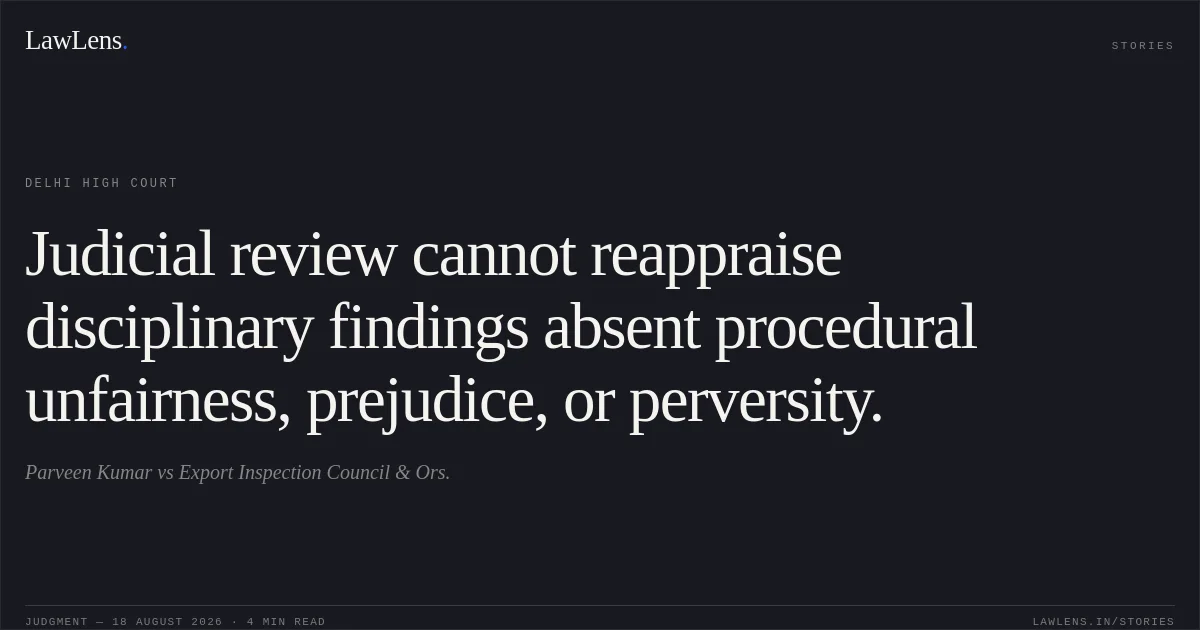
Source reference: pp.7–8, paras.15–16Relying on Bhupinderpal Singh Gill v. State of Punjab, 2025 SCC OnLine SC 113, the Court reiterated that judicial review of disciplinary proceedings is limited to examining procedural fairness, prejudice, jurisdictional error, and perversity; it is not an appeal on the merits.
Source reference: p.8, para.17Reasoning
The Court held that describing the statutory body as the “Export Inspection Council of India” was, at most, a minor nomenclatural deviation and did not invalidate proceedings initiated by the competent authority within the statutory EIC/EIA structure.
Source reference: p.5, para.9The challenge to the posting order and allegations of mala fides were already barred from being reopened because the posting order had previously been upheld, including in appellate proceedings.
Source reference: pp.4–6, paras.8, 10The appellant had submitted written defences, participated in the inquiry, cross-examined witnesses, examined himself, responded to the Presenting Officer’s brief, and made representations against the inquiry report; consequently, no denial of natural justice or resulting prejudice was shown.
Source reference: p.6, para.12The Inquiry Officer and disciplinary authority had found, on the evidence, that the appellant deliberately failed to join at Tuticorin despite repeated directions, thereby establishing wilful disobedience and unauthorised absence.
Source reference: pp.3, 7, para.14Unlike the genuine constraints found in Raghubir Singh, the appellant’s absence resulted from his decision not to comply with the posting order.
Source reference: p.8, para.15Given the respondent’s operational requirement to make temporary postings across the country, the Court found dismissal proportionate and declined to reappreciate factual findings that were neither perverse nor unsupported by evidence.
Source reference: pp.7–9, paras.13, 16–17Holding
The Division Bench found no legal, procedural, or evidentiary defect warranting interference with the disciplinary proceedings, the dismissal order dated 5 April 2016, the appellate order dated 21 February 2017, or the learned Single Judge’s judgment dated 10 March 2026.
The appeal and pending applications were dismissed, with no order as to costs.
Source reference: p.10, paras.20–21Acts & Sections Cited
2 provisions across 1 statute referred to in this judgment. Each provision opens on LawLens.
Original Court PDF
Parveen KumarvsExport Inspection Council & Ors.
Click to open original judgment
Original judgment, available to read, download and summarize on LawLens.in