Facts
The petitioner, initially appointed as an Assistant Engineer in the Public Works Department on 24 October 1984, was promoted as Assistant Executive Engineer with effect from 26 December 2005.
Source reference: no citationAn FIR was registered against him under the Prevention of Corruption Act concerning alleged irregularities in the execution of public works during 2008–2009.
Source reference: no citationInstead of criminal prosecution, disciplinary proceedings were initiated before the Tribunal for Disciplinary Proceedings (“TDP”).
Source reference: p.3The TDP examined eight witnesses and relied upon 26 documents, ultimately finding the petitioner and two others guilty of charges relating to improper execution of retaining-wall and desilting works, manipulation of records, and loss to the Government.
Source reference: pp.4, 13Although the TDP submitted its report on 5 November 2015, the petitioner’s explanation was obtained only on 3 January 2017, and the final order was passed on 7 July 2020.
Source reference: p.3The Government imposed compulsory retirement and directed recovery of ₹3,09,842 from the petitioner’s death-cum-retirement gratuity, representing his alleged one-third share of the loss.
Source reference: pp.6–7The petitioner challenged the order under Article 226 of the Constitution, seeking quashing of the punishment, permission to retire normally, consequential benefits, and retrospective promotion as Executive Engineer.
Source reference: p.2Issues
1. Whether the disciplinary authority’s order was non-speaking and vitiated by failure to independently consider the petitioner’s defence and the TDP report.
Source reference: pp.5–82. Whether the findings of guilt were unsupported by evidence, perverse, or otherwise liable to interference in judicial review under Article 226.
Source reference: pp.8–143. Whether the delay in the disciplinary proceedings materially prejudiced the petitioner and warranted quashing of the proceedings.
Source reference: p.134. Whether the punishment of compulsory retirement, together with recovery from gratuity, was shockingly disproportionate to the misconduct proved.
Source reference: p.15Law Applied
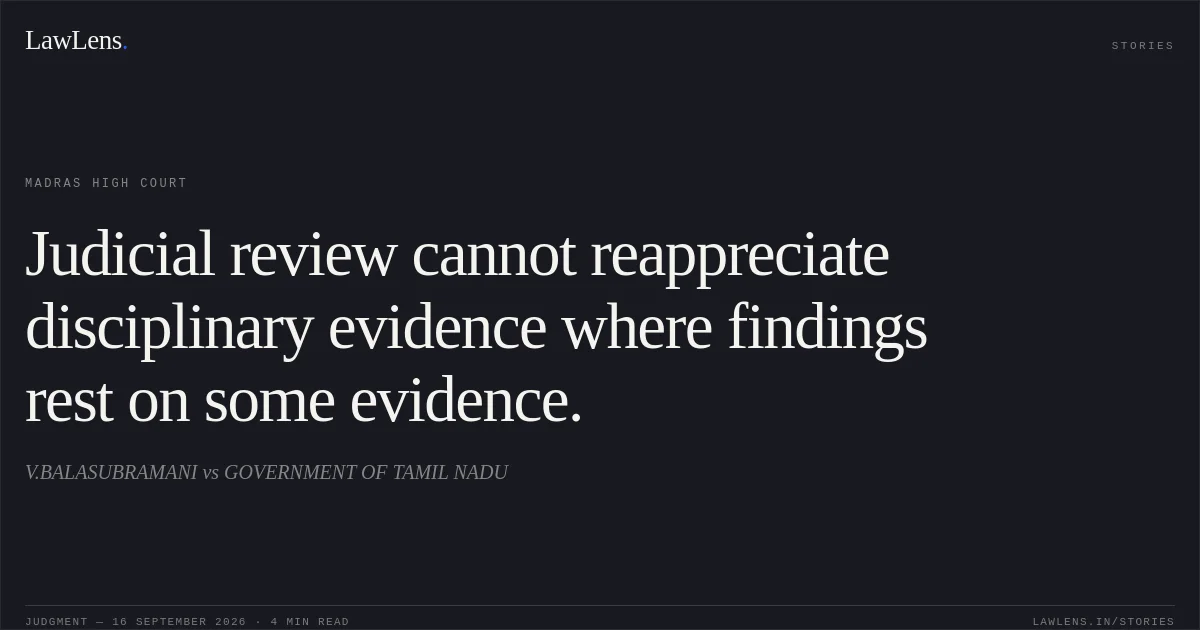
The Court applied the principles governing judicial review of disciplinary proceedings under Article 226 of the Constitution.
Source reference: no citationRelying on B.C. Chaturvedi v. Union of India, (1995) 6 SCC 749, it held that judicial review concerns the decision-making process rather than the correctness of the factual conclusion; interference is permissible where there is violation of natural justice or statutory procedure, absence of evidence, or a conclusion that no reasonable person could reach.
Source reference: pp.9–11Relying on Deputy General Manager (Appellate Authority) v. Ajai Kumar Srivastava, (2021) 2 SCC 612, the Court reiterated that findings in departmental proceedings should not be disturbed unless they are perverse, mala fide, based on no evidence, or legally unsustainable.
Source reference: pp.11–12The Court further applied the principle that a disciplinary authority must provide reasons and independently consider the delinquent employee’s representation, but an order is not rendered non-speaking merely because it adopts or concurs with the enquiry findings after such consideration.
Source reference: pp.5–8Judicial review does not permit re-appreciation of evidence or substitution of the Court’s view for that of the disciplinary authority, and interference with punishment is warranted only where it is shockingly disproportionate.
Source reference: pp.9–12, 15Reasoning
The Court found that the impugned order, read as a whole, was not cryptic.
Source reference: no citationIn paragraph 5, the Government considered the charges, the petitioner’s defence, the TDP’s findings, and his further representation, and recorded reasons for concluding that he had participated in irregular execution of works, caused Government loss, and failed to rebut the evidence of the relevant witnesses.
Source reference: pp.5–8The Court held that the petitioner’s reliance on an allegedly unconsidered supervisory report was an afterthought because he had not produced or summoned the document during the disciplinary proceedings.
Source reference: p.8The TDP’s findings were supported by witness testimony and documentary evidence concerning the construction of a sluice instead of the sanctioned retaining wall and the alleged manipulation of records; therefore, the findings could not be characterised as based merely on suspicion or as perverse.
Source reference: pp.8–10, 13–14Although delays occurred between the initiation, enquiry, submission of the report, and final order, the petitioner failed to establish any specific prejudice caused by the delay, and the Court declined to interfere on that ground.
Source reference: p.13Given the findings of corruption-related misconduct, record manipulation, and loss to the public exchequer, the punishment of compulsory retirement was not considered shockingly disproportionate.
Source reference: p.15Holding
The Court answered the issues against the petitioner.
It held that the disciplinary authority had independently applied its mind, that the findings of guilt were supported by evidence, that the procedural delay caused no demonstrated prejudice, and that the punishment was not shockingly disproportionate.
Source reference: pp.8, 13–15The writ petition was accordingly dismissed, with no order as to costs, and the impugned Government Order dated 7 July 2020 imposing compulsory retirement and recovery from gratuity was left undisturbed.
Source reference: p.16Original Court PDF
V.BALASUBRAMANIvsGOVERNMENT OF TAMIL NADU
Click to open original judgment
Original judgment, available to read, download and summarize on LawLens.in