Facts
The appellant, a member of the Police Department, was allotted Government Quarter No. G-03 in Rewa.
Source reference: para. 2An inspection by a departmentally constituted committee revealed that the appellant was not residing in the allotted accommodation; instead, the premises were occupied by a private truck driver and labourers.
Source reference: para. 2A preliminary enquiry further established that the appellant had constructed and was residing in his own private residence within the same city while retaining the government quarter.
Source reference: para. 2Following a regular departmental enquiry where the appellant was afforded full opportunity to participate, the disciplinary authority imposed a penalty of withholding one annual increment with cumulative effect via order dated 23.03.2014.
Source reference: para. 3The appellant’s statutory appeal was dismissed on 08.08.2014, and a subsequent writ petition (W.P. No. 19389 of 2014) was dismissed by a learned Single Judge.
Source reference: para. 3The appellant filed this intra-court appeal challenging the dismissal.
Source reference: para. 1Issues
1. Whether the disciplinary proceedings were vitiated by procedural irregularities or perversity in findings.
Source reference: para. 4 & 92. Whether the punishment of withholding one annual increment with cumulative effect was shockingly disproportionate to the proved misconduct.
Source reference: para. 5 & 103. Whether the High Court can exercise powers of judicial review to substitute its own findings of fact for those of the disciplinary authority.
Source reference: para. 7 & 11Law Applied
The Court primarily applied Section 2(1) of the Madhya Pradesh Uchcha Nyayalaya (Khand Nyaya Peeth Ko Appeal) Adhiniyam, 2005, governing intra-court appeals.
Source reference: para. 1It relied on the settled principles of judicial review in service jurisprudence as established in B.C. Chaturvedi v. Union of India (1995), Coal India Ltd. v. Mukul Kumar Choudhuri (2009), and The General Manager (P), Punjab & Sind Bank & Ors. v. Daya Singh (2010), which dictate that a writ court cannot act as a court of appeal over findings of fact in departmental enquiries and should only interfere if the punishment shocks the conscience of the court.
Source reference: para. 7 & 10Reasoning
The Court examined the record and found that the foundational requirements of procedural fairness and natural justice were satisfied, as the appellant was provided with the charge-sheet, allowed to cross-examine witnesses, and permitted to lead evidence.
Source reference: para. 9The Court rejected the appellant's contention that the disciplinary authority acted mechanically, noting that the inspection report and oral/documentary evidence clearly established the unauthorized retention and sub-letting of the premises to private persons.
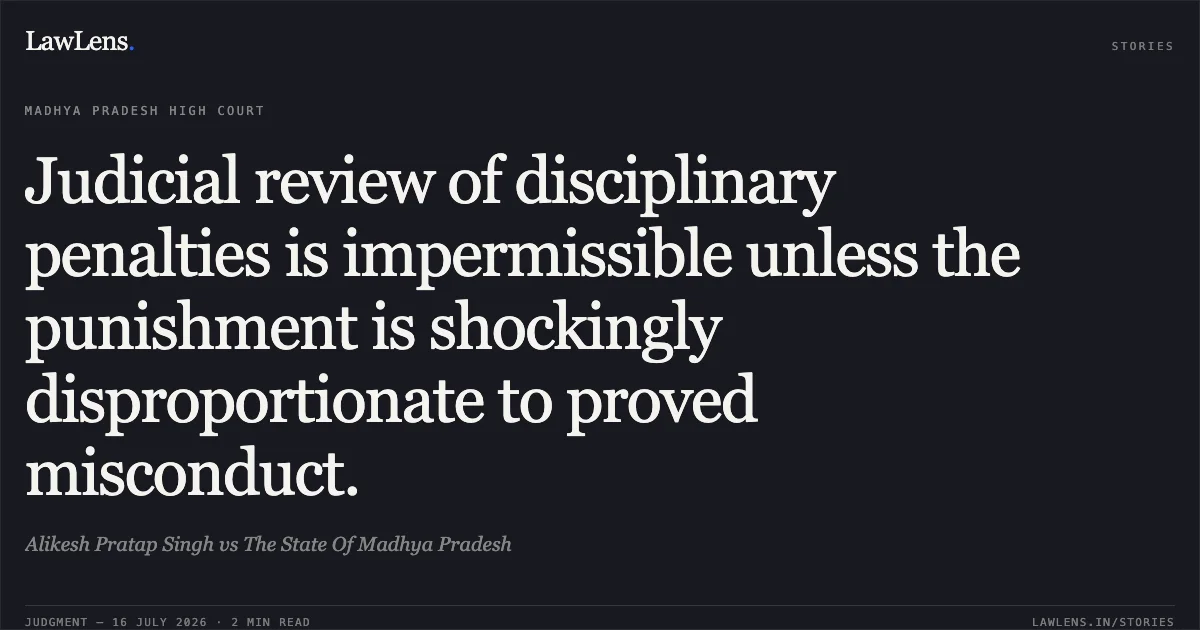
Source reference: para. 10Regarding proportionality, the Court held that the punishment (withholding one increment) was limited in nature and did not "shock the conscience," thereby precluding judicial substitution of the penalty.
Source reference: para. 10The Court emphasized that since the findings were based on material evidence, they could not be characterized as perverse in an intra-court appeal.
Source reference: para. 11Holding
The Court answered the issues in the negative, holding that the appellant failed to demonstrate any illegality or perversity in the impugned judgment.
The Court affirmed that the scope of judicial review in disciplinary matters is extremely limited and that the findings of the authorities were supported by evidence. Consequently, the Writ Appeal was dismissed as being devoid of merit.
Source reference: para. 11Acts & Sections Cited
1 provisions across 1 statute referred to in this judgment. Linked provisions open on LawLens.
M.P. Uchcha Nyayalaya (Khand Nyayapeeth Ko Appeal) Adhiniyam, 20051
Original Court PDF
Alikesh Pratap SinghvsThe State Of Madhya Pradesh
Click to open original judgment
Original judgment, available to read, download and summarize on LawLens.in