Facts
The applicant, a Sub-Postmaster, was issued a charge memorandum on 22.12.2011 for financial irregularities involving Recurring Deposit (RD) bulk deposits that were not credited to postal accounts
Source reference: p. 2-3Three charges were framed: (i) failure to account for deposits he personally accepted, (ii) failure to supervise a subordinate Postal Assistant who similarly failed to credit deposits, and (iii) failure to verify transaction lists
Source reference: p. 3Following a departmental inquiry, the Disciplinary Authority dismissed the applicant on 25.09.2012
Source reference: p. 3The applicant's appeal and revision petition were rejected on 26.04.2013 and 21.03.2018, respectively
Source reference: p. 3, 14The applicant, who reached superannuation on 31.12.2012, challenged these orders on the grounds that the charges were vague, the evidence was misappreciated, and a joint inquiry with the co-delinquent was not conducted
Source reference: p. 3-5Issues
1. Whether the charge memorandum and statement of imputations were vague or inconsistent so as to vitiate the inquiry
Source reference: p. 3-4, 92. Whether the failure to conduct common proceedings under Rule 18 of the CCS (CCA) Rules, 1965, rendered the disciplinary action illegal
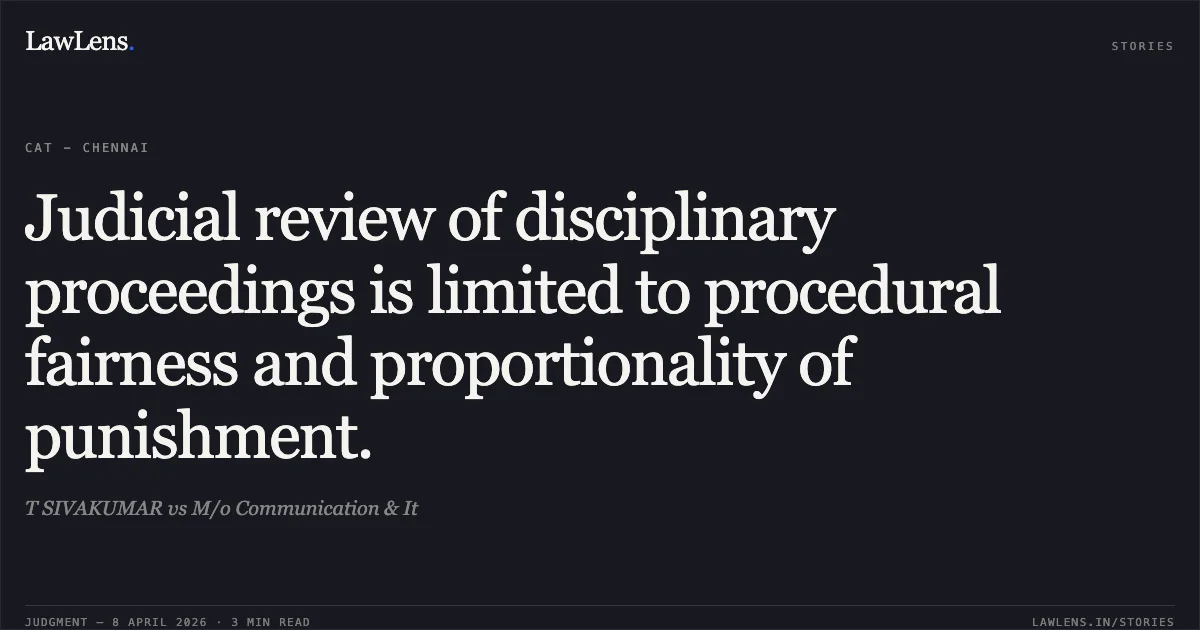
Source reference: p. 9-103. Whether the Tribunal can re-appreciate evidence or interfere with the quantum of punishment in disciplinary matters
Source reference: p. 11-13Law Applied
Rule 18(1) of the CCS (CCA) Rules, which provides that the competent authority may order common proceedings for multiple government servants, establishing that joint inquiries are discretionary rather than mandatory
Source reference: p. 9-10Indian Oil Corporation Ltd. & Anr v. Ashok Kumar Arora (1997), which limits court intervention to cases of natural justice violations, "no evidence" findings, or shocking disproportionality
Source reference: p. 11Principle from State of Andhra Pradesh v. S. Sree Rama Rao, stating that the standard of proof in departmental inquiries is "preponderance of probability" rather than "beyond reasonable doubt," and courts should not re-appreciate evidence if some legal evidence exists
Source reference: p. 12-13R. Mahalingam v. Chairman, TNPSC (2013) was cited to reiterate that courts are primarily concerned with procedural compliance and the presence of tangible evidence
Source reference: p. 13Reasoning
The Tribunal rejected the applicant's contention that the charges were vague, finding that both the charges and imputations were clear, specific, and had not been challenged by the applicant during the earlier stages of the inquiry
Source reference: p. 9Regarding Rule 18, the Tribunal noted that the rule confers discretion upon the authority and that the applicant never requested a joint inquiry during the proceedings
Source reference: p. 10The co-delinquent had already been dismissed in a separate fraud case, making joint proceedings moot
Source reference: p. 10The Tribunal found that the applicant, as Sub-Postmaster, was responsible for the non-credit of Rs. 1,11,850/-, and his negligence enabled the fraud
Source reference: p. 12The Tribunal held that since the inquiry followed the prescribed procedure and was supported by oral and documentary evidence, it could not act as an appellate court to re-evaluate the findings of the Inquiry Officer
Source reference: p. 12-14The fact that the applicant subsequently repaid the amount did not absolve him of the misconduct
Source reference: p. 12Holding
The Tribunal dismissed the Original Application, holding that no grounds existed to interfere with the disciplinary action
The court held that the inquiry was conducted in accordance with the law, natural justice was observed, and the charges were sufficiently proved by material evidence
Source reference: p. 14-15The final holding sustained the penalty of "Dismissal from Service," declaring it commensurate with the gravity of the financial misconduct and loss to the Department
Source reference: p. 15Original Court PDF
T SIVAKUMARvsM/o Communication & It
Click to open original judgment
Original judgment, available to read, download and summarize on LawLens.in