Facts
Departmental proceedings under Rule 14 of CCS (CCA) Rules, 1965 were initiated against the applicant, Sambhu Prasad Dora, a Supervisor in Ordnance Factory, Badmal, via memorandum dated 04.04.2013, containing two articles of charges.
Source reference: p.1-2Article-I alleged negligence and dereliction of duty for not maintaining up-to-date records of stock position, leading to material shortages/surpluses and unrecorded materials.
Source reference: p.2Article-II alleged false endorsements in material issue registers and failure to maintain absolute integrity.
Source reference: p.2The applicant's defence assistant submitted a written statement on 27.01.2015.
Source reference: p.2The Inquiry Officer (IO) submitted a report on 24.02.2015, holding Article-I as proved and Article-II as not proved/established.
Source reference: p.3The applicant replied on 14.03.2015.
Source reference: p.3The Disciplinary Authority (DA) imposed a punishment of "reduction of pay by one stage for a period of one year" on 18.08.2016.
Source reference: p.3The applicant's appeal to the Appellate Authority (AA) on 19.09.2016 was rejected on 05.07.2018.
Source reference: p.3He then submitted an application to the President of India on 20.09.2018.
Source reference: p.3This application was returned on 21.01.2020 by the Ordnance Factory, Badmal, advising him to submit it to the appropriate Revisional Authority due to restructuring.
Source reference: p.3-4The applicant filed this Original Application (OA) on 29.10.2019 seeking to quash the DA and AA orders.
Source reference: p.4Issues
1. Whether the Original Application is barred by delay and laches under Section 21 of the AT Act, 1985.
Source reference: p.52. Whether the findings of the Disciplinary Authority and Appellate Authority, holding Article-I of the charges proved and imposing punishment, suffer from illegality, irrationality, or fallibility, warranting interference by the Tribunal.
Source reference: p.4, p.6, p.113. Whether the non-supply of documents to the delinquent employee during disciplinary proceedings automatically vitiates the proceedings.
Source reference: p.8Law Applied
The court primarily applied Section 21 of the Administrative Tribunals Act, 1985, regarding the limitation period for filing applications.
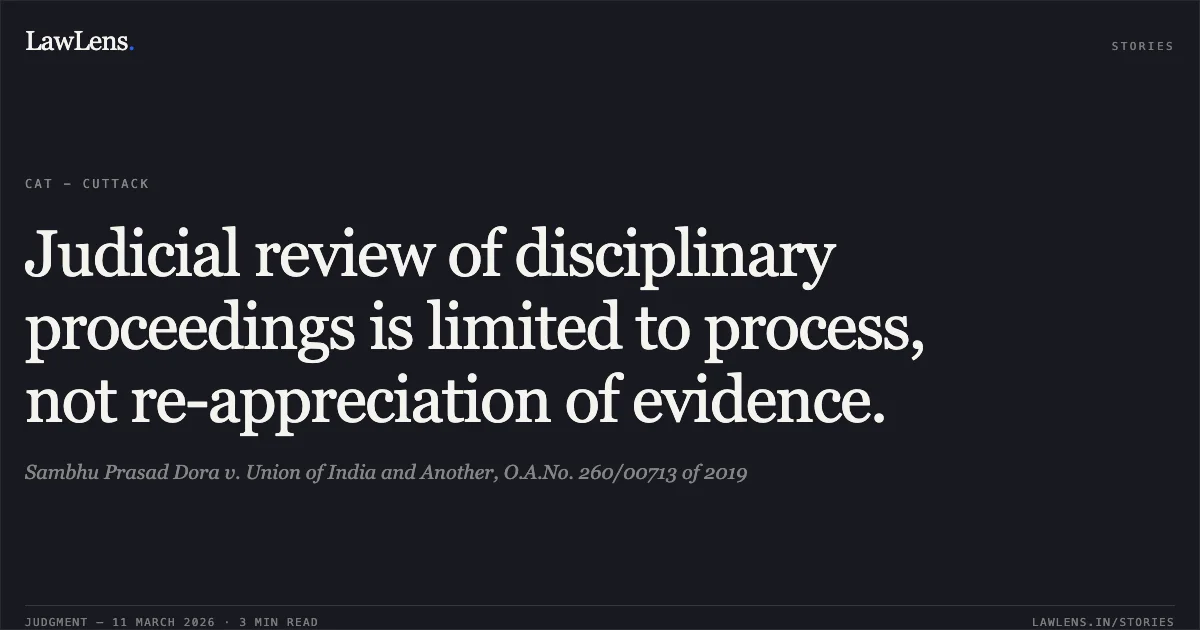
Source reference: p.5It also applied the principles laid down by the Hon'ble Apex Court regarding judicial review of disciplinary proceedings, specifically referencing *B.C. Chaturvedi v. Union of India*, (1995) 6 SCC 749, and *Union of India v. P Gunasekaran*, (2015) 2 SCC 610, which define the limited scope of judicial review, emphasizing that courts are not appellate authorities for re-appreciating evidence and can only interfere if the proceedings violate natural justice, statutory rules, or if findings are based on no evidence or are perverse.
Source reference: p.8-11The court also relied on *State of Andhra Pradesh v. S. Sreerama Rao*, AIR 1963 SC 1723, which states that adequacy or reliability of evidence in departmental authorities' findings is not a matter for canvass in a writ proceeding if there is some legal evidence.
Source reference: p.8-9Reasoning
The Tribunal found no force in the respondents' submission that the OA was hit by Section 21 of the AT Act, implying it was within the prescribed limitation period or that grounds existed to condone any perceived delay, thus allowing adjudication on merits.
Source reference: p.5Regarding the merits, the Tribunal noted that while Article-II was not established, Article-I (negligence in maintaining stock records) was proved by the IO after due inquiry.
Source reference: p.6-7The Tribunal found no document submitted by the applicant to refute the allegation in Article-I, instead observing efforts to justify actions without disproving the charge.
Source reference: p.7The Tribunal also addressed the applicant's implicit claim of non-supply of documents, stating that non-supply is not automatically fatal unless actual prejudice is pleaded and established, which was not done in this case.
Source reference: p.8Applying the precedents from *B.C. Chaturvedi* and *P Gunasekaran*, the Tribunal reiterated that its role is not to re-appreciate evidence or act as an appellate authority and found no perversity, lack of evidence, or violation of natural justice in the DA's decision, which was subsequently upheld by the AA.
Source reference: p.8-11The DA and AA orders were considered well-reasoned and based on available materials.
Source reference: p.6Holding
The Tribunal dismissed the Original Application.
It held that the OA was not barred by Section 21 of the AT Act.
Source reference: p.5However, based on the record, it found no illegality, irrationality, or fallibility in the decision-making process of the Disciplinary Authority, which was upheld by the Appellate Authority, particularly as Article-I was found proved after due inquiry.
Source reference: p.7, p.11It also implicitly held that the alleged non-supply of documents did not vitiate the proceedings as the applicant failed to demonstrate actual prejudice.
Source reference: p.8Acts & Sections Cited
1 provisions across 1 statute referred to in this judgment. Linked provisions open on LawLens.
AT Act, 19851
Original Court PDF
Sambhu Prasad Dora v. Union of India and Another, O.A.No. 260/00713 of 2019
Click to open original judgment
Original judgment, available to read, download and summarize on LawLens.in