Facts
Disciplinary proceedings were initiated against D.K. Mishra on five charges. The first Enquiry Officer recommended his transfer; after the Disciplinary Authority ordered a fresh enquiry, the second Enquiry Officer found proved the charge that Mishra had quarrelled with colleagues and disturbed official work, while other charges were not proved.
Source reference: para. 2The Disciplinary Authority imposed stoppage of three annual increments with cumulative effect; the appellate authority affirmed the penalty, and the revisional authority reduced it to stoppage of two annual increments with cumulative effect.
Source reference: para. 3The Central Administrative Tribunal dismissed Mishra’s original application, and he challenged that decision before the High Court.
Source reference: paras. 1, 3Issues
1. Whether the Tribunal erred in declining to interfere with the disciplinary findings and penalty when only one charge was found proved and the petitioner alleged that the penalty was unsupported or disproportionate.
Source reference: paras. 3–42. Whether the penalty of stoppage of two annual increments with cumulative effect was so disproportionate as to warrant judicial interference.
Source reference: paras. 4, 6Law Applied
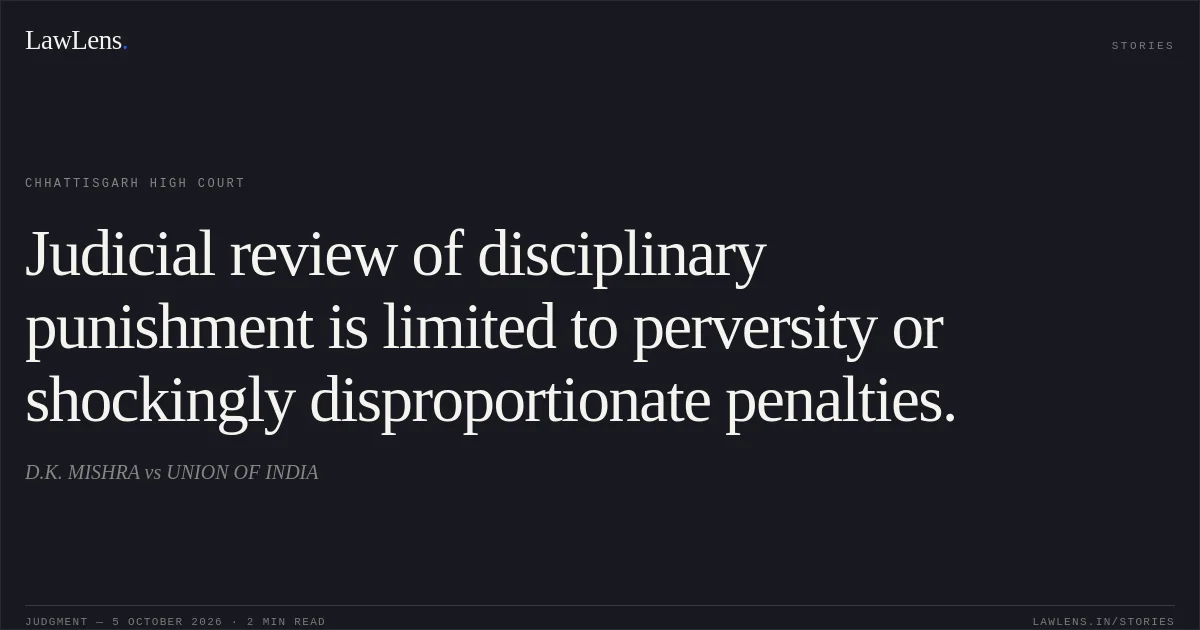
Relying on Union of India v. Parma Nanda, (1989) 2 SCC 177, and B.C. Chaturvedi v. Union of India, (1995) 6 SCC 749, the Court applied the principle that a reviewing court or tribunal does not sit as an appellate authority over disciplinary findings or reappraise the evidence merely because another view is possible.
Source reference: para. 3Interference with disciplinary action is limited to cases involving, among other grounds, arbitrariness or perversity in the findings or a punishment that is shockingly disproportionate.
Source reference: para. 3Reasoning
The High Court found that the Disciplinary Authority accepted the second Enquiry Officer’s finding that the charge of disturbing official work and quarrelling with colleagues was proved, and was not in disagreement with that report; therefore, no reasons for disagreement were required.
Source reference: para. 6The Court found no perversity in the enquiry or the imposition of the revised penalty, and held that the stoppage of two increments with cumulative effect was not shockingly disproportionate. A possible alternative view on reassessment of the record was insufficient to justify interference.
Source reference: para. 6Holding
The Court answered the issues against the petitioner. It found no basis to interfere with the Tribunal’s decision or the disciplinary penalty.
The Court dismissed the writ petition as devoid of merit.
Source reference: paras. 6–7Original Court PDF
D.K. MISHRAvsUNION OF INDIA
Click to open original judgment
Original judgment, available to read, download and summarize on LawLens.in