Facts
The petitioner, an elected ward representative of the Jaitahari Municipal Council, filed a Public Interest Litigation (PIL) alleging systemic corruption and the misappropriation of approximately Rs. 50 crores in public funds
Source reference: paras. 2, 4Specifically, the petitioner claimed that drainage construction in Ward No. 5 was substandard and that the Municipal Council President had misused his position to benefit family members
Source reference: para. 5The petitioner sought a court-monitored independent inquiry, alleging that prior complaints to the CM Helpline and various administrative representations had yielded no effective results
Source reference: paras. 1, 6-7The State responded that a formal inquiry had already been initiated by the Director of Urban Administration and Development, resulting in a report dated March 28, 2025, which confirmed certain irregularities and fixed responsibility upon specific officials
Source reference: para. 9Issues
1. Whether the High Court should exercise its extraordinary jurisdiction under Article 226 to adjudicate or monitor a matter where a statutory administrative inquiry is already in progress
Source reference: paras. 10, 122. Whether the petitioner provided sufficient evidentiary material to substantiate allegations of personal gratification and misuse of office by the Municipal Council President
Source reference: paras. 14-15Law Applied
The court applied the principles of judicial review under Article 226 of the Constitution of India, which generally restrain the judiciary from pre-empting or substituting ongoing administrative proceedings
Source reference: para. 12It relied on the guidelines established in State of Uttarakhand v. Balwant Singh Chaufal (2010), which mandate that PILs must disclose clear credentials, sources of information, and prima facie evidence to prevent the abuse of the court's jurisdiction for oblique motives
Source reference: para. 8Additionally, the court adhered to the principle that writ jurisdiction cannot be invoked to resolve disputed questions of fact that require detailed factual verification by competent authorities
Source reference: para. 12Reasoning
The court reasoned that since the competent statutory authorities had already taken cognizance of the grievances and initiated a departmental inquiry, judicial intervention would be premature
Source reference: paras. 11-12The court noted that the investigative process had already reached a stage where a three-member committee identified irregularities and initiated actions against erring officers, thereby demonstrating that the administrative mechanism was functional
Source reference: paras. 12-13Regarding the allegations of nepotism and personal gain by the President, the court found the claims to be vague and "bald," noting a total lack of cogent evidence or credible sources of information to back these specific charges
Source reference: paras. 14-15Consequently, the court determined that a parallel judicial investigation was unnecessary as the grievance was already engaging the attention of the executive branch
Source reference: para. 12Holding
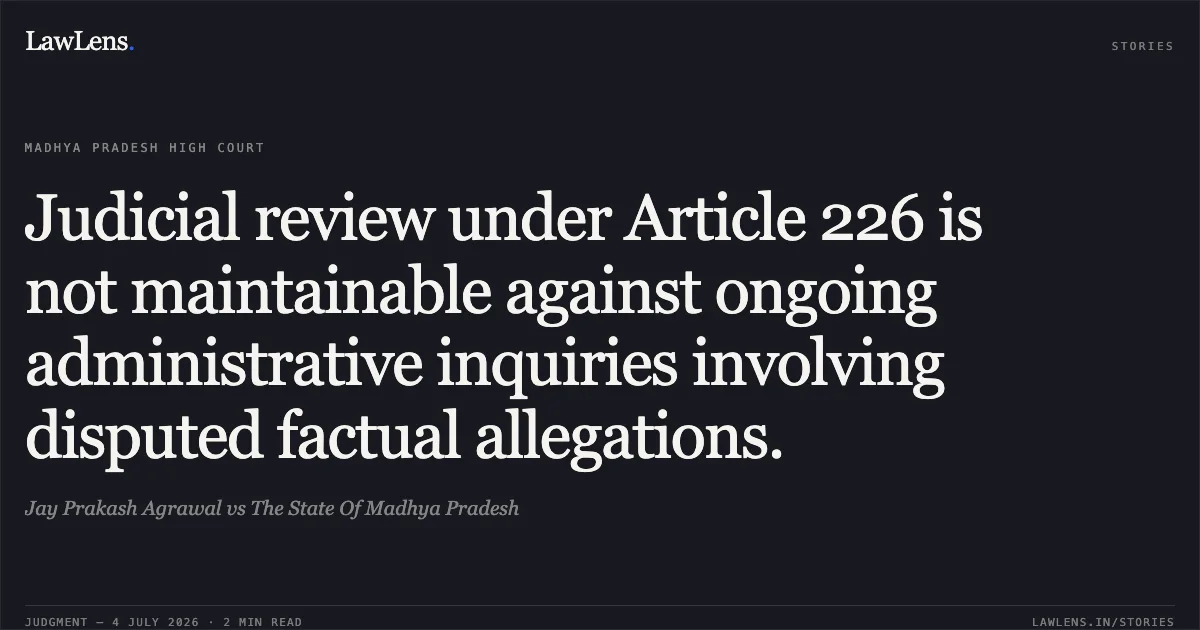
The Court dismissed the writ petition as premature, holding that no interference was warranted under Article 226 when an effective departmental process is already in motion
The Court answered the first issue by affirming that judicial review should not substitute an ongoing administrative inquiry
Source reference: para. 12The second issue by ruling that unsubstantiated allegations cannot form the basis for a writ
Source reference: para. 15The petitioner was directed to pursue the matter through the existing administrative channels until its logical conclusion; no costs were awarded
Source reference: para. 16Acts & Sections Cited
1 provisions across 1 statute referred to in this judgment. Linked provisions open on LawLens.
M.P. Municipalities Act, 19611
Original Court PDF
Jay Prakash AgrawalvsThe State Of Madhya Pradesh
Click to open original judgment
Original judgment, available to read, download and summarize on LawLens.in