01Facts
The Petitioner approached the High Court under Section 11(6) of the Arbitration and Conciliation Act, 1996, seeking the appointment of a Sole Arbitrator based on Clause 12 of an "Agreement of Sell" dated 18.08.2018.
¶ 1The Petitioner had previously invoked the arbitration clause via a statutory notice dated 02.04.2025.
¶ 2The Respondent opposed the petition, contending that no cause of action existed as no amounts were due and that the claims were barred by limitation.
¶ 302Issues
i.1. Whether the Court, at the stage of Section 11, should adjudicate preliminary objections regarding limitation and the existence of a cause of action.
¶ 4ii.2. Whether the Court should appoint an arbitrator given the limited scope of judicial scrutiny under Section 11(6) of the Act.
¶ 603Law Applied
Section 11(6) of the Arbitration and Conciliation Act, 1996, which governs the appointment of arbitrators.
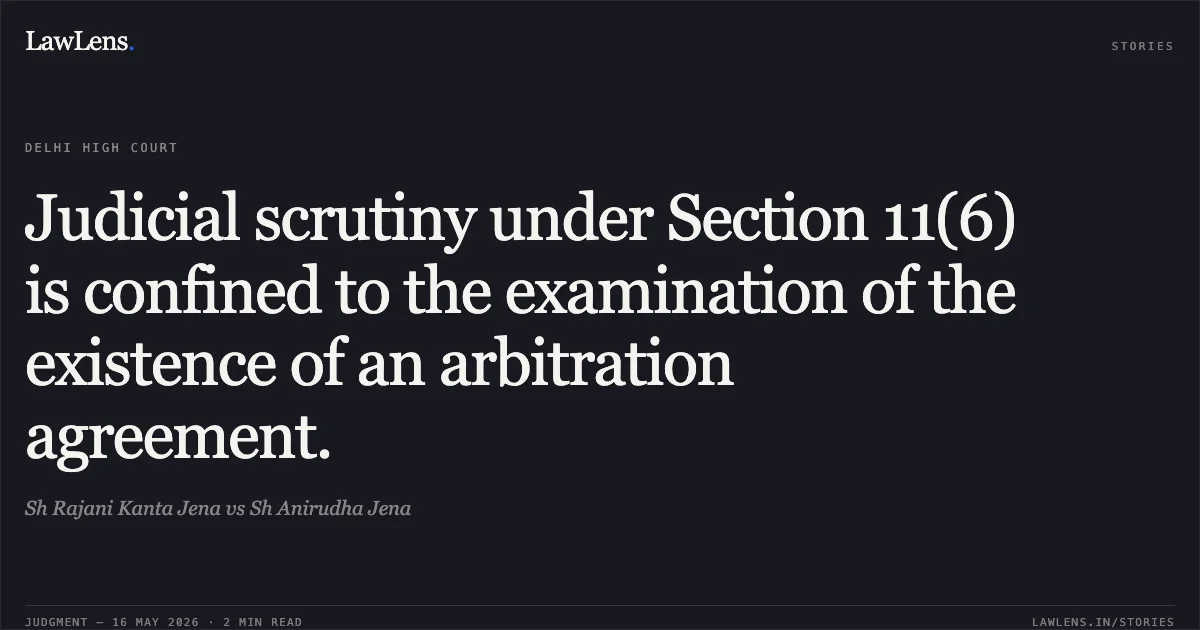
¶ 1The principle established in SBI General Insurance Co. Ltd. v. Krish Spinning (2024), integrating the seven-judge bench ruling in Interplay Between Arbitration Agreements under Arbitration Act, 1996 & Stamp Act, 1899, In re, that judicial interference under Section 11 is confined strictly to a prima facie examination of the existence of an arbitration agreement.
¶ 113-114Matters of "accord and satisfaction" or limitation are mixed questions of law and fact to be determined by the Arbitral Tribunal under the principle of competence-competence.
¶ 119-121Provisions in the judgment · 8 · Linked ones open on LawLens
Arbitration and Conciliation Act, 1996 Section 7Section 8Section 11Section 12Section 16Section 21Section 37Section 4
04Reasoning
The Court observed that while the Respondent raised objections regarding limitation and the lack of outstanding dues, the legislative intent of Section 11(6-A) limits the Court’s role to verifying the formal existence of the arbitration agreement.
¶ 4, 113Referencing Krish Spinning, the Court noted that tests such as "eye of the needle" or "ex facie meritless" are no longer the standard, as they infringe upon arbitral autonomy.
¶ 121The Court reasoned that the Arbitral Tribunal is better equipped to handle "laborious enquiries" and "frivolous disputes" through evidentiary appreciation.
¶ 128Since a written agreement existed and the Section 21 notice was served, the Court held that the referral must be made, leaving all substantive objections to be decided by the arbitrator.
¶ 4, 1205Holding
The Court allowed the petition and appointed Ms. Monisha Handa, Advocate, as the Sole Arbitrator.
¶ 8It held that all rights and contentions of the parties, including objections regarding limitation and cause of action, remain open to be adjudicated by the learned Arbitrator.
¶ 12The court directed the arbitrator to file a disclosure under Section 12(2) and fixed the fee structure in accordance with the Fourth Schedule of the Act.
¶ 9-10Original Court PDF
Sh Rajani Kanta JenavsSh Anirudha Jena
Click to open original judgment
Original judgment, available to read, download and summarize on LawLens.in