Facts
The opposite party (landlord) instituted Ejectment Suit No. 69 of 2011 against the petitioner (tenant) on grounds of reasonable requirement and default
Source reference: para. 2On November 11, 2011, the petitioner filed an application under Section 7(2) of the West Bengal Premises Tenancy Act, 1997, along with a Section 5 Limitation Act application to condone the delay in filing
Source reference: paras. 3–4On July 10, 2018, the Trial Court allowed the delay condonation on consent of both parties
Source reference: para. 5However, on November 14, 2025, the Trial Court ultimately dismissed the Section 7(2) application, ruling it was filed beyond the statutory period and noting that the petitioner failed to deposit admitted arrears of rent
Source reference: paras. 1, 13The petitioner moved the High Court in revision against this dismissal
Source reference: para. 6Issues
1. Whether a Trial Court can dismiss an application under Section 7(2) of the 1997 Act as time-barred after previously condoning the delay based on the consent of the parties
Source reference: paras. 7, 102. Whether the Court has the jurisdiction to extend the statutory period prescribed under Section 7 of the 1997 Act by applying Section 5 of the Limitation Act
Source reference: para. 113. Whether the petitioner's failure to deposit admitted arrears of rent independently necessitates the dismissal of the application
Source reference: para. 14Law Applied
The Court applied Section 7 of the West Bengal Premises Tenancy Act, 1997, emphasizing that statutory timelines for rent deposits and applications must be strictly adhered to
Source reference: para. 15It relied on the Supreme Court precedent in Seventh Day Adventist Senior Secondary School vs. Ismat Ahmed & Ors. (2025) regarding the mandatory nature of these periods
Source reference: para. 15Furthermore, the court applied the principle from Noharlal Verma vs. Distt. Coop. Central Bank (2008), which establishes that a question of limitation goes to the root of jurisdiction and cannot be waived by the court
Source reference: para. 16It also cited Mathura Prasad Bajoo Jaiswal vs. Dossibai N.B. Jeejeebhoy (1970) to affirm that an erroneous assumption of jurisdiction by a court does not operate as res judicata
Source reference: para. 16Reasoning
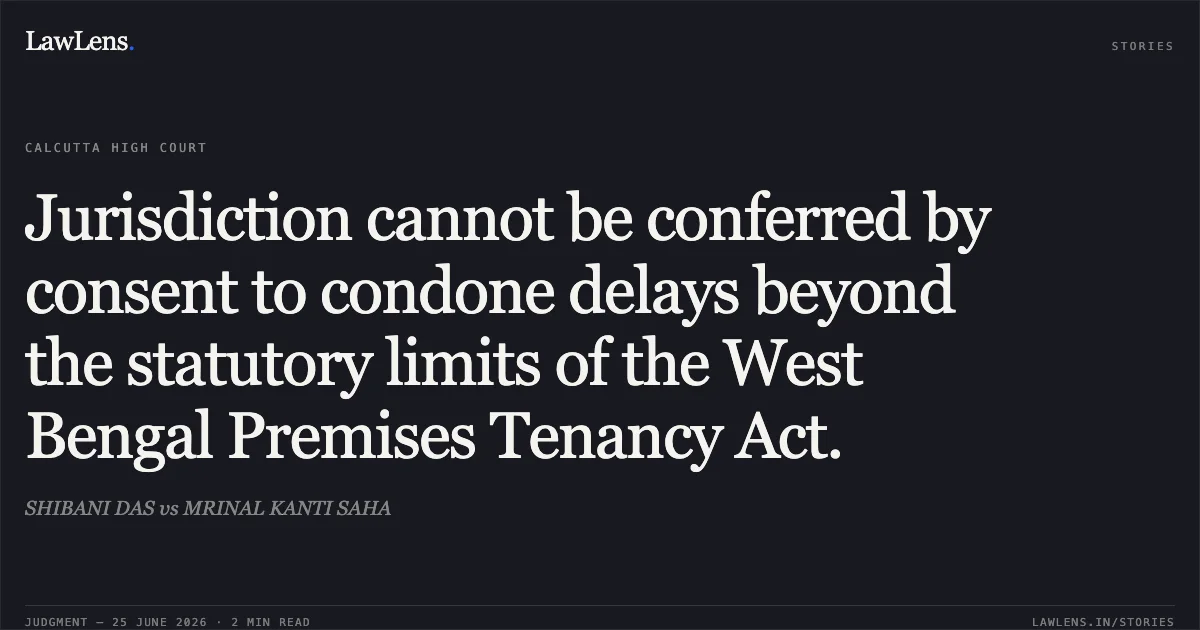
The Court reasoned that jurisdiction is a matter of law and cannot be conferred upon a court by the consent of the parties
Source reference: para. 10, 16Although the Trial Court initially condoned the delay in 2018, that order was legally erroneous because the Court lacked the statutory authority to extend the limitation period prescribed in the 1997 Act via the Limitation Act
Source reference: para. 11, 16Therefore, the Trial Court was competent to later dismiss the application upon realizing it was entertained without jurisdiction
Source reference: para. 16Furthermore, the Court noted that even if the limitation argument were ignored, the petitioner failed the mandatory requirement of Section 7(2) by not depositing admitted arrears of rent, which would automatically trigger the striking out of the defense under Section 7(3)
Source reference: para. 14Holding
The High Court held that the Trial Court did not commit any illegality in dismissing the Section 7(2) application
The court affirmed that statutory timelines under the West Bengal Premises Tenancy Act are mandatory and that consent cannot cure a jurisdictional defect regarding limitation
Source reference: para. 15, 16The revisional application was dismissed, and the order dated November 14, 2025, was upheld
Source reference: para. 18, 20No order as to costs was made
Source reference: para. 19Acts & Sections Cited
2 provisions across 2 statutes referred to in this judgment. Each provision opens on LawLens.
West Bengal Premises Tenancy Act, 19971
Limitation Act, 19631
Original Court PDF
SHIBANI DASvsMRINAL KANTI SAHA
Click to open original judgment
Original judgment, available to read, download and summarize on LawLens.in


