Facts
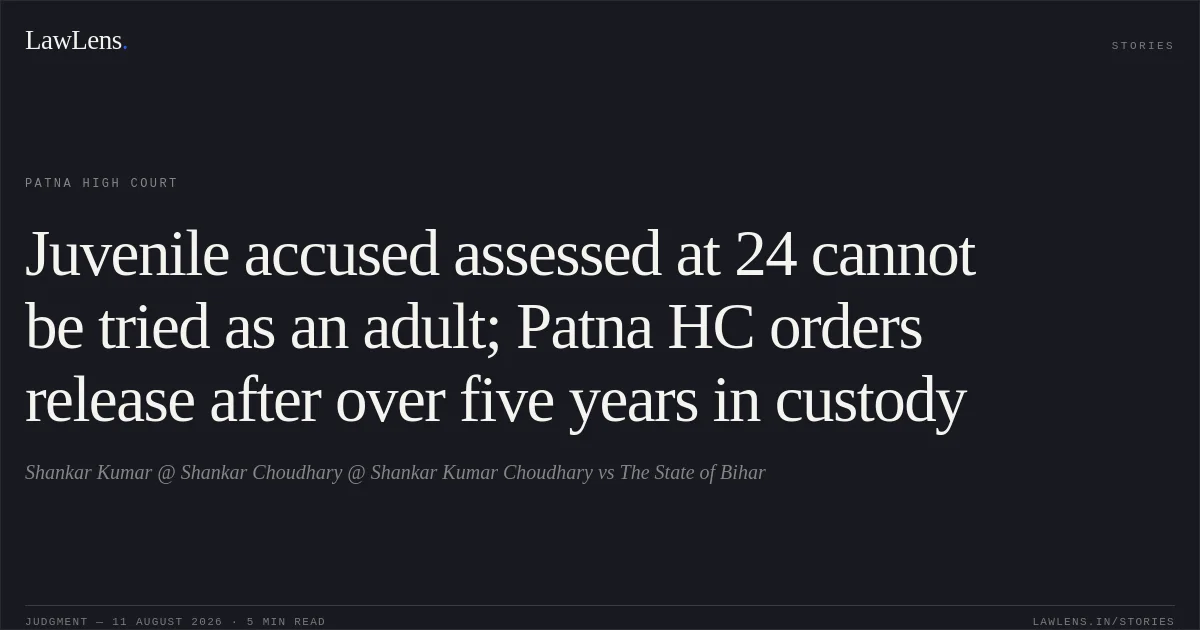
Bihta P.S. Case No. 704 of 2017 was registered for offences under Sections 326 and 302/34 of the IPC and Section 27 of the Arms Act after Nirbhay Singh was allegedly shot by masked assailants and subsequently died during treatment.
Source reference: p.3; para. 4During investigation, co-accused Akshay Kumar allegedly confessed and implicated the appellant in the occurrence.
Source reference: p.3; para. 3The appellant was arrested on 26 September 2017 and charge-sheeted with other accused persons; he was initially granted bail, but his bail bond was cancelled in 2022 for non-appearance.
Source reference: p.3–4; para. 3The appellant raised a plea of juvenility before the Sessions Court in 2024 and 2025.
Source reference: p.4–5; para. 5On the basis of a School Leaving Certificate, the matter was referred to the Juvenile Justice Board, which held that he was 16 years, 5 months and 7 days old on the date of the offence, 15 September 2017.
Source reference: p.4–5; para. 5The Juvenile Justice Board conducted a preliminary assessment under Section 15 of the Juvenile Justice Act on 6 August 2025 and found him sufficiently mature to understand the consequences of the alleged offence.
Source reference: p.5; para. 5The Children’s Court, by order dated 19 September 2025 under Section 19 of the Act, affirmed that he should be tried as an adult.
Source reference: p.5; para. 5The appellant challenged that order, contending that the assessment was conducted nearly eight years after the occurrence, when he was over 24 years old, and that the psychologist had assessed his mental age at 16 years.
Source reference: p.6–8; paras. 7–11He also contended that he had already undergone more than five years of incarceration, exceeding the maximum three-year period of detention available under Section 18 of the Act.
Source reference: p.7; para. 10Issues
Whether the preliminary assessment under Sections 15 and 19 of the Juvenile Justice (Care and Protection of Children) Act, 2015, conducted nearly eight years after the alleged offence when the appellant was over 24 years old, could validly determine his mental and physical capacity and ability to understand the consequences of the offence at the time of its commission.
Source reference: p.5–11; paras. 7–9, 17–18, 21–22Whether the Children’s Court properly performed its independent assessment under Section 19 of the Juvenile Justice Act, or whether its reliance primarily on the appellant’s answers, without adequately considering the psychologist’s report, rendered the order unsustainable.
Source reference: p.8–11; paras. 14, 17–19Whether the appellant was required to be tried as an adult or dealt with by the Children’s Court in the manner prescribed for the Juvenile Justice Board under Section 19(1)(ii) of the Act.
Source reference: p.11–12; para. 19Whether the connected bail appeal survived after the order directing the appellant’s release.
Source reference: p.14; paras. 23–26Law Applied
The Court applied Sections 15, 18 and 19 of the Juvenile Justice (Care and Protection of Children) Act, 2015.
Source reference: p.11–12; para. 19Section 15 requires a preliminary assessment of a child alleged to have committed a heinous offence, including assessment of mental and physical capacity, ability to understand the consequences of the offence, and the circumstances in which it was allegedly committed.
Source reference: p.11–12; para. 19Section 19 requires the Children’s Court to independently determine whether the child should be tried as an adult; where the child is not capable of understanding the consequences of the offence, the Children’s Court must conduct the inquiry as a Board and pass an appropriate order under Section 18.
Source reference: p.11–12; para. 19The Court further relied on Thirumoorthy v. State of Tamil Nadu, (2024) 12 SCC 307, which held that directing a preliminary assessment when the accused has reached an advanced age may be futile because there may be no realistic possibility of reliably determining the accused’s mental and physical capacity at the time of the historical offence.
Source reference: p.12–13; paras. 21–22Under Section 18, the maximum period of detention that may be ordered by the Juvenile Justice Board is three years.
Source reference: p.11–12; para. 20Reasoning
The Court found that the appellant’s juvenility on the date of the offence had already been determined by the Juvenile Justice Board and remained unchallenged.
Source reference: p.8–9; para. 13Although the offence occurred when the appellant was 16 years old, the preliminary assessment was conducted nearly eight years later, when he was approximately 24 years old.
Source reference: p.10–13; paras. 17, 21–22The Court held that such a belated assessment was substantially futile, as it could not realistically establish the appellant’s mental and physical capacity, or his ability to understand the consequences of the alleged offence, as they existed in 2017.
Source reference: p.10–13; paras. 17, 21–22The psychologist’s report stated that the appellant had below-average intellectual capacity and a mental age of 16 years at the time of the 2025 assessment.
Source reference: p.10–11; para. 17The Court reasoned that if his mental age was 16 in 2025, his mental capacity approximately eight years earlier could not reasonably be treated as higher; consequently, he could not be held sufficiently mature at the time of the occurrence to understand the alleged offence and its consequences.
Source reference: p.10–11; para. 17The Children’s Court also failed to properly consider the psychologist’s report and based its assessment principally on answers elicited from the appellant, contrary to the requirement that the assessment be conducted carefully and independently.
Source reference: p.11; para. 18Applying Thirumoorthy, the Court concluded that the impugned adult-trial determination could not stand.
Source reference: p.11–13; paras. 20–23Since the appellant had already been incarcerated for more than five years and four months, exceeding the maximum three-year detention contemplated under Section 18, remanding him for another preliminary assessment would serve no practical purpose.
Source reference: p.11–13; paras. 20–23Holding
The High Court allowed Criminal Appeal (SJ) No. 5170 of 2025 and set aside the Children’s Court’s order dated 19 September 2025 directing that the appellant be tried as an adult.
It held that the appellant was not shown to have been mentally and physically capable, at the time of the alleged occurrence, of understanding the offence, its consequences, and the circumstances in which it was committed.
Source reference: p.13; para. 23The appellant was directed to be released forthwith, unless required in any other case.
Source reference: p.13; para. 23In consequence, the connected bail appeal, Criminal Appeal (SJ) No. 2579 of 2026, was dismissed as infructuous.
Source reference: p.14; paras. 25–26The Court also directed payment of ₹15,000 as honorarium to the Amicus Curiae.
Source reference: p.13–14; para. 24Acts & Sections Cited
9 provisions across 4 statutes referred to in this judgment. Each provision opens on LawLens.
Juvenile Justice (Care and Protection of Children) Act, 2015.3
Code of Criminal Procedure, 19731
Indian Penal Code, 18604
Arms Act, 19591
Original Court PDF
Shankar Kumar @ Shankar Choudhary @ Shankar Kumar ChoudharyvsThe State of Bihar
Click to open original judgment
Original judgment, available to read, download and summarize on LawLens.in