Facts
On September 17, 2025, a complainant reported a robbery involving the theft of a mobile phone and ₹2000 near Subhashpura, Shivpuri
Source reference: para. 2Consequently, Crime No. 127/2025 was registered under Section 309(4) of the Bharatiya Nyaya Sanhita and Sections 11 and 13 of the MPDVPK Act
Source reference: para. 2The petitioner, a 17-year-old juvenile, was taken into custody and sent to an Observation Home on January 28, 2026
Source reference: para. 2Both the Juvenile Justice Board and the Special Judge, Shivpuri (in Criminal Appeal No. 38/2026 dated February 12, 2026) rejected the petitioner’s bail applications
Source reference: para. 1-2The petitioner challenged these orders via a criminal revision under Section 102 of the Juvenile Justice (Care and Protection of Children) Act, 2015
Source reference: para. 1Issues
1. Whether the lower courts failed to apply the statutory mandate of Section 12 of the Juvenile Justice (Care and Protection of Children) Act, 2015, regarding the grant of bail to a juvenile
Source reference: para. 3, 72. Whether there existed reasonable grounds to believe that the release of the juvenile would bring him into association with known criminals or expose him to moral, physical, or psychological danger
Source reference: para. 8, 11Law Applied
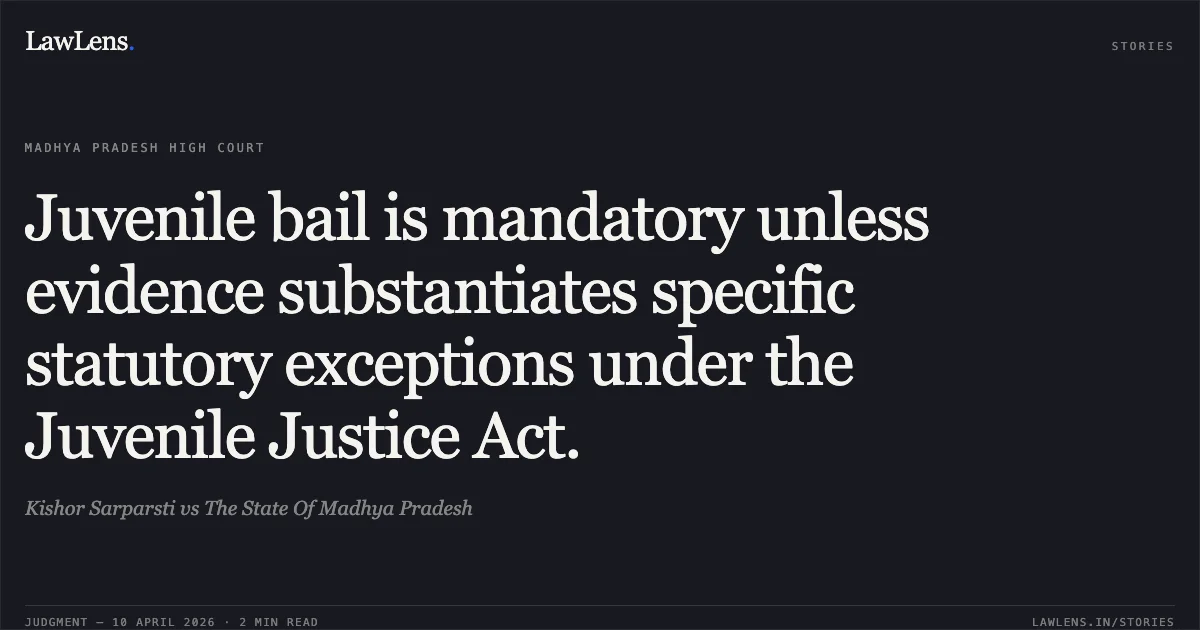
The court primarily applied Section 12 of the Juvenile Justice (Care and Protection of Children) Act, 2015, which stipulates that a juvenile must be released on bail notwithstanding the nature of the offense, unless specific exceptions are met: likelihood of association with criminals, exposure to moral/physical/psychological danger, or if release defeats the ends of justice
Source reference: para. 7-8The court also referenced the principle that considerations for juvenile bail are distinct from the Code of Criminal Procedure, as affirmed in Jaif Ahmed Sheikh v. State of Rajasthan (2004), emphasizing that a juvenile is protected separately by the Act due to their age
Source reference: para. 9-10Reasoning
The Court reasoned that the mandate of Section 12 is to grant bail as a rule, with refusal being a rare exception based on specific adverse conditions
Source reference: para. 8In the present case, the Court found no evidence on record to suggest that the petitioner’s release would lead to criminal association or personal danger
Source reference: para. 11The Court relied heavily on a conduct report dated February 2, 2026, from the Superintendent of the Special Home for Boys, Indore, which described the juvenile’s behavior as disciplined, cooperative, and mentally stable
Source reference: para. 3, 11Additionally, the Court noted the father’s undertaking to supervise the juvenile, concluding that the lower courts' mechanical rejection of bail lacked the necessary legal foundation required under the Act
Source reference: para. 3, 12Holding
The High Court allowed the revision petition and set aside the judgment of the Special Judge, Shivpuri dated February 12, 2026
The Court held that the petitioner was entitled to bail and directed his release upon furnishing a personal bond of ₹50,000 with one solvent surety of the same amount, to be executed by his father
Source reference: para. 12The father must provide an undertaking to ensure the juvenile does not indulge in unlawful activities and appears before the Board as required
Source reference: para. 3, 12Acts & Sections Cited
3 provisions across 2 statutes referred to in this judgment. Each provision opens on LawLens.
Juvenile Justice (Care and Protection of Children) Act, 2015.2
Bharatiya Nyaya Sanhita, 20231
Original Court PDF
Kishor SarparstivsThe State Of Madhya Pradesh
Click to open original judgment
Original judgment, available to read, download and summarize on LawLens.in


