Facts
The appeals arose from orders refusing bail to two children in conflict with law.
Source reference: no citationCriminal Appeal No. 1470 of 2024 challenged the order dated 3 January 2024 passed by the Children’s Court/Special Judge (POCSO Act), Kasganj, in a case alleging offences under Sections 328, 363, 366, 376D and 506 IPC, Sections 5/6 of the POCSO Act and Section 67A of the Information Technology Act.
Source reference: para. 2Criminal Appeal No. 2446 of 2026 arose from the rejection of bail by the Additional District and Sessions Judge/Special Judge (POCSO Act), Jalaun, in a case under Section 376(3) IPC and Sections 3/4(2) of the POCSO Act.
Source reference: para. 3The appeals were heard together.
Source reference: para. 4During the proceedings, the High Court called for social investigation and social background reports, assessed the children’s educational, socio-economic and family circumstances, and found that both required rehabilitation and reintegration (“R&R”) programmes after release on bail.
Source reference: paras. 199–202Interim R&R plans were framed, the children were admitted to schools, and the schools and teachers were provisionally treated as “fit institutions” and “fit persons”.
Source reference: para. 201Issues
Whether the High Court, while exercising appellate jurisdiction under Section 101(5) of the Juvenile Justice (Care and Protection of Children) Act, 2015 (“JJ Act”), is required to assess the child’s need for an R&R programme or individual child care plan and school education while granting bail.
Source reference: para. 5(A)Whether the Juvenile Justice Board (“JJB”) or Children’s Court has a statutory obligation to assess and, where necessary, initiate an R&R programme, frame an individual child care plan and secure the child’s admission or re-admission to school while granting bail.
Source reference: para. 5(B)Which institutions and persons may implement the post-release R&R programme or individual child care plan, and which authorities must supervise its implementation.
Source reference: para. 5(C)Law Applied
The Court applied Sections 1(4), 3, 8, 12, 18, 19, 39, 45, 47, 51–54, 101(5) and 110 of the JJ Act, 2015, read with Rules 2(ix), 7, 10, 11, 24, 27, 28 and 29–38 of the Juvenile Justice Rules, 2016.
Source reference: no citationThe governing principles were the child’s best interests, positive measures, diversion, institutionalisation as a last resort, rehabilitation and social reintegration.
Source reference: no citationSection 12 creates a liberal statutory bail regime for children, subject to the limited exceptions of association with known criminals, exposure to moral, physical or psychological danger, or defeat of the ends of justice.
Source reference: paras. 23, 39Sections 8(2), 18 and 19 require the High Court and Children’s Court to combine adjudicatory functions with rehabilitative responsibilities, including school attendance, educational services and individual care plans.
Source reference: paras. 29, 36–38Section 39 and Rule 2(ix) require rehabilitation to be based on an individual care plan addressing health, psychological, educational, vocational, social and life-skill needs.
Source reference: para. 62Rule 7 requires monitoring of the child’s progress and continuation of school education, while Rule 11 requires an individual care plan in dispositional orders.
Source reference: paras. 30, 35Sections 51 and 52 and Rules 27 and 28 permit recognition of suitable institutions and persons as “fit facilities” and “fit persons”.
Source reference: para. 143The Court relied on Pratap Singh v. State of Jharkhand, 2005 (3) SCC 551, for construing juvenile justice law consistently with international child-rights instruments; Jitendra Singh v. State of U.P., (2013) 11 SCC 193, for the primacy of rehabilitative and restorative objectives over retribution and repression; and Bachpan Bachao Andolan v. Union of India, (2011) 5 SCC 112, for protecting children’s dignity and prioritising their best interests.
Source reference: paras. 15, 17, 18The Court also harmonised the JJ Act with Article 21A and the Right of Children to Free and Compulsory Education Act, 2009, and, where relevant, the Rights of Persons with Disabilities Act, 2016 and the Mental Healthcare Act, 2017.
Source reference: paras. 79–82, 103–123Reasoning
The Court held that bail proceedings under Section 12 are not purely adjudicatory; they are part of the statutory rehabilitative process.
Source reference: paras. 40–50Because Section 12 permits release under the supervision of a probation officer or the care of a fit person, the power to grant bail necessarily includes authority to impose appropriate rehabilitative directions where the child’s circumstances require them.
Source reference: para. 41The Court found that release on bail does not eliminate the child’s vulnerabilities or the need for care and protection.
Source reference: no citationAccordingly, the JJB, Children’s Court and High Court must examine the child’s social background, educational status, mental health, family environment and other risks through appropriate reports and direct interaction with the child and family.
Source reference: paras. 64–69Where a need is established, the court must frame and monitor an individualised R&R programme, rather than leave the child without support after release.
Source reference: paras. 43–51Education was treated as a central component of rehabilitation and as a constitutional and statutory right under Article 21A and the RTE Act; the court therefore has a duty, where necessary, to secure school admission and continuity of education.
Source reference: paras. 95–101, 124–125For post-release implementation, the Court held that parents are ordinarily natural fit persons, but additional fit persons and institutions may be appointed where the family lacks the capacity or resources to implement the plan.
Source reference: paras. 151–153Schools and teachers may be recognised as fit institutions and fit persons after due inquiry, subject to safeguards concerning the seriousness of the alleged offence, the child’s mental capacity, the welfare and safety of other students, available resources and protection of the child’s anonymity.
Source reference: paras. 156–163The State cannot rely on absence of budgetary allocation or subordinate rules to frustrate the statutory and constitutional rights of children; pending formal rules, government day schools and teachers may be provisionally recognised after appropriate inquiry.
Source reference: paras. 183–189Holding
The Court answered all three questions in the affirmative.
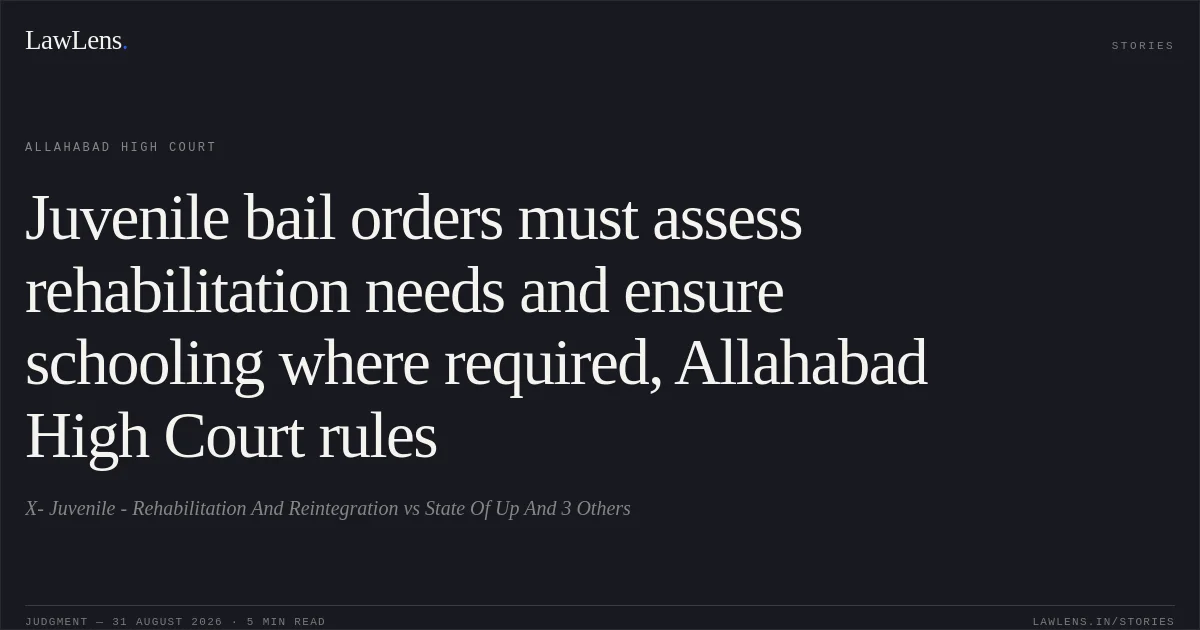
The High Court, JJB and Children’s Court must assess, at the stage of bail and upon conclusion of the inquiry, whether the child requires an R&R programme, individual child care plan and/or school education; where required, they must initiate and frame the programme and supervise its implementation.
Source reference: para. 197Suitable fit institutions, fit persons, foster-care institutions and other stakeholders may implement the programme under the oversight of the JJB or Children’s Court, with assistance from the State Government, local administration, education authorities and statutory child-protection bodies.
Source reference: paras. 197–198The Court directed that the R&R programmes for the two children—comprising academics, yoga, sports, music, arts, crafts, theatre, storytelling, environmental activities, group activities, moral and life-skills education, counselling and nutritious food—be continued through their schools, with regular progress reports to the competent JJB/Children’s Court and protection of the children’s anonymity.
Source reference: paras. 201–205In Criminal Appeal No. 1470 of 2024, the bail-rejection order dated 3 January 2024 was set aside and the appeal was allowed; the appellant was directed to be released on bail on the previously furnished personal bond and sureties, subject to non-tampering and appearance conditions.
Source reference: paras. 209–211The trial court was directed not to frustrate bail through arbitrary or onerous surety requirements.
Source reference: paras. 212–213Acts & Sections Cited
50 provisions across 7 statutes referred to in this judgment. Each provision opens on LawLens.
Juvenile Justice (Care and Protection of Children) Act, 2015.
Indian Penal Code, 18605
Code of Criminal Procedure, 19733
Right of Children to Free and Compulsory Education Act, 20093
Rights of Persons with Disabilities Act, 2016.2
Mental Healthcare Act, 20173
Original Court PDF
X- Juvenile - Rehabilitation And ReintegrationvsState Of Up And 3 Others
Click to open original judgment
Original judgment, available to read, download and summarize on LawLens.in