Facts
The applicant was provisionally selected as a Constable (Executive) in the Delhi Police in 2009
Source reference: para. 3His candidature was cancelled in 2010 due to his involvement in FIR No. 47/2002 under Sections 399/402 IPC and Section 25 of the Arms Act
Source reference: para. 3, 6At the time of the alleged offence, the applicant was a juvenile (approx. 17 years and 10 months old) and was subsequently acquitted by the Juvenile Justice Board on 04.02.2009
Source reference: para. 6, 7Following previous litigation before the Tribunal and the Delhi High Court, the respondents issued an offer of appointment on 11.07.2012, subject to the outcome of a Special Leave Petition (SLP)
Source reference: para. 4, 5Following the Supreme Court's decision in Sunil Kumar Rai v. Union of India, a Screening Committee re-evaluated the applicant’s suitability
Source reference: para. 5, 6The Committee recommended withdrawing the appointment on 17.01.2017, citing "criminal propensity" and the "serious nature" of the juvenile offence, despite the acquittal
Source reference: para. 6, 7The applicant challenged this withdrawal while continuing in service under interim protection granted by the Tribunal
Source reference: para. 8Issues
1. Whether the respondents were justified in withdrawing the offer of appointment based on a criminal case registered against the applicant when he was a juvenile, which resulted in an acquittal
Source reference: para. 9Law Applied
The court primarily applied the protections afforded under the Juvenile Justice (Care and Protection of Children) Act, 2000 (Section 19) and the 2015 Act (Section 24), which mandate that a child in conflict with law shall not suffer disqualification on account of conviction or past records
Source reference: para. 13It relied on the "Principle of Fresh Start" under Section 3(xiv) of the 2015 Act, which requires the erasure of past records to prevent stigma
Source reference: para. 13The court followed the precedents of Union of India v. Ramesh Bishnoi (2019), which held that juvenile offences cannot deprive a person of a job
Source reference: para. 13Anuj Kumar v. State of Uttar Pradesh, which established that using juvenile prosecution to determine suitability is arbitrary and violative of Article 14
Source reference: para. 12, 13It further applied the ratio from Vikash v. Govt. of NCT of Delhi (O.A. 158/2019), which quashed similar Standing Orders of the Delhi Police for being contrary to the Juvenile Justice Act
Source reference: para. 13Reasoning
The Tribunal found that the Screening Committee erred by using the applicant's past juvenile record to assess his integrity and "criminal propensity"
Source reference: para. 7, 13Integrating the findings from the Vikash and Ramesh Bishnoi cases, the Tribunal reasoned that the legislative intent of the Juvenile Justice Act is to reintegrate juveniles into society without the shadow of past conduct
Source reference: para. 13, 14The court noted that even if a juvenile is convicted—which was not the case here as the applicant was acquitted—the law requires that such records be obliterated
Source reference: para. 13The respondents’ argument that the acquittal was on "technical grounds" or "benefit of doubt" was deemed irrelevant because the underlying incident occurred when the applicant was a minor, making it an unlawful basis for employment disqualification
Source reference: para. 13Since the applicant had been serving since 2012 and the legal position regarding juvenile records was settled, the withdrawal of the appointment was held to be illegal and contrary to the spirit of the Act
Source reference: para. 13, 14Holding
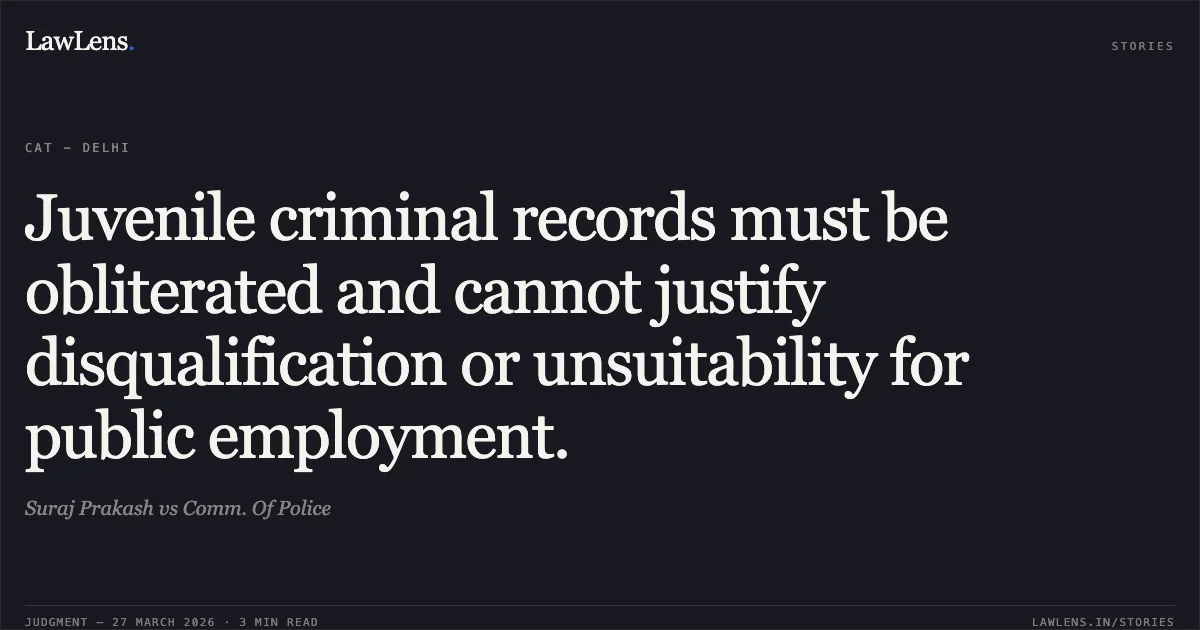
The Tribunal allowed the O.A. and quashed the impugned order dated 17.01.2017
It held that juvenile involvement in a criminal case cannot be a bar to appointment
Source reference: para. 13The Tribunal made the interim stay absolute and directed the respondents to restore the applicant’s appointment with all consequential benefits, including seniority based on merit, notional pay fixation, and consideration for promotion
Source reference: para. 14The respondents were ordered to comply within six weeks
Source reference: para. 14Original Court PDF
Suraj PrakashvsComm. Of Police
Click to open original judgment
Original judgment, available to read, download and summarize on LawLens.in


