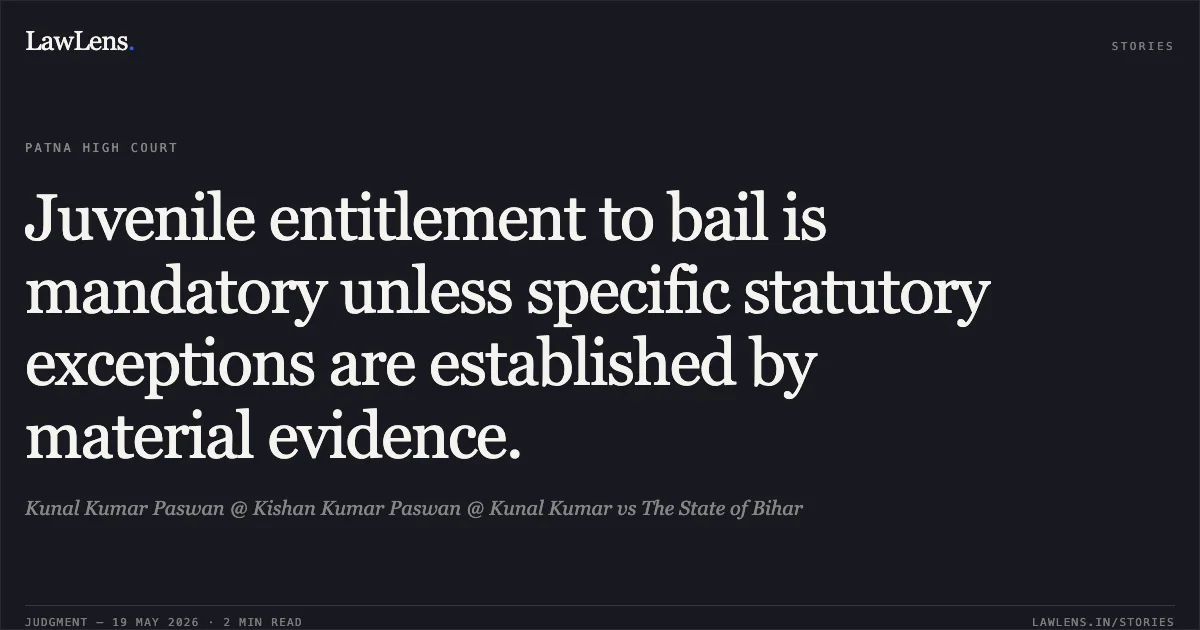
Facts
The appellant, a juvenile, was named in an FIR (Bhargama P.S. Case No. 138 of 2024) initially registered under Sections 302 and 120-B/34 of the IPC regarding the abduction and death of a 19-year-old girl.
Source reference: para. 2Following a police investigation, the charges were downgraded to Section 306 IPC (abetment of suicide).
Source reference: para. 3The Social Investigation Report (SIR) revealed a love affair between the appellant and the deceased, which her family rejected due to the appellant's lower economic status, leading the victim to commit suicide.
Source reference: para. 4The Children’s Court rejected the appellant’s bail application on January 21, 2026, citing parental negligence and negative peer influence.
Source reference: para. 1The appellant challenged this order, having been in an Observation Home since July 23, 2025.
Source reference: para. 10Issues
1. Whether the Children’s Court erred in denying bail to the juvenile based on the nature of the offense and perceived parental negligence.
Source reference: para. 7-82. Whether the appellant’s case falls under the three restrictive exceptions for denying bail to a juvenile under the proviso to Section 12(1) of the J.J. Act, 2015.
Source reference: para. 13Law Applied
The court applied Section 12 of the Juvenile Justice (Care and Protection of Children) Act, 2015, which mandates that bail is the rule for juveniles regardless of the nature of the offense, unless its release brings the juvenile into association with criminals, exposes them to danger, or defeats the ends of justice.
Source reference: para. 12-13The court relied on the Supreme Court's ruling in Juvenile in Conflict with Law v. State of Rajasthan (2024), which held that bail cannot be denied without a clear finding on the applicability of the Section 12 proviso.
Source reference: para. 14The court further applied the "General Principles" under Section 3 of the J.J. Act, emphasizing the "Principle of best interest," "Family responsibility," and "Institutionalisation as a measure of last resort".
Source reference: para. 23, 27Reasoning
The Court observed that the Children’s Court denied bail based on "surmises" regarding parental negligence and peer influence without supporting material in the SIR.
Source reference: para. 7, 34The Court clarified that under Section 12, the seriousness of the crime is irrelevant to the bail determination for a juvenile.
Source reference: para. 17, 30(2)The Court analyzed the SIR, noting the appellant had no criminal antecedents and that the suicide stemmed from social/economic friction between families rather than the appellant’s criminal conduct.
Source reference: para. 32-33The Court reasoned that "ends of justice" in juvenile law refers to the child's reform and rehabilitation; since the family is the primary institution for such development, and no evidence suggested the appellant would be exposed to danger or criminals, there was no legal ground to withhold bail.
Source reference: para. 22, 26, 30(3)Holding
The Court allowed the appeal and set aside the order dated January 21, 2026, holding that no grounds under the proviso to Section 12 of the J.J. Act were made out to deny bail.
The Court directed the appellant's release on a bail bond of Rs. 10,000, subject to an undertaking by his father to maintain vigil over the appellant’s conduct and ensure he does not associate with criminals, and ordered case records to be returned forthwith.
Source reference: para. 35, 36Acts & Sections Cited
8 provisions across 2 statutes referred to in this judgment. Each provision opens on LawLens.
Indian Penal Code, 18603
Juvenile Justice (Care and Protection of Children) Act, 2015.5
Original Court PDF
Kunal Kumar Paswan @ Kishan Kumar Paswan @ Kunal KumarvsThe State of Bihar
Click to open original judgment
Original judgment, available to read, download and summarize on LawLens.in


