Facts
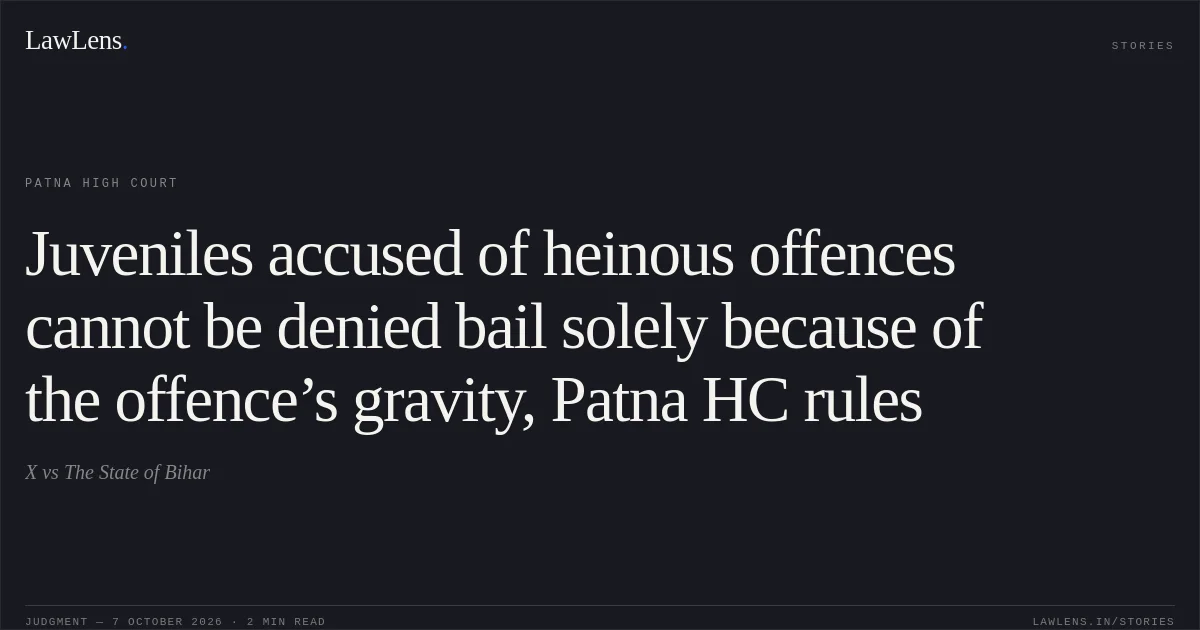
The appellant, a child in conflict with law, appealed the Children Court’s order rejecting his bail application under Section 12 of the Juvenile Justice (Care and Protection of Children) Act, 2015 (“J.J. Act”).
Source reference: para. 1–2He was accused of participating in a group attack in which the victim was shot and later died; the informant, the victim’s wife, was not an eyewitness to the shooting.
Source reference: para. 1–2, 28The Children Court had refused bail, referring to the gravity of the offence and the Probation Officer’s report.
Source reference: para. 1, 29The appellant had been in an observation home since 24 May 2025.
Source reference: para. 7Issues
Whether the Children Court could refuse bail to the appellant based on the seriousness of the alleged offence.
Source reference: para. 9–10, 29Whether the Social Investigation Report disclosed a statutory ground under the proviso to Section 12(1) of the J.J. Act sufficient to deny bail.
Source reference: para. 10, 27(5)–(6), 30–32Law Applied
Section 12(1) of the J.J. Act requires a child alleged to be in conflict with law to be released on bail, with or without surety, unless reasonable grounds support one of three exceptions: release is likely to bring the child into association with a known criminal, expose the child to moral, physical or psychological danger, or defeat the ends of justice; reasons for refusal must be recorded.
Source reference: para. 9The Court relied on *Juvenile in Conflict with Law v. State of Rajasthan*, 2024 SCC OnLine SC 5297, and *In Re: Exploitation of Children in Orphanages in the State of T.N. v. Union of India*, (2020) 14 SCC 327, for the mandatory character of bail absent an established statutory exception.
Source reference: para. 11–12It further held that the seriousness of the offence is not, by itself, a ground for refusal, and that “ends of justice” must be considered in light of the J.J. Act’s rehabilitative purpose and the child’s best interests.
Source reference: para. 14, 19–25, 27(2)–(3)Reasoning
The Children Court relied on the heinous nature of the alleged offence, which is not a relevant standalone ground for denying bail under Section 12.
Source reference: para. 29Although the Social Investigation Report referred to one criminal antecedent and stated that the appellant was in contact with young men of criminal nature, it identified no such persons or specific association with known criminals; the Court therefore found the report vague and insufficient to establish a statutory exception.
Source reference: para. 30–32The informant’s lack of eyewitness knowledge was noted, but the decision turned on the absence of material supporting refusal under Section 12.
Source reference: para. 28Holding
The Court allowed the appeal and set aside the Children Court’s order.
It directed the appellant’s release on bail on a bond of ₹10,000, with his father to provide an affidavit undertaking to supervise him, prevent contact with criminal persons, support his developmental needs and continued studies, and ensure his attendance when required.
Source reference: para. 33The Children Court record was directed to be returned.
Source reference: para. 34Acts & Sections Cited
15 provisions across 3 statutes referred to in this judgment. Each provision opens on LawLens.
Bharatiya Nyaya Sanhita, 2023
Arms Act, 19591
Juvenile Justice (Care and Protection of Children) Act, 2015.5
Original Court PDF
XvsThe State of Bihar
Click to open original judgment
Original judgment, available to read, download and summarize on LawLens.in