Facts
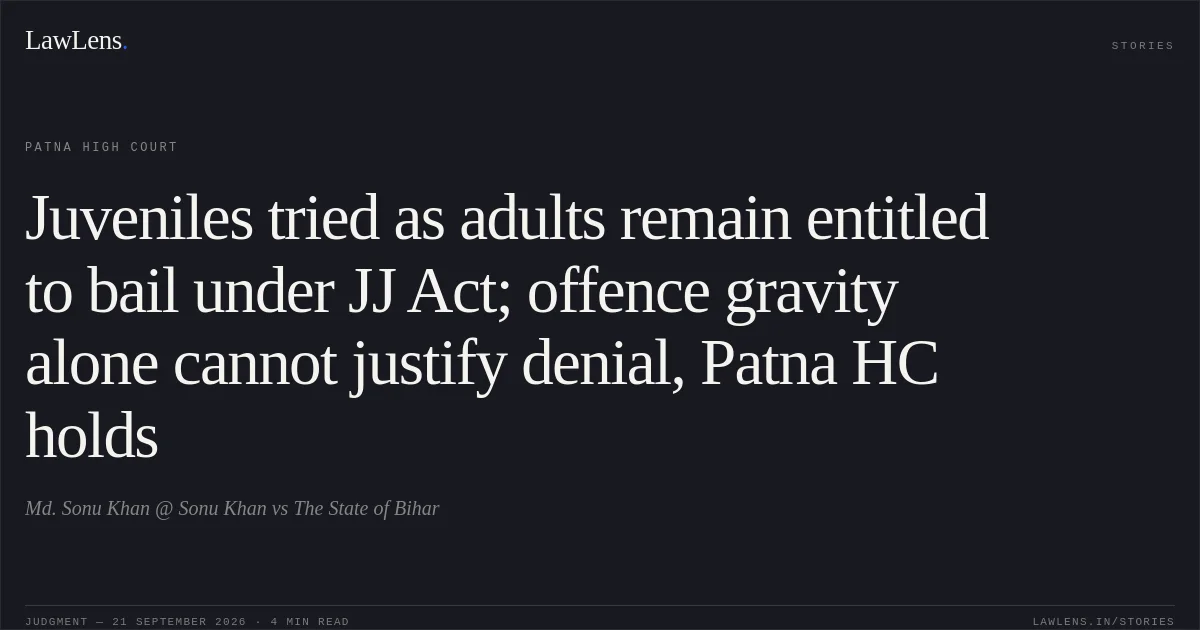
The appellant, a child in conflict with law, challenged the order dated 1 May 2025 passed by the Children Court-cum-Additional District and Additional Sessions Judge-I, Saharsa, rejecting his bail application under Section 12 of the Juvenile Justice (Care and Protection of Children) Act, 2015 (“J.J. Act”) in Special Child Case No. 6 of 2024.
Source reference: para. 1The prosecution alleged that the informant’s son went missing on 22 September 2022, and that his dead body was subsequently recovered from a ditch.
Source reference: para. 2The post-mortem report attributed the death to a firearm injury.
Source reference: para. 2The appellant was not alleged to have assaulted the informant’s family.
Source reference: para. 4The prosecution case against him was principally based on the police-recorded confessional statement of co-accused Golu Kumar.
Source reference: para. 4The appellant was aged 16 years, 7 months and 18 days at the time of the occurrence and had remained in the Observation Home since 22 October 2022.
Source reference: paras. 9, 30Although he had one criminal antecedent, the appellant asserted that he had subsequently been acquitted in that case.
Source reference: para. 6His family members, including his elder brother, undertook to supervise him, continue his education, and facilitate vocational training.
Source reference: paras. 7–8Issues
Whether the appellant, being a child in conflict with law, was entitled to bail under Section 12 of the J.J. Act notwithstanding the allegation of murder and the fact that he was being dealt with by the Children Court?
Source reference: paras. 11–18, 29(1)–29(5)Whether the statutory exceptions under the proviso to Section 12(1)—association with known criminals, exposure to moral, physical or psychological danger, or defeat of the ends of justice—were established on the material available on record?
Source reference: paras. 12, 15–16, 29(6), 31Whether the Children Court’s reliance on the seriousness of the offence and the appellant’s alleged criminal antecedent justified rejection of bail?
Source reference: paras. 1, 10, 16, 30–31Law Applied
The Court primarily applied Section 12(1) of the J.J. Act, which mandates release of a child in conflict with law on bail, with or without surety, or under the supervision of a probation officer or the care of a fit person, unless one of the three statutory exceptions is established: likely association with a known criminal, exposure to moral, physical or psychological danger, or defeat of the ends of justice.
Source reference: paras. 11–12Bail under Section 12 is therefore the rule and refusal is the exception; the denial must be supported by recorded reasons and relevant material.
Source reference: paras. 13–15, 29(5)–29(6)The Court relied on Juvenile in Conflict with Law v. State of Rajasthan, 2024 SCC OnLine SC 5297, and Re-Exploitation of Children in Orphanages in the State of T.N. v. Union of India, (2020) 14 SCC 327, for the mandatory nature of release under Section 12.
Source reference: paras. 13–14It further relied on XYZ v. State of Maharashtra, 2023 SCC OnLine Bom 2790; Radhika (Juvenile) v. State of U.P., 2019 SCC OnLine All 4911; Vishvas v. State of Punjab, MANU/PH/0067/2021; and Gau v. State of Rajasthan, 2025 SCC OnLine Raj 2526, for the proposition that the gravity or nature of the alleged offence is not, by itself, a ground to deny bail to a juvenile.
Source reference: paras. 15, 18–20Section 3 of the J.J. Act, including the principles of best interest, family responsibility, positive measures, institutionalisation as a measure of last resort, and repatriation and restoration, requires a rehabilitative rather than punitive approach.
Source reference: paras. 21–26The Court also held that Section 12 applies even to a child aged 16–18 years alleged to have committed a heinous offence and tried as an adult before the Children Court.
Source reference: para. 17; para. 29(1)Reasoning
The Court held that the allegation of murder and the appellant’s age did not independently justify refusal of bail because Section 12 applies irrespective of the nature or gravity of the offence.
Source reference: paras. 16, 29(1)–29(2)The prosecution material against the appellant consisted principally of the co-accused’s confession to the police, which had no legally admissible evidentiary value against him; the post-mortem report only established that the victim died from a firearm injury and did not connect the appellant to the offence.
Source reference: para. 30The alleged criminal antecedent also did not justify detention because the appellant had reportedly been acquitted in that case.
Source reference: paras. 6, 31The Social Investigation Report did not indicate that the appellant had been associated with criminals or that his release would expose him to moral, physical or psychological danger.
Source reference: paras. 7, 31Nor did the Probation Officer record any such apprehension.
Source reference: para. 31In light of the appellant’s family support, the elder brother’s undertaking, and the statutory preference for family-based rehabilitation over institutionalisation, the Court found that none of the three exceptions under the proviso to Section 12(1) was established.
Source reference: paras. 25–27, 31Holding
The appeal was allowed and the Children Court’s order dated 1 May 2025 rejecting bail was set aside.
The appellant was directed to be released on bail on furnishing a bail bond of Rs. 10,000, together with an affidavit and undertaking by his elder brother.
Source reference: para. 32The elder brother was required to supervise the appellant, prevent his association with criminals, ensure his attendance before the Court, support his education or vocational training, attend to his developmental needs, and ensure that he did not become involved in any further offence.
Source reference: para. 32The Court consequently reaffirmed that a child in conflict with law is ordinarily entitled to bail under Section 12 of the J.J. Act and may be denied bail only upon a reasoned finding based on relevant material establishing one of the statutory exceptions.
Source reference: paras. 29(5)–29(7), 32Acts & Sections Cited
5 provisions across 1 statute referred to in this judgment. Each provision opens on LawLens.
Juvenile Justice (Care and Protection of Children) Act, 2015.5
Original Court PDF
Md. Sonu Khan @ Sonu KhanvsThe State of Bihar
Click to open original judgment
Original judgment, available to read, download and summarize on LawLens.in