Facts
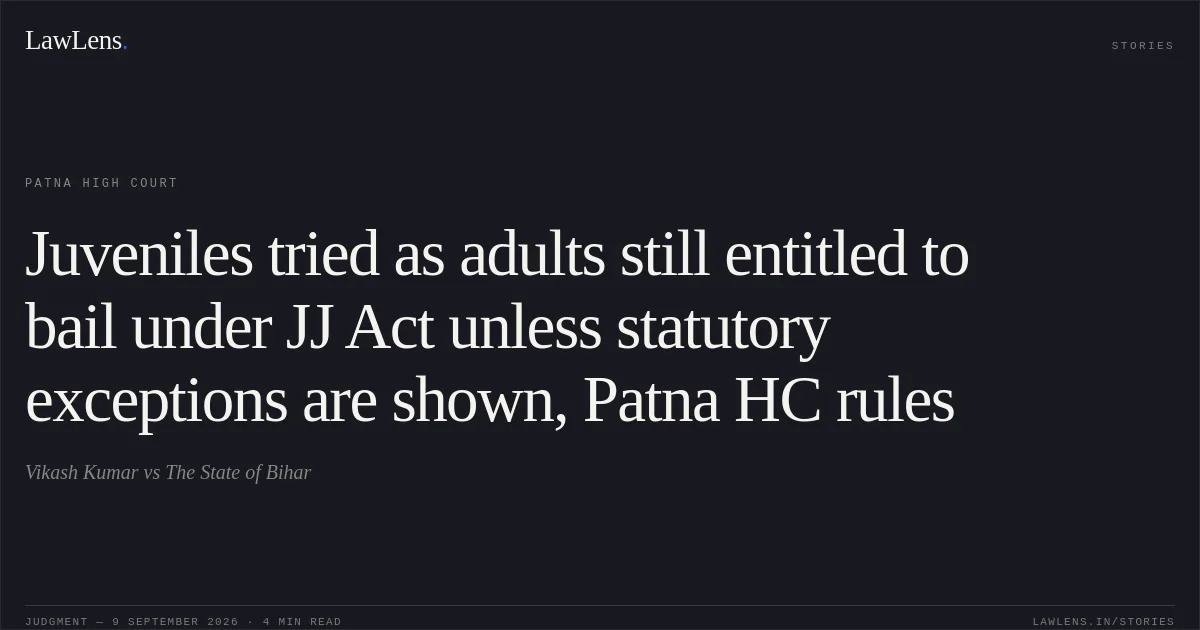
The juvenile-appellant challenged the order dated 2 January 2026 by which the Children Court rejected his application for regular bail under Section 12 of the Juvenile Justice (Care and Protection of Children) Act, 2015, in connection with Siwan Muffasil P.S. Case No. 539 of 2025.
Source reference: para. 1The prosecution alleged that the appellant and eight co-accused persons abducted or restrained the deceased outside V2 Mall, and that co-accused Vikas Kumar stabbed him, causing his death.
Source reference: para. 2The informant, father of the deceased, was not an eyewitness and relied on information allegedly received from the deceased’s friends.
Source reference: paras. 2, 4The appellant relied on the post-mortem report, which recorded only one ante-mortem incised injury, the absence of criminal antecedents, the enlargement of the co-accused on bail, and a favourable family background.
Source reference: paras. 5–11, 35Although the appellant was 16 years, 8 months and 1 day old at the time of the alleged occurrence and had been assessed as capable of understanding the consequences of the alleged offence, he was being tried as an adult by the Children Court.
Source reference: para. 33The Children Court rejected bail on the basis of the Social Investigation Report, which referred to the appellant’s aggressive and revengeful attitude, lack of parental supervision, bad company, and the possibility of physical and psychological danger if released.
Source reference: para. 34Issues
1. Whether bail could be denied to the juvenile under Section 12 of the J.J. Act merely because the allegation concerned a serious or heinous offence and the appellant was being tried as an adult.
Source reference: paras. 14, 18–20, 31(1)–31(2)2. Whether the materials in the Social Investigation Report established any of the three statutory grounds under the proviso to Section 12(1)—association with known criminals, exposure to moral, physical or psychological danger, or the release defeating the ends of justice.
Source reference: paras. 31(5)–31(6), 34–393. Whether the appellant’s release on bail was appropriate in light of the J.J. Act’s principles of family responsibility, rehabilitation, best interests of the child, and institutionalisation as a last resort.
Source reference: paras. 23–29, 31(3)–31(7)Law Applied
Section 12(1) of the Juvenile Justice (Care and Protection of Children) Act, 2015 makes release on bail the rule for a child alleged to be in conflict with law, irrespective of whether the offence is bailable or non-bailable, subject only to the three exceptions in its proviso: likely association with a known criminal, exposure to moral, physical or psychological danger, or the release defeating the ends of justice.
Source reference: para. 13The denial of bail must be supported by recorded reasons and relevant material; the gravity or seriousness of the alleged offence is not, by itself, a ground for refusal.
Source reference: paras. 14, 18, 20–22Section 12 applies even where a child aged between 16 and 18 is directed to be tried as an adult under Section 18(3) of the J.J. Act.
Source reference: para. 19The Court relied on Juvenile in Conflict with Law v. State of Rajasthan, 2024 SCC OnLine SC 5297, and Re-Exploitation of Children in Orphanages in the State of T.N. v. Union of India, (2020) 14 SCC 327, which emphasise the mandatory and child-protective character of Section 12.
Source reference: paras. 15–16Sections 3(iv), 3(v), 3(vii), 3(xii) and 3(xiii) embody the principles of the child’s best interests, family responsibility, positive measures, institutionalisation as a last resort, and restoration to the family.
Source reference: paras. 23–29“Ends of justice” under Section 12 must therefore be understood in the context of the child’s protection, development, rehabilitation and welfare, rather than ordinary punitive criminal jurisprudence.
Source reference: paras. 23–27, 31(3)Reasoning
The High Court held that the appellant’s age, the seriousness of the alleged murder, and his trial as an adult could not independently justify denial of bail under Section 12.
Source reference: paras. 18–19, 31(1)–31(2)On examining the Social Investigation Report, the Court found no criminal antecedents of the appellant or his family and no material showing that he had been used by a criminal gang or would associate with known criminals upon release.
Source reference: paras. 35–36The Children Court’s finding of likely physical, mental and psychological danger was unsupported: the report did not establish that release would expose the appellant to such danger, and the alleged apprehension of villagers did not satisfy the statutory test.
Source reference: para. 36Nor had the Children Court explained how release would defeat the ends of justice in the rehabilitative context of the J.J. Act; merely postponing reconsideration of bail until six months after commencement of trial was impermissible and reflected an approach drawn from ordinary criminal courts rather than juvenile justice principles.
Source reference: paras. 37–38Given the appellant’s family circumstances and his father’s willingness to supervise him and facilitate vocational training, the Court concluded that rehabilitation and development would be better served at home than through continued institutionalisation.
Source reference: paras. 35, 39Holding
The appeal was allowed and the Children Court’s order dated 2 January 2026 was set aside.
The High Court held that none of the grounds under the proviso to Section 12(1) of the J.J. Act was established and directed the appellant’s release on bail.
Source reference: para. 39Release was made subject to furnishing a bail bond of ₹10,000 and an affidavit-undertaking by the appellant’s father to supervise the appellant, prevent his contact with criminal persons, attend to his developmental needs, ensure his appearance before the Court when required, and ensure that he undertakes vocational training.
Source reference: para. 40Original Court PDF
Vikash KumarvsThe State of Bihar
Click to open original judgment
Original judgment, available to read, download and summarize on LawLens.in