Facts
Bhuri and her infant daughter Guddi were found dead on a railway track on 13 September 2004. The appellant, Mahavir @ Avnish, along with his relatives, was prosecuted under Sections 302, 304B and 201 read with Section 34 of the IPC, on allegations relating to dowry harassment, murder and destruction of evidence
Source reference: p.2, para. 3The prosecution witnesses did not support the allegations of dowry demand or murder. The Trial Court acquitted the accused of the charges under Sections 302 and 304B IPC but convicted them under Section 201 Part II IPC and sentenced each to three years’ rigorous imprisonment and fine
Source reference: p.3, para. 3; p.4, para. 4The High Court affirmed the conviction on 17 March 2017. The appellant’s Special Leave Petition was dismissed as withdrawn on 11 May 2018
Source reference: p.4, para. 4Thereafter, he invoked the High Court’s jurisdiction under Sections 482 and 362 CrPC, claiming that he was below eighteen years of age on the date of the offence. Pursuant to the High Court’s direction, the Juvenile Justice Board conducted an inquiry and, relying on school records, birth records and witness testimony, determined that his date of birth was 1 July 1987 and that he was aged seventeen years, two months and twelve days on 13 September 2004
Source reference: p.6–7, para. 7; p.28–30, para. 23The High Court nevertheless dismissed his petition, holding that the conviction had attained finality and could not be reopened under Section 482 CrPC
Source reference: p.31–33, para. 24Issues
Whether the High Court could exercise its inherent jurisdiction under Section 482 CrPC to recall or correct its earlier judgment where the appellant’s statutory claim of juvenility had not previously been considered and denial of that claim caused grave prejudice?
Source reference: p.34–40, paras. 25–33Whether the plea of juvenility could be raised after the conclusion of the criminal proceedings, notwithstanding the dismissal as withdrawn of the appellant’s Special Leave Petition?
Source reference: p.25–27, paras. 20–21Whether the appellant could legally be convicted under Section 201 Part II IPC after his acquittal on the charges under Sections 302 and 304B IPC, in the absence of a finding that an underlying offence had been committed?
Source reference: p.39–40, paras. 32–34Law Applied
Section 7A of the Juvenile Justice (Care and Protection of Children) Act, 2000 (“JJA 2000”) mandates an inquiry whenever juvenility is claimed and permits such a claim to be raised at any stage, even after final disposal of the case; the relevant date for determining juvenility is the date of commission of the offence
Source reference: p.25–27, paras. 20–21Sections 3, 16, 20 and 25 of the JJA 2000, and the corresponding protective provisions of the Juvenile Justice Act, 2015, require a beneficial and purposive interpretation in favour of children and prohibit adult imprisonment of juveniles
Source reference: p.15–22, paras. 15–18Under Section 362 CrPC, a criminal court ordinarily cannot alter or review a signed judgment, but this bar does not prevent the High Court from exercising its inherent power to recall an order suffering from lack of jurisdiction, violation of natural justice, fraud or a fundamental mistake causing miscarriage of justice
Source reference: p.34–38, paras. 27–30The Court relied, inter alia, on Gopinath Ghosh v. State of West Bengal, Pratap Singh v. State of Jharkhand, Hari Ram v. State of Rajasthan, Dharambir v. State (NCT of Delhi), Abdul Razzaq v. State of U.P., Karan alias Fatiya v. State of Madhya Pradesh and A.R. Antulay v. R.S. Nayak for these principles
Source reference: p.23–28, paras. 19–22, 31Section 201 IPC requires proof that an offence was committed and that the accused, knowing or having reason to believe that such offence had been committed, caused evidence of it to disappear with the intention of screening the offender from legal punishment
Source reference: p.39–40, para. 32Reasoning
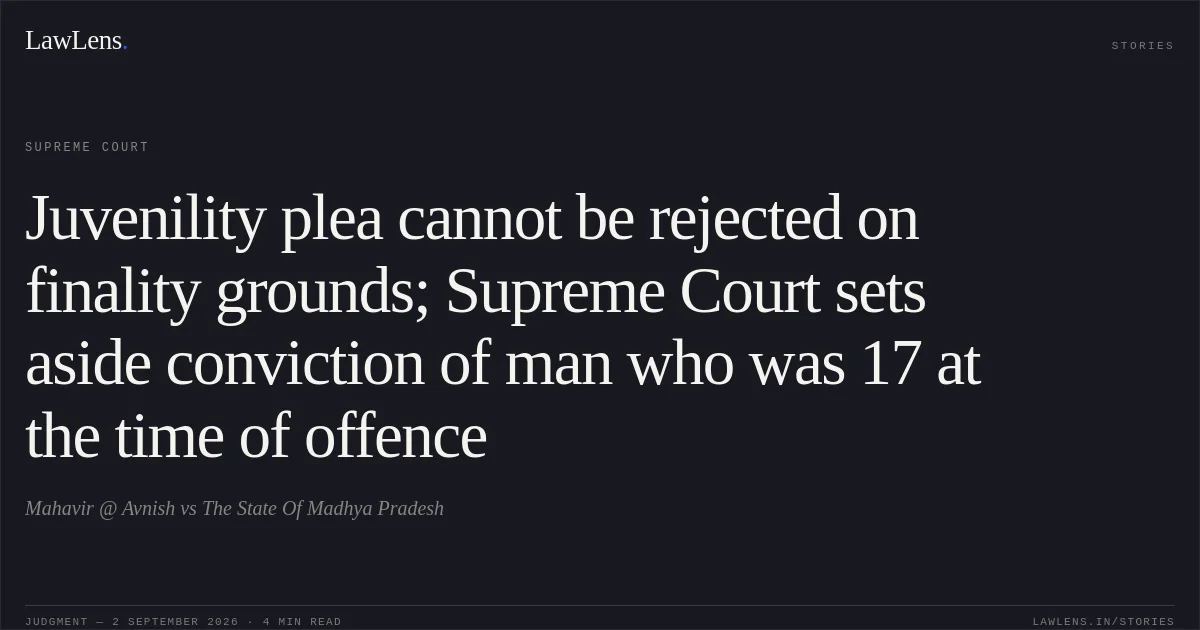
The Supreme Court held that the High Court had acted with excessive technicality. The JJ Board’s finding, based on contemporaneous school and birth records and not challenged by the State, conclusively established that the appellant was a juvenile on the date of the offence
Source reference: p.28–31, paras. 23–24Since juvenility is a jurisdictional fact affecting the competence of the regular criminal court to try and sentence the accused as an adult, the appellant’s failure to raise the plea earlier could not defeat the statutory protection under Section 7A of the JJA 2000
Source reference: p.24–27, paras. 19–21The dismissal of the SLP as withdrawn did not amount to a merits-based adjudication of the conviction; moreover, the Supreme Court noted that the appellant had stated that he withdrew the SLP to pursue the juvenility claim before the High Court
Source reference: p.33–35, paras. 25–26The High Court therefore retained inherent jurisdiction to correct its earlier order because the failure to consider juvenility resulted in denial of a statutory benefit and grave prejudice
Source reference: p.37–40, paras. 29–33Independently, the conviction under Section 201 Part II IPC was legally unsustainable: after acquittal under Sections 302 and 304B IPC, there was no finding establishing the commission of the underlying offence whose evidence was allegedly destroyed
Source reference: p.39–40, para. 32Holding
The Supreme Court allowed the appeal. It held that the appellant’s juvenility claim was maintainable despite its belated assertion and the withdrawal of his SLP, and that the High Court had jurisdiction under Section 482 CrPC to correct the resulting miscarriage of justice
It further held that the conviction under Section 201 Part II IPC could not be sustained in the absence of proof of the underlying offence.
Source reference: p.39–40, para. 33Accordingly, the appellant’s conviction and sentence dated 21 December 2005 were set aside, and he was discharged from the liability of his bail bonds
Source reference: p.40, paras. 34–35Acts & Sections Cited
23 provisions across 4 statutes referred to in this judgment. Each provision opens on LawLens.
Code of Criminal Procedure, 19733
Indian Penal Code, 18606
Juvenile Justice (Care and Protection of Children) Act, 2015.
West Bengal Children Act, 19591
Original Court PDF
Mahavir @ AvnishvsThe State Of Madhya Pradesh
Click to open original judgment
Original judgment, available to read, download and summarize on LawLens.in