01Facts
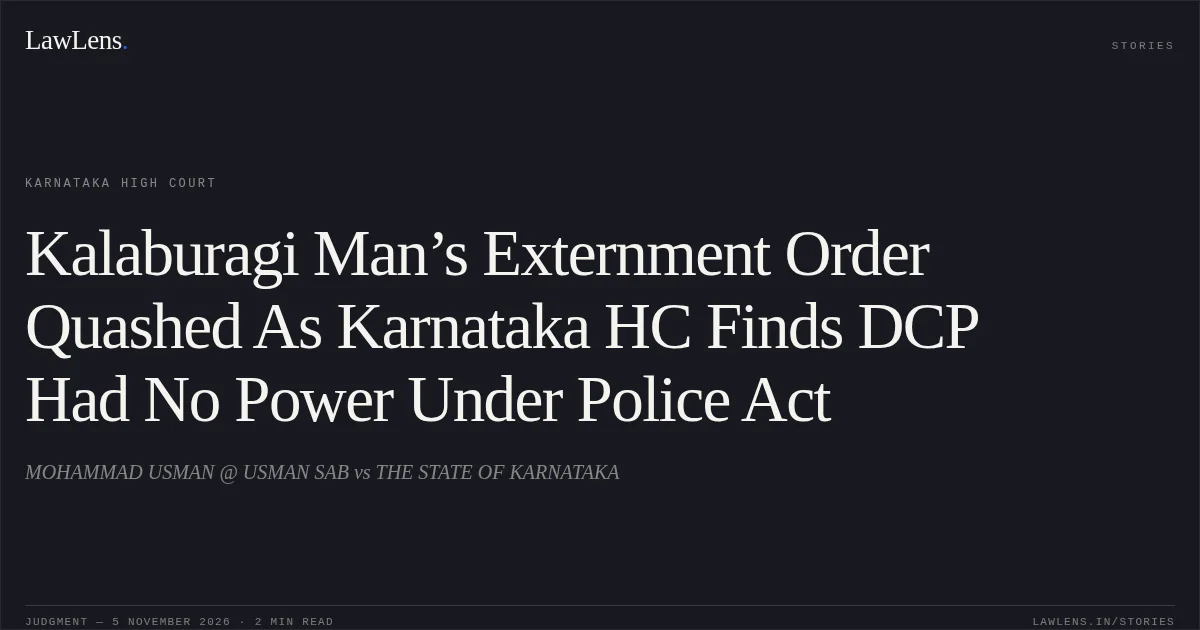
The petitioner, represented by his mother, challenged an externment order dated 16 May 2026 made by the Deputy Commissioner of Police (Law and Order) and Special Executive Magistrate, Kalaburagi City, under the Karnataka Police Act, 1963.
p. 2 · p. 5He argued that the Deputy Commissioner of Police was not an authority empowered to make such an order under Section 55 of the Act, relying on a coordinate Bench decision.
p. 3The State defended the order, including on the ground that the petitioner was a habitual offender.
p. 4The Court considered the statutory provisions and the coordinate Bench decision, and determined the petition on the authority’s competence.
p. 5 · pp. 7–802Issues
i.1. Whether the Deputy Commissioner of Police was competent under Section 55 of the Karnataka Police Act, 1963, to pass the petitioner’s externment order.
pp. 3, 7–803Law Applied
Section 55 of the Karnataka Police Act, 1963, identifies the authorities competent to exercise the externment power: the Commissioner of Police in the specified commissionerate areas, and, in other areas, the District Magistrate or Sub-Divisional Magistrate having jurisdiction and specially empowered by the Government through notification.
pp. 6–7As explained in Chandrakant Shankar Vaddar v. State of Karnataka and Others, an executive notification cannot substitute an authority not included in Section 55’s statutory categories.
pp. 6–7The Court also noted that it had considered Sections 7–11, Section 2(10), Sections 55–56 of the Act, and Sections 14–17 of the Bharatiya Nagarik Suraksha Sanhita, 2023.
p. 5Provisions in the judgment · 12 · Linked ones open on LawLens
KARNATAKA POLICE ACT, 1963. Section 55Section 56Section 7Section 8Section 9Section 10Section 11Section 2
Bharatiya Nagarik Suraksha Sanhita, 2023 Section 14Section 15Section 16Section 17
04Reasoning
The impugned order was made by the Deputy Commissioner of Police, not by an authority identified as competent under Section 55.
p. 5Applying the statutory interpretation in Chandrakant Shankar Vaddar, the Court held that the statutory categories could not be extended to include an officer who was not one of the authorities specified by the legislature.
pp. 6–7The Deputy Commissioner of Police therefore lacked jurisdiction to make the externment order, making it unnecessary to determine the State’s submission about the petitioner’s alleged habitual offending.
pp. 4, 7–805Holding
The Court held that the Deputy Commissioner of Police lacked jurisdiction to pass the externment order under Section 55 of the Karnataka Police Act, 1963.
p. 7It allowed the writ petition and set aside the order dated 16 May 2026; there was no order as to costs.
p. 8Original Court PDF
MOHAMMAD USMAN @ USMAN SABvsTHE STATE OF KARNATAKA
Click to open original judgment
Original judgment, available to read, download and summarize on LawLens.in