01Facts
The prosecution alleged that, in February 2013, the appellant entered the complainant’s home and sexually assaulted her on multiple occasions, threatened to kill her if she disclosed the incidents, and that she later became pregnant.
¶ 3The trial court convicted him under Sections 376(1) and 506 of the IPC and Section 6 of the POCSO Act, imposing concurrent sentences of 12 years’ rigorous imprisonment under Sections 376(1) IPC and 6 POCSO, and seven years’ imprisonment under Section 506 IPC.
¶ 6On appeal, the appellant did not challenge the IPC convictions but disputed the POCSO conviction for want of legally sufficient proof that the complainant was under 18.
¶ 7He also sought reduction of sentence, relying on the period already served.
¶ 17The trial court’s age finding relied on a date-of-birth certificate issued by the complainant’s college vice-principal; the prosecution did not produce the underlying school admission records or other specified age documents.
¶ 1102Issues
i.Whether the prosecution proved beyond reasonable doubt that the complainant was a “child” under Section 2(d) of the POCSO Act on the date of the alleged offence.
¶ 9(1)ii.Whether the prosecution proved the offence under Section 6 of the POCSO Act.
¶ 9(2)iii.Whether the trial court’s convictions under Sections 376(1) and 506 IPC should be disturbed.
¶ 9(3)iv.Whether the appellant had made out grounds for modification of sentence.
¶ 9(4)03Law Applied
Section 2(d) of the POCSO Act defines a child as a person below 18 years; proof that the complainant was a child was therefore necessary to sustain the POCSO conviction.
¶ 9(1), 13–14The Court applied Section 94 of the Juvenile Justice (Care and Protection of Children) Act, 2015, concerning the prescribed means of determining age, and relied on P. Yuvaprakash v. State, (2024) 17 SCC 684, regarding the need for legally acceptable age evidence and the relevance of medical examination where the prescribed documentary evidence is unavailable.
¶ 12–13The Court also considered Section 376(1) IPC, which prescribes a minimum seven-year term of rigorous imprisonment, and Section 428 CrPC, which provides for set-off of detention already undergone.
¶ 16–17 · order · p. 17Provisions in the judgment · 8 · Linked ones open on LawLens
Code of Criminal Procedure, 1973 Section 374Section 313Section 428
Indian Penal Code, 1860 Section 376Section 506
Protection of Children from Sexual Offences Act, 2012 Section 6Section 2
Juvenile Justice (Care and Protection of Children) Act, 2015. Section 94
04Reasoning
The college certificate stated the complainant’s date of birth, but the prosecution did not establish the basis on which it was issued or produce the underlying admission-register extract, birth certificate, or SSLC marks card.
¶ 11The Court accordingly held that the evidence did not establish the complainant’s age as required to prove that she was a “child” under the POCSO Act; without that proof, the Section 6 conviction could not stand.
¶ 11–14The appellant’s challenge to the IPC convictions was not pressed, and the Court’s own review disclosed no legal or factual error in those convictions.
¶ 15In sentencing, the Court considered the period already served, the circumstances advanced by the appellant, and the nature of the offence, and reduced the Section 376(1) sentence to the period already undergone.
¶ 16–1705Holding
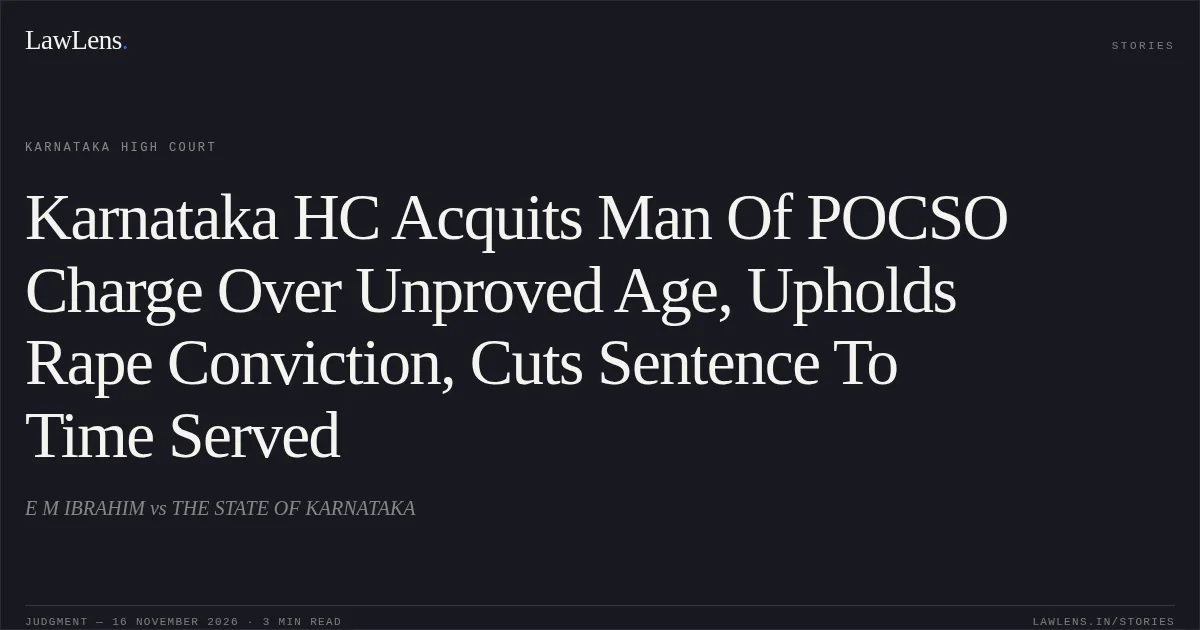
The appeal was partly allowed.
order · pp. 15–16The conviction under Section 6 of the POCSO Act was set aside and the appellant acquitted of that offence; the convictions under Sections 376(1) and 506 IPC were confirmed.
order · pp. 15–16The Section 376(1) sentence was modified to seven years, four months and 22 days’ rigorous imprisonment—the period already undergone—and the seven-year sentence under Section 506 IPC was retained, with both sentences to run concurrently.
order · pp. 16–17The deposited fine was ordered forfeited to the Government, and set-off under Section 428 CrPC was directed.
order · pp. 16–17Original Court PDF
E M IBRAHIMvsTHE STATE OF KARNATAKA
Click to open original judgment
Original judgment, available to read, download and summarize on LawLens.in