Facts
The consolidated proceedings concerned recruitments to various State posts, including Assistant Engineer, Special Reserve Sub-Inspector, Graduate Primary Teacher and Assistant Professor.
Source reference: para. 3–23Article 371J and the 2013 Orders and Rules provided for Local Cadres in the Hyderabad-Karnataka (now Kalyana-Karnataka) Region and a Residual Parent Cadre.
Source reference: para. 3–23The Government’s Circular dated 6 June 2020 prescribed a procedure under which eligible regional candidates could exercise a cadre option; the Circular dated 15 June 2022 protected certain recruitments already in progress under that procedure.
Source reference: para. 3–23By Circular dated 1 February 2023, the Government changed the order of consideration for pending recruitments: regional candidates were to be considered first for Residual Parent Cadre vacancies and then, if unsuccessful, for Local Cadre vacancies, regardless of their earlier options.
Source reference: para. 3–23Candidates challenged the circular and resulting selection lists before the Karnataka State Administrative Tribunal. The Tribunal reached differing conclusions in the applications; the parties then brought these connected writ proceedings and an appeal.
Source reference: para. 3–23Issues
Whether the Circular dated 1 February 2023 materially altered the procedure for considering and allocating candidates between Local Cadre and Residual Parent Cadre vacancies in recruitments already underway
Source reference: para. 52Whether that alteration was authorised by, and consistent with, Article 371J, the applicable Orders and Rules, and the recruitment notifications
Source reference: para. 52–59Whether applying the revised procedure to ongoing recruitments was inconsistent with the principles of fairness and non-arbitrariness under Articles 14 and 16
Source reference: para. 75–80Law Applied
Article 371J authorises special measures to provide equitable opportunities in public employment to persons belonging to the Kalyana-Karnataka Region; the 2013 Presidential and Governor’s Orders and the Rules made under them establish the framework for Local Cadres, cadre allocation and reservation.
Source reference: para. 53, 55–56Executive instructions may supplement statutory rules where they are silent, but may not supersede or contradict them (Sant Ram Sharma v. State of Rajasthan and Union of India v. Ashok Kumar Aggarwal).
Source reference: para. 58, 62Under Tej Prakash Pathak v. Rajasthan High Court, recruitment begins with the advertisement and ends when the notified vacancies are filled; the rules governing eligibility and the method and manner of selection ordinarily cannot be changed midway unless the governing rules or a consistent advertisement permit it, and any permitted change must satisfy Article 14.
Source reference: para. 60A candidate has no indefeasible right to appointment merely by being included in a select list, but that principle does not permit departure from the lawful procedure governing recruitment.
Source reference: para. 72–73Reasoning
The Court held that the question was not confined to whether eligibility criteria or examination marks had changed. The cadre options and the order in which candidates were considered affected the vacancies against which they competed and their relative prospects of selection.
Source reference: para. 65–68, 70–71The 2020 procedure had governed the relevant recruitments, and the 2022 circular expressly protected specified ongoing processes; the 2023 circular displaced that procedure by requiring Residual Parent Cadre lists to be prepared first, irrespective of candidates’ prior options. The change therefore affected the operative basis of cadre allocation, rather than merely regulating an administrative step.
Source reference: para. 65–68, 70–71Because the State identified no authority in the governing Orders, Rules or notifications to impose that change during pending recruitments, the assertion that the revised process preserved merit did not cure the legal defect. Applying the new procedure also displaced candidates under selection lists prepared on the prior framework, without a demonstrated lawful basis, and failed the requirements of fairness and non-arbitrariness.
Source reference: para. 74, 76–80Holding
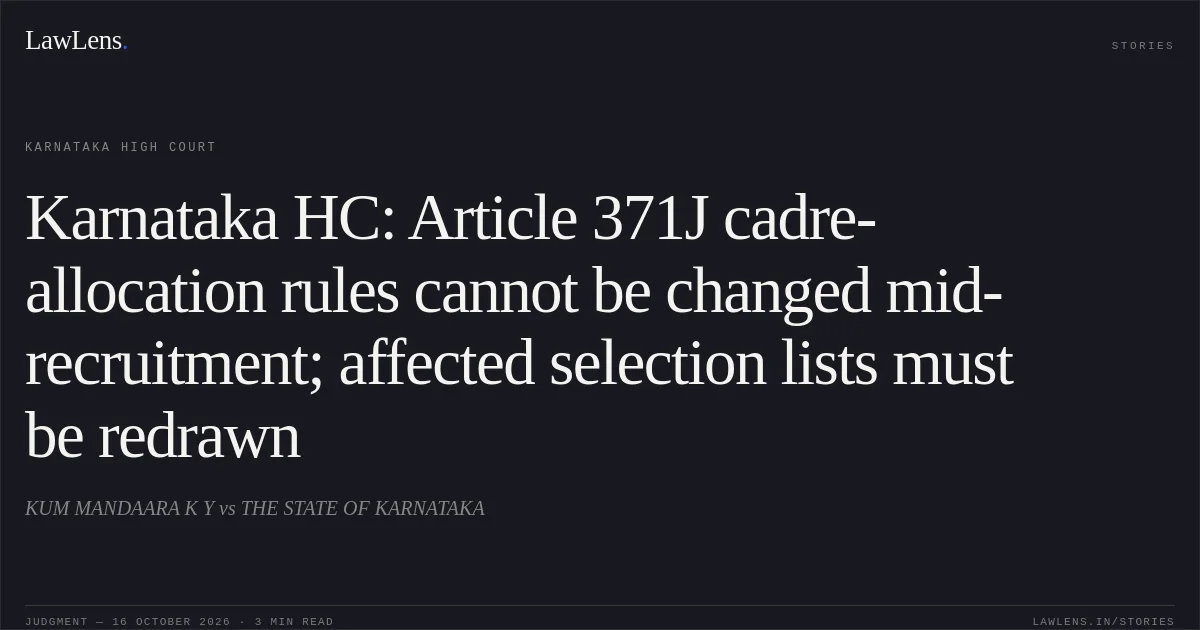
The Court held that the Circular dated 1 February 2023 materially altered the cadre-allocation procedure and could not lawfully be applied to the recruitments in question while they were underway.
It allowed W.P. Nos. 1464/2024, 52772/2019, 23162/2023, 23450/2023, 27336/2023, 27517/2023, 28614/2023, 29056/2023, 1633/2024, 1900/2024, 2034/2024, 7927/2024, 9473/2024, 24251/2024, 24410/2024 and W.A. No. 1218/2023, and dismissed W.P. Nos. 16343/2024 and 863/2024.
Source reference: para. 82–84It set aside the Tribunal’s orders in O.A. Nos. 956/2023, 2688–2689/2023 and 10432/2023, while leaving undisturbed the Tribunal orders setting aside the circular in the other proceedings.
Source reference: para. 82–84The recruiting authorities were directed to reconsider affected selection lists under the procedure applicable when each recruitment commenced, giving effect to the relevant cadre vacancies, roster, merit and validly exercised cadre options. Eligibility and examination marks were not to be reopened.
Source reference: para. 82–84Acts & Sections Cited
1 provisions across 1 statute referred to in this judgment. Each provision opens on LawLens.
KARNATAKA HIGH COURT ACT, 19611
Original Court PDF
KUM MANDAARA K YvsTHE STATE OF KARNATAKA
Click to open original judgment
Original judgment, available to read, download and summarize on LawLens.in