01Facts
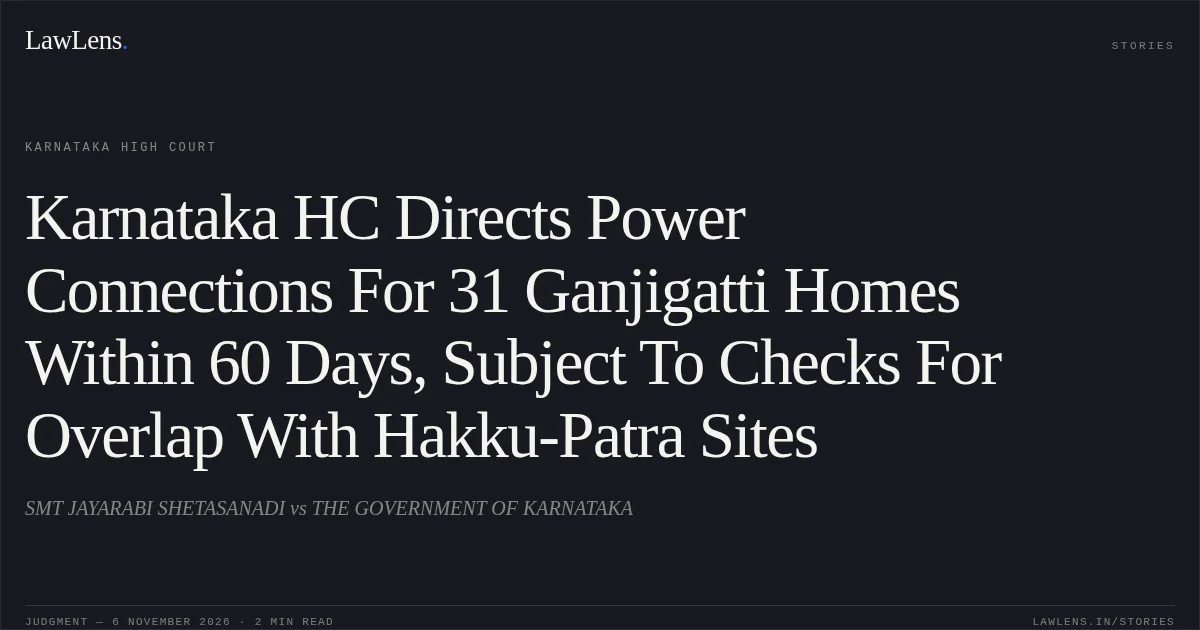
The petitioners in W.P. No. 106631 of 2026 occupied dwelling structures on part of Government land in Sy. No. 71, Ganjigatti, and sought electricity connections.
¶ 2–6They relied, among other things, on a Gram Panchayat communication expressing no objection to supply.
¶ 2–6In the connected petition, the petitioners claimed that sites in the same survey number had been allotted to them under the Ashraya Yojana in 1991–1997 and that Hakkupatras had been issued, but they had not received physical possession or basic amenities.
¶ 8–10The parties disputed whether the occupied land and the sites claimed under the Hakkupatras overlapped; the Court considered that this required identification by the competent authorities.
¶ 17–2002Issues
i.1. Whether the occupants in W.P. No. 106631 of 2026 should receive electricity connections to their dwelling units despite the dispute concerning the location of sites claimed under Hakkupatras in the connected petition.
¶ 17–23ii.2. Whether the authorities should consider the connected petitioners’ representation concerning their Hakkupatras and the delivery of the allotted sites.
¶ 24–26iii.3. Whether the Court should determine the validity or effect of the notification proposing to declare the area a revenue village.
¶ 2703Law Applied
The petitions invoked the High Court’s jurisdiction under Articles 226 and 227 of the Constitution.
The connected petition also referred to a notification issued under Section 5 of the Karnataka Land Revenue Act.
¶ 8The Court stated no specific statutory test or precedent; its directions turned on the need for the authorities to identify the respective areas of occupation and the sites claimed under the Hakkupatras before resolving the related claims.
¶ 17, 20, 23, 25–27Provisions in the judgment · 1
Karnataka Land Revenue Act, 1964 Section 5
04Reasoning
The Court noted that the electricity authority had no objection in principle to providing connections, while the competing claims concerned whether the occupants’ land overlapped with sites covered by the Hakkupatras.
¶ 7, 17–19Because the occupants were in possession but lacked Hakkupatras, and the Hakkupatra holders had not received possession, the Court left identification and demarcation to the competent authorities rather than deciding the parties’ land claims itself.
¶ 18–20It therefore permitted electricity connections subject to the specified identification process and directed the authorities to consider the Hakkupatra holders’ representation.
¶ 21–26The Court did not determine the notification’s validity or the proposed revenue-village declaration.
¶ 21–2705Holding
W.P. No. 106631 of 2026 was allowed, and the electricity authority was directed to provide connections to the petitioners’ dwelling units within 60 days, subject to the identification condition stated in the order.
¶ 21–23W.P. No. 108751 of 2025 was partly allowed: the specified authorities were directed to consider the petitioners’ representation in light of the Hakkupatras and communicate the action taken within six months of receiving a certified copy of the order.
¶ 24–26The Court made no order on the proposed revenue-village declaration, which remains subject to determination of the petitioners’ claims.
¶ 27Original Court PDF
SMT JAYARABI SHETASANADIvsTHE GOVERNMENT OF KARNATAKA
Click to open original judgment
Original judgment, available to read, download and summarize on LawLens.in