01Facts
The petitioners’ lands were included in a preliminary acquisition notification dated 27 June 2022 under Section 11(1) of the Right to Fair Compensation and Transparency in Land Acquisition, Rehabilitation and Resettlement Act, 2013, for the Back Waters Upper Krishna Project.
p. 7They sought a consent award under the Government Order dated 9 October 2025, additional compensation or damages from the date possession was taken, or acquisition proceedings in accordance with law.
pp. 6–7The petitioners said they had submitted representations accepting the consent-award amount, but the respondents had not acted on them.
p. 8The State contended that no final notification had issued within the period under Section 19(1), so the preliminary notification had lapsed and a consent award could not be made without a final notification.
pp. 8–9The petitioners relied on an affidavit filed by the Principal Secretary in related contempt proceedings concerning issuance of a final notification and subsequent consent awards; the State said that affidavit related to different notifications.
pp. 9–1002Issues
i.1. Whether the State should be directed to act on the petitioners’ representations and extend the benefit of the Government Order dated 9 October 2025, notwithstanding the State’s contention that the preliminary notification had lapsed.
pp. 8–10ii.2. Whether the petitioners were entitled to a direction requiring acquisition proceedings or a consent award despite the absence of a final notification.
pp. 9–1103Law Applied
The Court considered Sections 11(1) and 19(1) of the Right to Fair Compensation and Transparency in Land Acquisition, Rehabilitation and Resettlement Act, 2013: Section 11(1) provides for a preliminary notification, while Section 19(1) governs the time for issuance of the final declaration.
pp. 7–9It also considered the Government Order dated 9 October 2025 concerning consent awards and Section 93(2) of the Act as a possible statutory remedy for damages or other relief if the petitioners received an adverse order or endorsement.
pp. 11–12Provisions in the judgment · 3 · Linked ones open on LawLens
Right to Fair Compensation and Transparency in Land Acquisition, Rehabilitation and Resettlement Act, 2013 Section 11Section 19Section 93
04Reasoning
The State acknowledged that no final notification had issued within the period contemplated by Section 19(1), and argued that the preliminary notification had therefore spent itself and that a consent award could not be passed without a final notification.
pp. 8–9The petitioners, in turn, relied on the Government’s affidavit in related contempt proceedings and their representations seeking the benefit of the Government Order.
pp. 9–10The Court framed the relief as requiring the Government to act on those representations and extend the Government Order’s benefit, if available in law and not already granted, rather than directly ordering a final notification or a particular award.
p. 11It left the respondents to act in accordance with law and preserved the petitioners’ ability to pursue statutory remedies if their request was rejected.
pp. 11–1205Holding
The writ petition was allowed.
p. 11The Government was directed to act on the petitioners’ representations and extend the benefit of the Government Order dated 9 October 2025, if not already granted, in accordance with law.
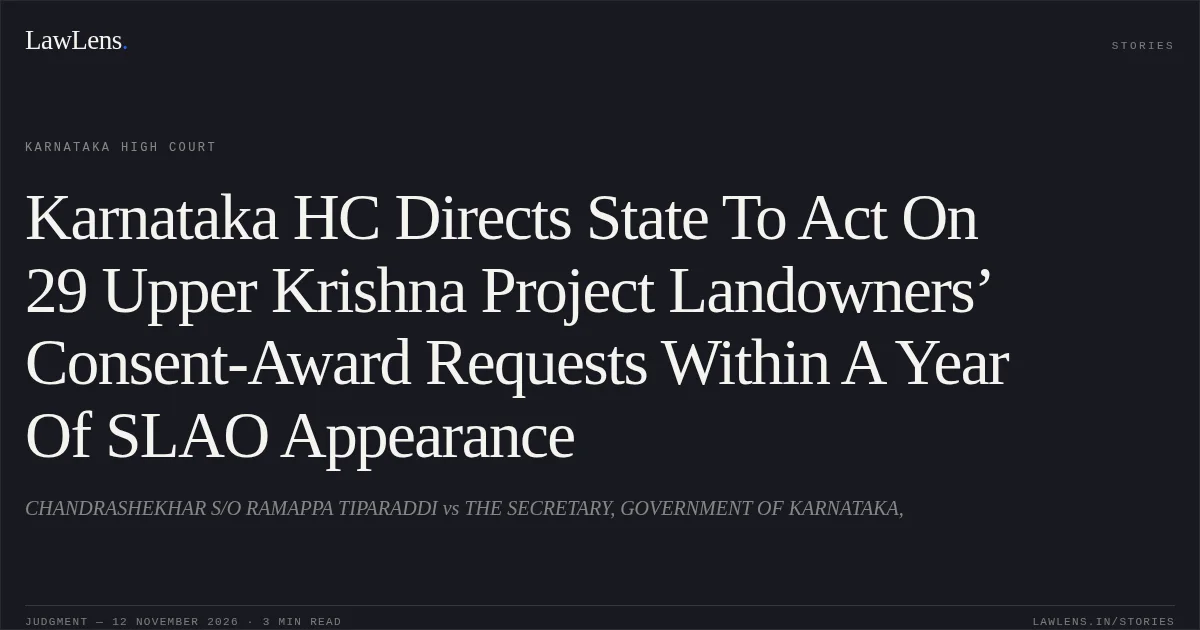
p. 11The petitioners were permitted to appear before the concerned SLAO on 20 November 2026 with relevant documents, and the SLAO was directed to act within one year of their first appearance.
p. 11If unable to comply within that period, the State may seek an extension for valid reasons; if an adverse order or endorsement is issued, the petitioners may pursue remedies available under the Act, including under Section 93(2), if advised.
p. 12Original Court PDF
CHANDRASHEKHAR S/O RAMAPPA TIPARADDIvsTHE SECRETARY, GOVERNMENT OF KARNATAKA,
Click to open original judgment
Original judgment, available to read, download and summarize on LawLens.in