Facts
Respondent No. 2, an Archaka of the temples, was among six temple staff members suspected of involvement in the tampering with and theft of hidden CCTV equipment on 11 January 2026.
Source reference: para. 3.3–3.12Following a police complaint and the registration of Crime No. 0085/2026, the Management Committee resolved on 16 June 2026 to suspend the six staff members pending enquiry and arranged temporary performance of temple duties.
Source reference: para. 3.3–3.12Respondent No. 2 challenged the suspension and temporary arrangement before the Commissioner under Section 63 of the Karnataka Hindu Religious Institutions and Charitable Endowments Act, 1997, and sought interim relief. On 12 August 2026, the Commissioner stayed the suspension and consequential arrangement, permitting Respondent No. 2 to resume duties.
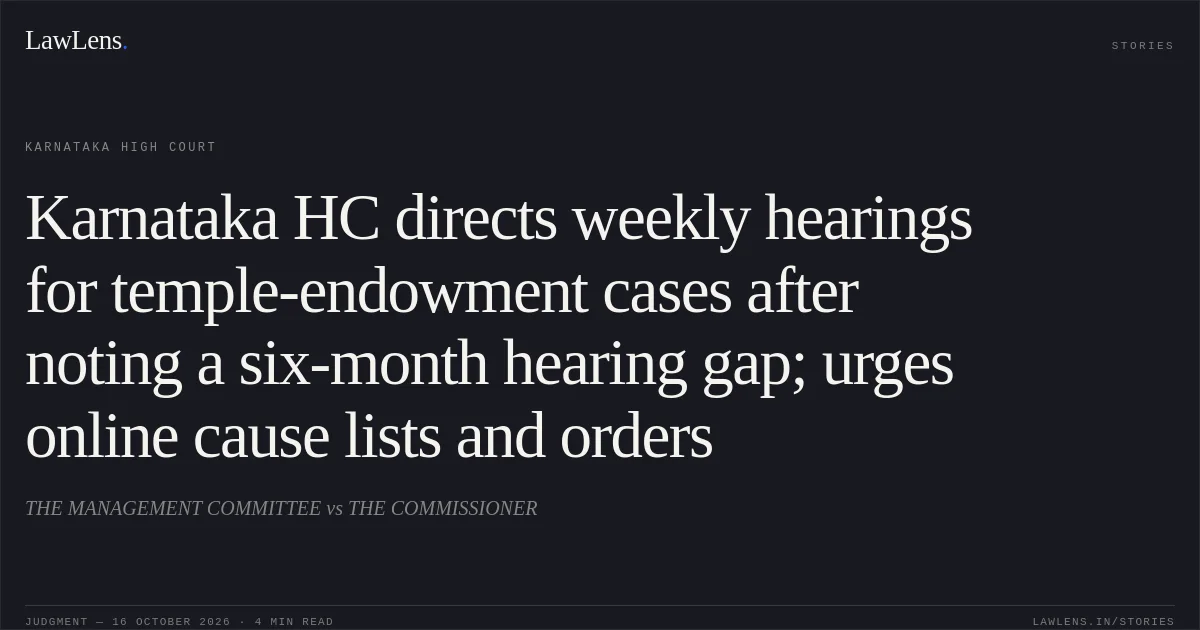
Source reference: para. 2, 3.13The Management Committee challenged that interim order before the High Court.
Source reference: para. 1Issues
1. Whether the writ petition challenging the Commissioner’s interlocutory order was maintainable under Articles 226 and 227 of the Constitution
Source reference: para. 7(i)2. Whether the Commissioner had jurisdiction under Section 63 to entertain a revision against the suspension order, including whether Section 16(2) provided an appeal and barred revision under Section 63(2)
Source reference: para. 7(ii)3. Whether the interim order disclosed a jurisdictional error, patent error of law, or non-application of mind warranting interference
Source reference: para. 7(iii)4. Whether the Commissioner could examine factual material when considering interim relief, and whether doing so amounted to conducting the disciplinary enquiry or prejudging its merits
Source reference: para. 7(iv)5. Whether permitting Respondent No. 2 to resume duties was sustainable while the disciplinary enquiry and criminal investigation remained pending
Source reference: para. 7(v)Law Applied
Section 16(2) of the Karnataka Hindu Religious Institutions and Charitable Endowments Act, 1997 provides an appeal against an order imposing a penalty; suspension pending enquiry under Rule 17(4) of the 2002 Rules is an interim measure, not a penalty, and is permissible where necessary in the institution’s interests.
Source reference: para. 10.14–10.29Section 63(1) authorises the Commissioner to examine orders of the Committee of Management or Executive Officer; the bar in Section 63(2) applies during a period in which an appeal can lie.
Source reference: para. 10.14–10.29Section 65 applies the Code of Civil Procedure to proceedings under the Act, subject to inconsistency.
Source reference: para. 10.14–10.29Rule 17(5) provides for subsistence allowance and ordinarily limits suspension to six months, with the Commissioner’s permission required for extension.
Source reference: para. 9.24–9.29Under Syed Yakoob v. K.S. Radhakrishnan, certiorari may correct jurisdictional error or a patent error of law, but is not an appeal on facts.
Source reference: para. 9.24–9.29Surya Dev Rai v. Ram Chander Rai requires sparing supervisory interference, particularly in pending proceedings; and Radhey Shyam v. Chhabi Nath distinguishes Articles 226 and 227 and excludes certiorari against judicial orders of civil courts, not orders of statutory authorities.
Source reference: para. 9.24–9.29Union of India v. Ashok Kumar Aggarwal requires consideration of the seriousness of the allegations and whether continued office may hamper or frustrate the enquiry; suspension should not be arbitrary and must be assessed on the circumstances of the case.
Source reference: para. 13.9–13.17Reasoning
The High Court held that the interlocutory character of the Commissioner’s order did not bar review because it was made by a statutory authority, not a civil court; the Court nevertheless applied the limited standards of certiorari and supervision.
Source reference: para. 9.13–9.23, 9.30–9.31Suspension was not a penalty appealable under Section 16(2), so Section 63(2) did not bar revision; nor did Section 63 prohibit an aggrieved person from bringing an order to the Commissioner’s attention.
Source reference: para. 10.15–10.22, 10.25–10.36The Commissioner could examine relevant factual material for the limited purpose of assessing the suspension and interim relief, but could not determine guilt, which remained for the disciplinary process.
Source reference: para. 12.9–12.16, 12.30–12.33The interim order was not wholly without reasons, but failed to disclose consideration of the Committee’s grounds for suspension, the pending criminal investigation, the risk to the enquiry, the balance of convenience, or possible safeguards. It also restored Respondent No. 2 to duty without explaining why that substantial interim relief was warranted.
Source reference: para. 11.16–11.27, 11.36–11.38Given the serious allegation concerning temple property, the ongoing investigation and enquiry, and the need to protect the institution and the integrity of proceedings, the Court concluded that suspension remained necessary in the institution’s interests at that stage. It made clear that this was not a finding of guilt.
Source reference: para. 13.25–13.34Holding
The writ petition was maintainable, and the Commissioner had jurisdiction under Section 63 to entertain the revision.
However, the interim order of 12 August 2026 was set aside for non-application of mind and failure to address material considerations.
Source reference: para. 14.1(i)–(iv)The suspension order dated 17 June 2026 and the temporary-arrangement memorandum dated 18 June 2026, insofar as they concerned Respondent No. 2, were restored; Respondent No. 2 was to remain suspended pending disposal of the revision, and the memorandum permitting his return to duty was to cease operating.
Source reference: para. 14.1(i)–(iv)The Commissioner was directed to decide the revision by a reasoned order after hearing the parties, without being influenced by observations on the merits of the disciplinary or criminal allegations.
Source reference: para. 14.1(v)–(viii)Respondent No. 2 remained entitled to subsistence allowance and was directed not to interfere with temple administration and to cooperate with any lawful enquiry.
Source reference: para. 14.1(v)–(viii)Acts & Sections Cited
10 provisions across 3 statutes referred to in this judgment. Each provision opens on LawLens.
HINDU RELIGIOUS INSTITUTIONS AND CHARITABLE ENDOWMENTS ACT, 19977
Code of Civil Procedure, 19082
Bharatiya Nyaya Sanhita, 20231
Original Court PDF
THE MANAGEMENT COMMITTEEvsTHE COMMISSIONER
Click to open original judgment
Original judgment, available to read, download and summarize on LawLens.in