Facts
The landlords sought eviction under Section 14(1)(e) of the Delhi Rent Control Act, 1958 (DRC Act).
Source reference: no citationThe tenant challenged the eviction order, contending that a gift deed dated 24 December 2021 in favour of the landlords attracted the five-year bar under Section 14(6) DRC Act.
Source reference: p. 2–4The Additional Rent Controller held that the transactions were inter se family arrangements among persons who had been co-owners and that the petition was not barred.
Source reference: p. 2–4The High Court rejected the tenant’s challenge in its order dated 2 December 2025. The tenant then sought review, again relying on the gift deed and additionally on N.P. Saseendran v. N.P. Ponnamma & Ors.
Source reference: p. 4–5Issues
Whether the tenant established a mistake or error apparent on the face of the record warranting review of the order dated 2 December 2025
Source reference: p. 5–7, 9Whether the gift deed dated 24 December 2021 attracted the bar under Section 14(6) DRC Act, such that the landlords could not maintain the eviction petition
Source reference: p. 3–4, 7–9Law Applied
Section 114 read with Order XLVII CPC permits review only on limited grounds, including an error apparent on the face of the record; it does not allow a rehearing or an appeal in disguise.
Source reference: p. 5–7Sanjay Kumar Agarwal v. State Tax Officer (1), drawing on Parsion Devi v. Sumitri Devi and other authorities, states that an error requiring a process of reasoning is not an error apparent and that previously decided questions cannot be reargued in review.
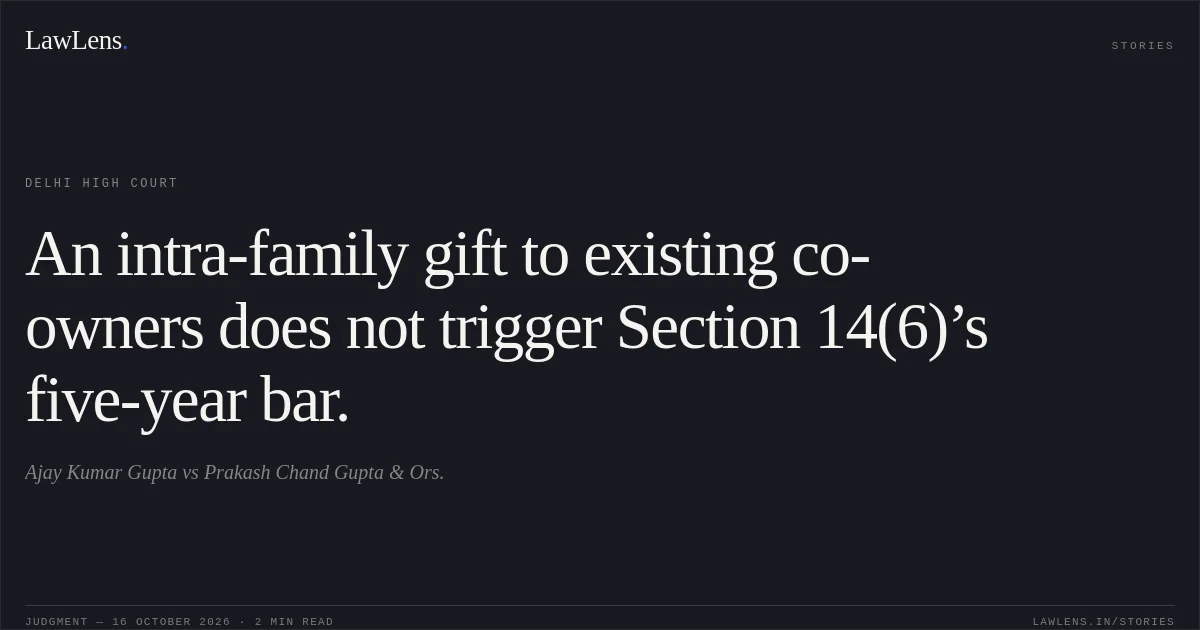
Source reference: p. 5–7Section 14(6) DRC Act bars eviction under Section 14(1)(e) where the landlord acquired the premises by transfer within the prescribed five-year period.
Source reference: p. 3–4Applying the five-judge decision in V.N. Sarin v. Major Ajit Kumar Poplai, the Court treated the provision as directed to an acquisition by transfer of the kind contemplated by the Act, and held that the family transactions in this case did not constitute such an acquisition.
Source reference: p. 3–4, 8–9The Court also held that Section 122 of the Transfer of Property Act, 1882, and N.P. Saseendran did not displace that DRC Act-specific analysis.
Source reference: p. 9Reasoning
The Court found that the tenant’s review grounds repeated the Section 14(6) objection already considered and rejected in the revision proceedings; the tenant had identified no patent error in that determination.
Source reference: p. 7–8The eviction petition itself stated that the landlords had become co-owners through family lineage and that their father later executed the gift deed in their favour.
Source reference: p. 2–3In light of those facts and V.N. Sarin, the Court upheld the conclusion that the inter-family transactions did not amount to an acquisition by transfer attracting Section 14(6).
Source reference: p. 8–9It considered N.P. Saseendran distinguishable because it concerned a title dispute and general property-law provisions, rather than the specific scheme of the DRC Act.
Source reference: p. 9Holding
The Court dismissed the review petition, finding no error apparent on the face of the record.
It also dismissed the revision petition and pending applications, vacated the interim order, and permitted the executing court to proceed with the landlords’ execution petition in accordance with law.
Source reference: p. 9–10Acts & Sections Cited
3 provisions across 3 statutes referred to in this judgment. Each provision opens on LawLens.
Code of Civil Procedure, 19081
delhi rent control act, 19581
Transfer of Property Act, 18821
Original Court PDF
Ajay Kumar GuptavsPrakash Chand Gupta & Ors.
Click to open original judgment
Original judgment, available to read, download and summarize on LawLens.in