Facts
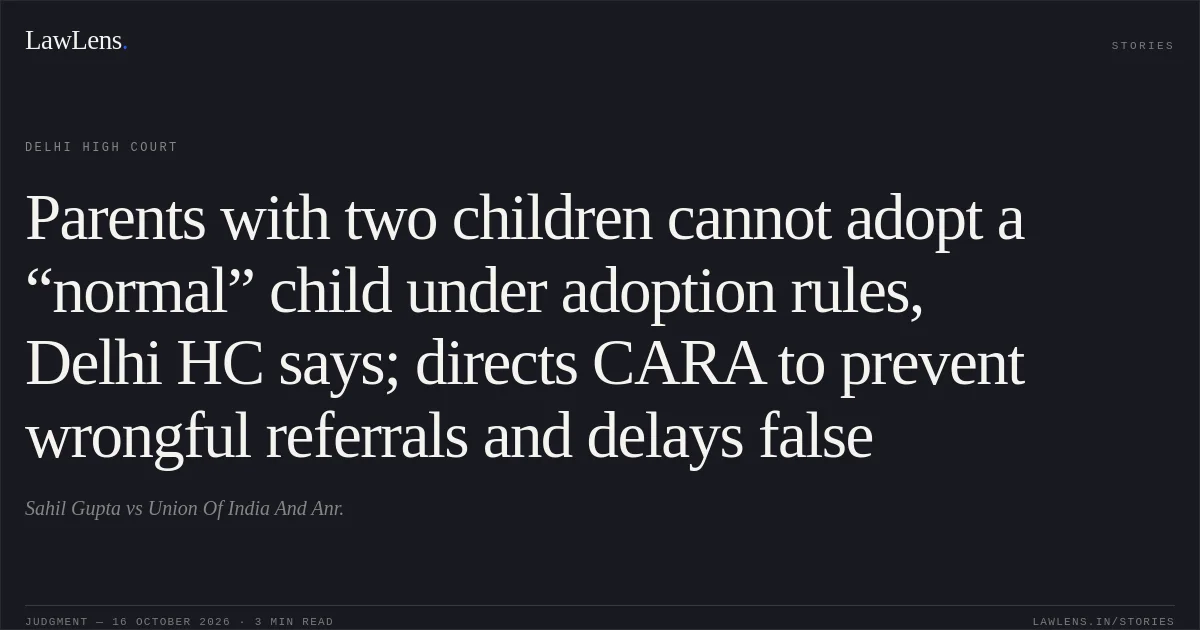
The petitioner and his spouse, residing in Singapore, registered as prospective adoptive parents (PAPs) in 2020.
Source reference: para. 2–14They had two biological children when their Home Study Report (HSR) was revalidated in 2025.
Source reference: para. 2–14In January 2026, CARA referred Baby K, classified as a normal child, to the petitioner, who accepted the referral.
Source reference: para. 2–14While the No Objection Certificate (NOC) was being processed, CARA rejected the application, stating that Regulation 5(7) of the Adoption Regulations, 2022 barred PAPs with two or more children from adopting a normal child.
Source reference: para. 2–14The petitioner sought restoration of the referral and issuance of the NOC.
Source reference: para. 2–14The Court had directed that the child’s status quo be maintained pending the petition.
Source reference: para. 2–14Issues
1. Whether a PAP couple with two biological children was eligible to be considered for Baby K, and whether she qualified as a special-needs or hard-to-place child.
Source reference: para. 30(i)2. Whether the referral and its acceptance, CARA’s conduct, or the delay in processing the NOC created an enforceable or vested right to adopt Baby K.
Source reference: para. 30(ii)3. Whether the child’s best interests warranted granting the petitioner’s requested relief.
Source reference: para. 30(iii)4. Whether directions were required to address CARA’s administrative lapses.
Source reference: para. 30(iv)Law Applied
Sections 57(5) and 59 of the Juvenile Justice (Care and Protection of Children) Act, 2015 (JJ Act) permit adoption regulations to prescribe PAP eligibility criteria and govern inter-country adoption; Sections 61 and 68 respectively address the adoption order and CARA’s regulatory functions.
Source reference: paras. 32–34, 39, 41Regulation 5(7) of the Adoption Regulations, 2022 restricts couples with two or more children to adoption of special-needs or hard-to-place children, subject to specified exceptions; Regulation 2(13) defines a hard-to-place child by reference to failure to place the child within prescribed periods after referral, and Regulation 2(25) defines a special-needs child by reference to disability under the Rights of Persons with Disabilities Act, 2016.
Source reference: paras. 36–37Regulation 16(5) requires scrutiny of PAPs’ HSR and documents, while Regulation 17(1) provides for an NOC within ten days, without requiring approval where the PAP is ineligible.
Source reference: paras. 38, 59The Court applied Debarati Nandee v. Union of India, holding that no right to adopt a particular child accrues before the final adoption order; Union of India v. Ankur Gupta, holding that statutory adoption procedures prevail despite a referral and acceptance; and Sivanandan C.T. v. High Court of Kerala on legitimate expectation, which must be grounded in law or established procedure.
Source reference: paras. 42, 54–56, 62It also applied the principles that there can be no estoppel against statute and that the child’s best interests are paramount under Section 2(9) and Section 3 of the JJ Act and Regulation 3 of the 2022 Regulations.
Source reference: paras. 64, 68–70Reasoning
Because the petitioner had two biological children when his HSR was revalidated and Baby K was referred, Regulation 5(7) applied.
Source reference: paras. 40, 46–52The medical reports classified Baby K as normal, and the Court found no basis to treat her as a special-needs child.
Source reference: paras. 40, 46–52Nor was she hard to place: she had been accepted by the petitioner and later referred to other PAPs, so the prescribed period could not be used to make her eligible for adoption by him.
Source reference: paras. 40, 46–52Although CARA had erred in referring the child and delayed its decision, the referral and acceptance could not override the statutory eligibility rule; the NOC was not automatic, and no mandamus could require CARA to act contrary to the Regulations.
Source reference: paras. 59–65The petitioner’s expectation arose from an unlawful referral and therefore was not legally enforceable.
Source reference: paras. 59–65The family’s interaction with the child did not displace the statutory framework or independently establish that adoption by the petitioner was in the child’s best interests.
Source reference: paras. 66–74The Court nevertheless found that CARA’s eligibility checks, portal status, communications, and NOC processing disclosed administrative failures requiring safeguards.
Source reference: paras. 75–76Holding
The Court held that the petitioner was ineligible to adopt Baby K, who was neither a special-needs nor a hard-to-place child, and that the referral, acceptance, and CARA’s conduct created no enforceable right to the NOC or adoption.
It dismissed the petition, vacated the interim status-quo order, and directed CARA to proceed with the child’s placement in accordance with law.
Source reference: paras. 76–79It also directed CARA to verify eligibility before referrals, audit profiles affected by portal migration, observe NOC timelines, ensure accurate portal statuses and reasoned communications, and take corrective and accountability measures.
Source reference: paras. 76–79Acts & Sections Cited
8 provisions across 1 statute referred to in this judgment. Each provision opens on LawLens.
Juvenile Justice (Care and Protection of Children) Act, 2015.8
Original Court PDF
Sahil GuptavsUnion Of India And Anr.
Click to open original judgment
Original judgment, available to read, download and summarize on LawLens.in