01Facts
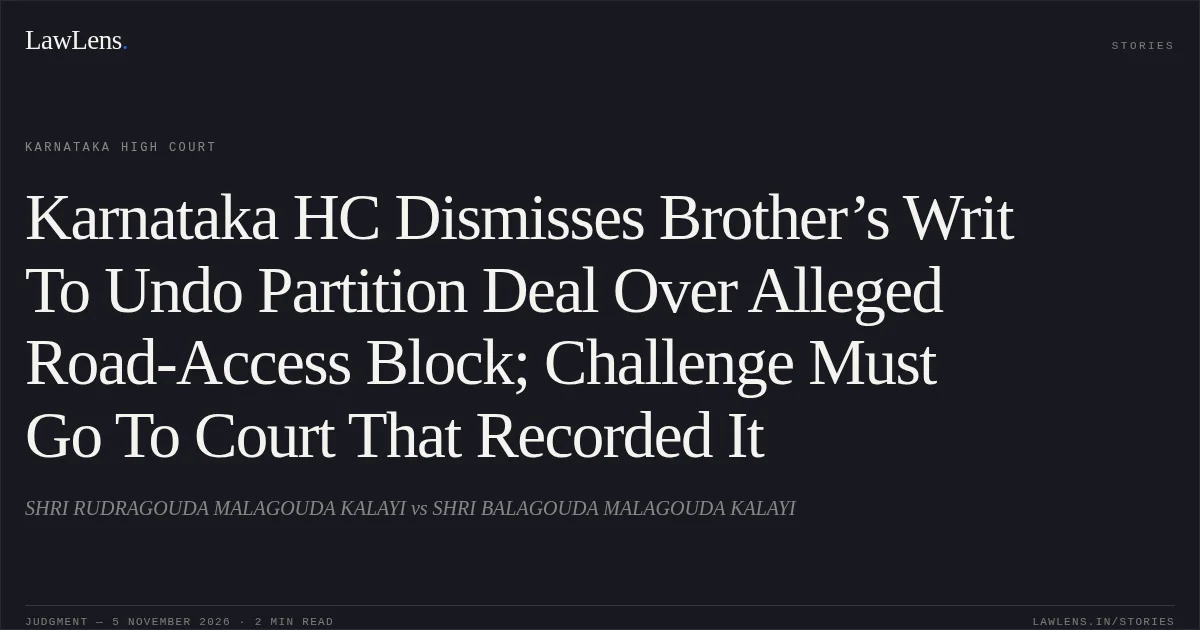
The petitioner filed a partition suit, O.S. No. 121/2018, against the respondents. During the suit, the parties entered into a compromise, which the Senior Civil Judge, Hukkeri, recorded on 6 January 2022.
p. 2 · ¶ 1–4The petitioner later alleged that respondent No. 1 was denying him access to a public road adjoining the portion allotted to respondent No. 1, and sought to have the compromise and decree set aside by writ petition.
p. 2 · ¶ 1–4Respondent No. 1 objected that the writ petition was not maintainable and that the petitioner’s remedy was before the court that recorded the compromise.
p. 3 · ¶ 5–702Issues
i.1. Whether a compromise decree recorded under Order XXIII Rule 3 of the Code of Civil Procedure, 1908, may be challenged by a writ petition under Articles 226 and 227 of the Constitution.
p. 2 · ¶ 1 · p. 3 · ¶ 5–7ii.2. Whether a challenge to the validity of the compromise must be brought before the court that recorded it.
p. 6 · ¶ 10–1103Law Applied
Order XXIII Rule 3 CPC requires the court to determine a dispute over whether a suit was adjusted or compromised by a lawful written agreement signed by the parties; under its Explanation, a compromise is not lawful if it is void or voidable under the Contract Act, 1872.
pp. 4–6 · ¶ 7–8Order XXIII Rule 3-A bars a separate suit to set aside a decree on the ground that the compromise was unlawful. Relying on R. Rajanna v. S.R. Venkateswamy, (2014) 15 SCC 471, the Court stated that the court which recorded the compromise is the court competent to examine and determine its validity.
pp. 4–6 · ¶ 7–804Reasoning
The petitioner’s grievance concerned the effect and validity of the compromise decree recorded in O.S. No. 121/2018. Applying R. Rajanna, the Court held that such a challenge must be raised before the court that recorded the compromise, rather than through a writ petition.
p. 6 · ¶ 9–12The alleged denial of access did not alter the proper forum for challenging the compromise decree.
p. 6 · ¶ 9–1205Holding
The Court held that the writ petition was not maintainable and dismissed it.
p. 7 · ¶ 10–11It left the petitioner at liberty to challenge the compromise before the appropriate forum in accordance with law.
p. 7 · ¶ 10–11Original Court PDF
SHRI RUDRAGOUDA MALAGOUDA KALAYIvsSHRI BALAGOUDA MALAGOUDA KALAYI
Click to open original judgment
Original judgment, available to read, download and summarize on LawLens.in