01Facts
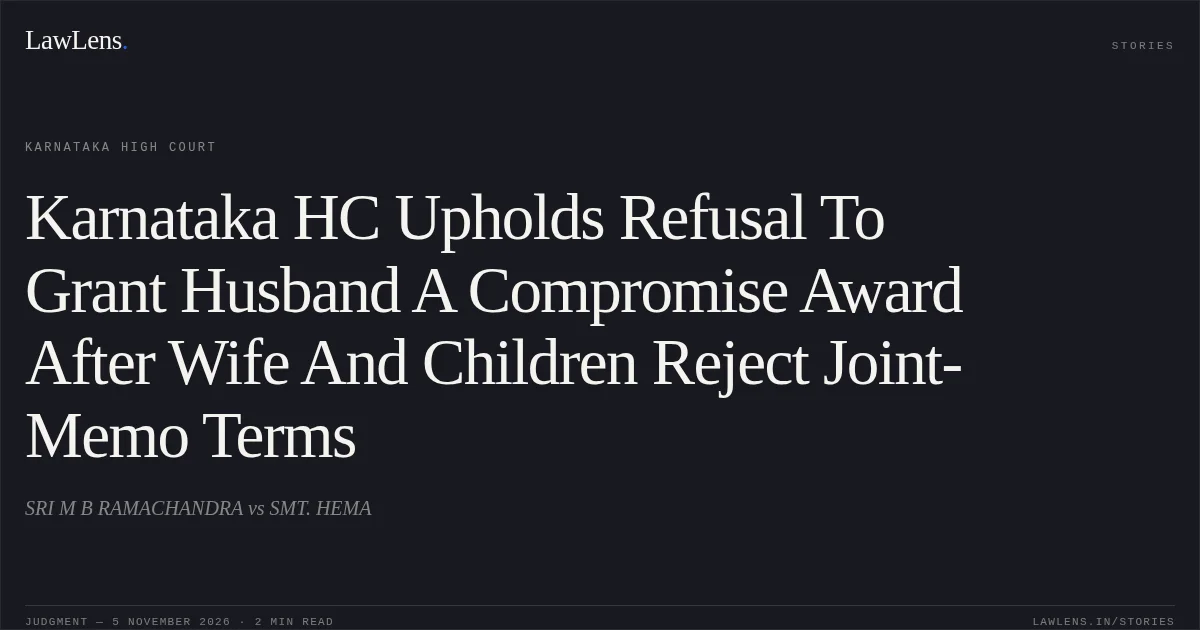
The husband challenged the Family Court’s dismissal of his application in Crl. Misc. No. 209/2020.
pp. 3–5He sought recall of the order dated 18 February 2021 referring the matter to the Lok Adalat and an award based on a joint memo filed that day.
pp. 3–5Alternatively, he sought to set aside the memo, contest the case on its merits, and obtain repayment of ₹20 lakh with interest and return of jewellery.
pp. 3–5He asserted that the money and jewellery had been delivered under the settlement; the wife and children disputed that they accepted the settlement as proposed.
pp. 3–5The Family Court held the application time-barred under the residuary limitation period and also rejected it on the merits, noting that the gift deed contemplated by the settlement had not been registered and the respondents did not accept the settlement.
pp. 3–5The husband brought this petition under Article 227 of the Constitution.
p. 202Issues
i.1. Whether the Family Court’s dismissal of the application seeking recall of the Lok Adalat referral order and an award based on the joint memo warranted interference under Article 227.
pp. 6–7ii.2. Whether the court could record a compromise or pass an award on the joint memo when the respondents no longer accepted its terms and the settlement formalities remained incomplete.
pp. 4–5, 703Law Applied
The application invoked Sections 13, 19(5) and 21 of the Legal Services Authorities Act, 1987, read with Section 7 of the Family Courts Act, 1984.
p. 3The judgment’s operative reasoning was that a compromise award could not be passed on the joint memo when the respondents did not accept the settlement; payment alone did not empower the court to record a compromise.
p. 7The Family Court had also applied the Limitation Act’s residuary article, finding the application filed more than three years after the order of 18 February 2021.
p. 3Provisions in the judgment · 4 · Linked ones open on LawLens
Legal Services Authorities Act, 1987 Section 19Section 13Section 21
Family Courts Act, 1984 Section 7
04Reasoning
The High Court considered that recalling the referral order would not enable the court to record the proposed settlement: the respondents were unwilling to accept its terms, and the gift deed required by the memo remained unregistered.
pp. 4–5, 7Because the parties’ agreement was no longer mutual, the court could not pass a compromise award merely because the husband claimed to have paid the money and delivered the jewellery.
p. 7The court therefore found no basis to interfere with the Family Court’s dismissal under Article 227.
p. 705Holding
It declined to direct the court to record a compromise or pass an award on the joint memo, holding that the respondents’ non-acceptance of its terms and the mere payment of money did not justify that relief.
p. 7The High Court dismissed the writ petition and closed any pending interlocutory applications.
p. 8Original Court PDF
SRI M B RAMACHANDRAvsSMT. HEMA
Click to open original judgment
Original judgment, available to read, download and summarize on LawLens.in