01Facts
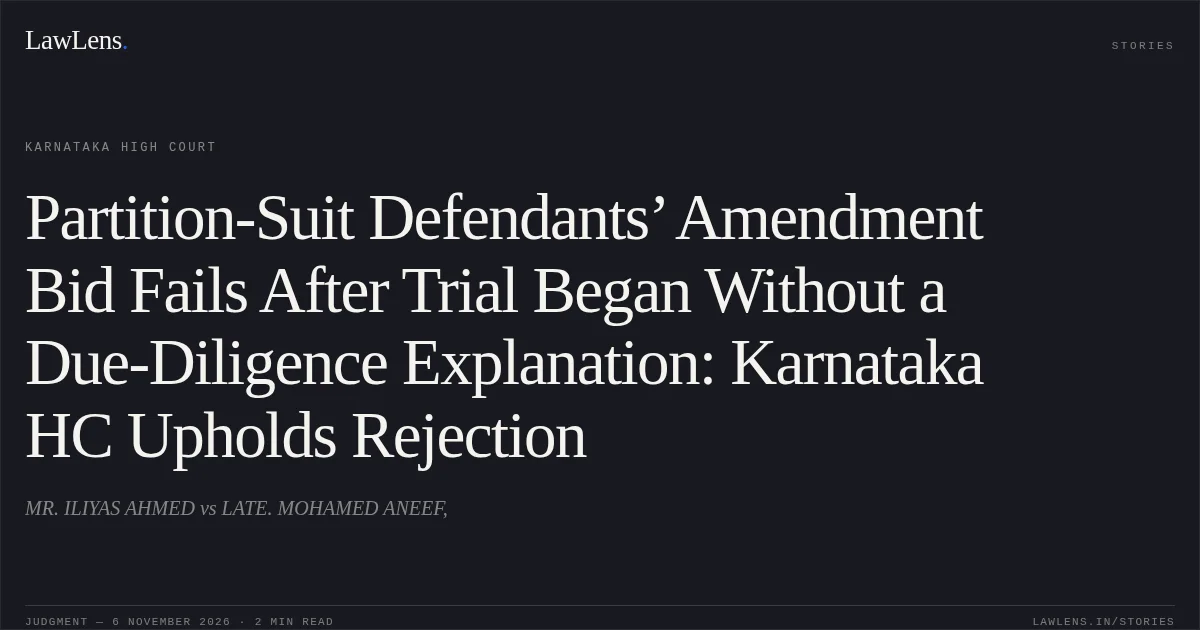
The petitioners challenged the Trial Court’s order dated 2 September 2026 rejecting their application under Order VI Rule 17 CPC to amend their written statement in a partition suit.
¶ 1The written statement had been filed on 28 October 2017, issues had been framed, and the suit had reached the cross-examination of the plaintiffs’ witnesses.
¶ 4The proposed amendment relied on a deed of confirmation dated 15 September 2020, but the supporting affidavit did not explain why the amendment could not have been sought before trial commenced.
¶ 4The petitioners argued that the amendment was necessary because the parties had not complied with the deed’s terms.
¶ 202Issues
i.1. Whether the Trial Court erred in rejecting the petitioners’ application to amend their written statement under Order VI Rule 17 CPC.
¶ 1–2, 9ii.2. Whether the petitioners established, as required by the proviso to Order VI Rule 17 CPC, that despite due diligence they could not have raised the proposed amendment before commencement of trial.
¶ 4–803Law Applied
Order VI Rule 17 CPC permits amendments to pleadings where they are relevant to adjudication, but its proviso bars an amendment after commencement of trial unless the court is satisfied that, despite due diligence, the party could not have raised the matter earlier.
¶ 5–6In Basavaraj v. Indira & Ors., (2024) 3 SCC 705, the Supreme Court affirmed that the party seeking a post-commencement amendment bears the burden of establishing this due-diligence requirement.
¶ 704Reasoning
The amendment application was made after the suit had progressed to cross-examination, bringing it within the proviso to Order VI Rule 17 CPC.
¶ 4Although the proposed amendment relied on a deed dated 15 September 2020, the supporting affidavit did not explain what due diligence the petitioners had exercised or why they could not have sought the amendment earlier.
¶ 8The petitioners therefore failed to discharge the burden required by the proviso, and the Trial Court was justified in rejecting the application.
¶ 7–905Holding
The High Court held that the Trial Court’s rejection of the amendment application disclosed no error or infirmity warranting interference under Article 227.
¶ 9The writ petition was dismissed.
¶ 10Original Court PDF
MR. ILIYAS AHMEDvsLATE. MOHAMED ANEEF,
Click to open original judgment
Original judgment, available to read, download and summarize on LawLens.in