01Facts
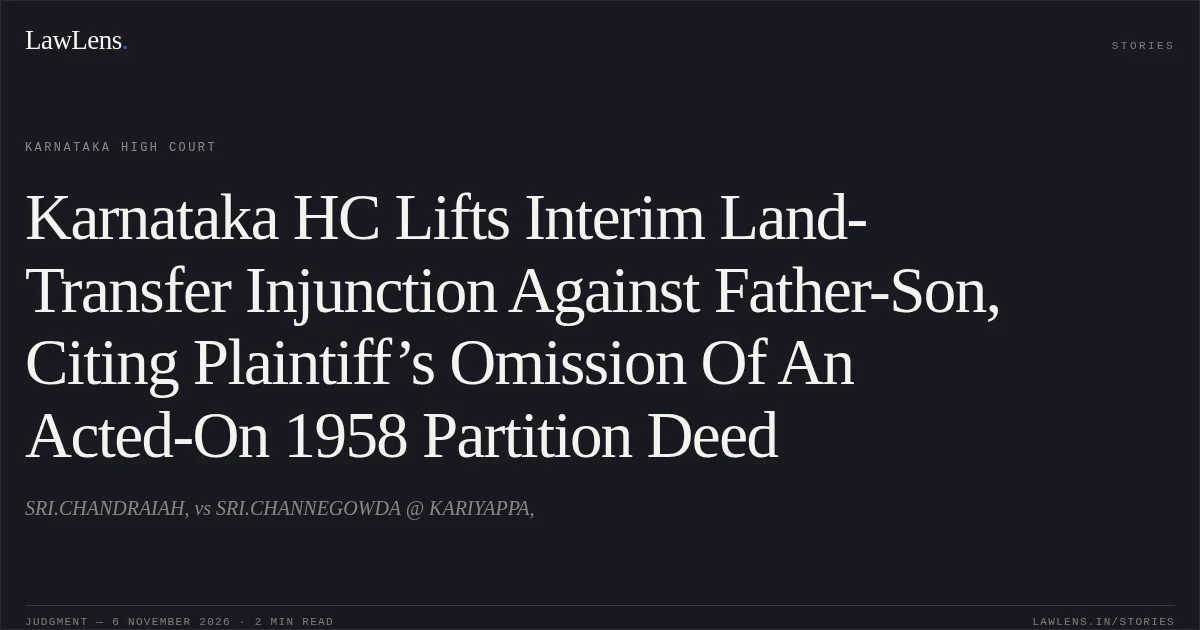
The respondent filed O.S. No. 481/2022 concerning the suit schedule property, claiming it had been excluded from an oral partition, retained as joint family property and continued to be used jointly.
pp. 2–4The petitioners relied on a registered partition deed dated 2 June 1958, which they contended allotted the property to Channiganna, the first petitioner’s father.
pp. 2–4The Trial Court granted a temporary injunction restraining the petitioners from alienating or encumbering the property; the appellate court upheld that order.
pp. 2–4The petitioners challenged both orders under Article 227 of the Constitution.
pp. 2–4The High Court noted that the respondent’s son had purchased an item allotted under the 1958 deed by a sale deed dated 22 January 2016.
pp. 5–602Issues
i.1. Whether the Courts below were justified in determining the identity of the suit schedule property by reference to the 1958 partition deed when that issue had not been pleaded or relied upon by the plaintiff.
p. 5ii.2. Whether the temporary injunction orders could stand in light of the partition deed, the parties’ conduct, and the omission of the deed from the plaint.
pp. 5–603Law Applied
The petition was brought under Article 227 of the Constitution, and the impugned injunction arose under Order XXXIX Rules 1 and 2 of the Code of Civil Procedure.
p. 2The Court applied the principle that a court must decide the dispute on the parties’ pleadings and should not travel beyond them; it also considered whether the injunction orders were supported by the material on record.
p. 5No precedent was cited in the judgment.
04Reasoning
The High Court observed that the respondent’s case was that the property had remained joint family property, but the Courts below based their orders on an assessment of the property’s identity under the registered partition deed—a matter not raised in the pleadings.
p. 5The deed prima facie allotted the suit property to Channiganna, and the respondent’s son’s 2016 purchase of another item allotted under that deed supported the view that the partition had been acted upon.
pp. 5–6The Court considered the plaint’s failure to disclose the deed, despite the parties’ conduct, material and found that the impugned orders had been made on a basis beyond the pleadings and contrary to the record.
p. 605Holding
The Court held that the impugned orders could not stand.
p. 7It allowed the writ petition and set aside the Trial Court’s order dated 1 April 2025 on I.A. No. 1 in O.S. No. 481/2022 and the appellate order dated 29 October 2025 in M.A. No. 32/2025.
p. 7Original Court PDF
SRI.CHANDRAIAH,vsSRI.CHANNEGOWDA @ KARIYAPPA,
Click to open original judgment
Original judgment, available to read, download and summarize on LawLens.in