01Facts
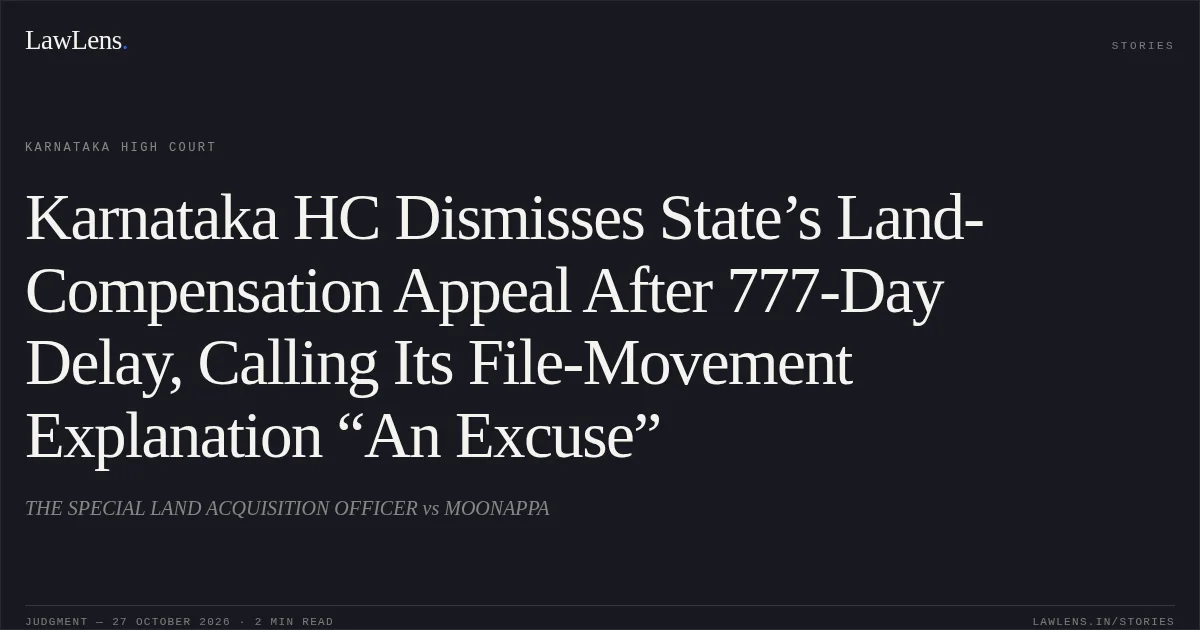
The appellants challenged the judgment and award dated 31 March 2023 in LAC No. 923/2021, filing the appeal on 12 September 2025 with a delay of 777 days.
pp. 1–2They sought condonation of delay by an application supported by an affidavit attributing the delay to administrative reasons and movement of files.
p. 2The High Court found the explanation bald, unsupported by relevant dates, and insufficient to account for the entire period of delay.
pp. 3, 13–1402Issues
i.Whether the appellants established sufficient cause for condoning the 777-day delay in filing the appeal.
pp. 2–3, 13–14ii.Whether administrative delay and inter-departmental file movement, without a satisfactory explanation covering the period of delay, warranted condonation.
pp. 9, 13–1403Law Applied
The appeal was brought under Section 74(1) of the Right to Fair Compensation and Transparency in Land Acquisition, Rehabilitation and Resettlement Act.
p. 1Applying the principles governing condonation of delay, the Court held that an applicant must provide a reasonable, satisfactory, bona fide explanation for the delay; the State has no special privilege and must act with diligence, like any other litigant.
p. 3, 9Relying on Shivamma v. Karnataka Housing Board, 2025 SCC OnLine SC 1969, and State of Odisha v. Managing Committee of Namatara Girls High School, 2026 SCC OnLine SC 191, the Court reiterated that bureaucratic inefficiency or administrative lethargy, without a proper explanation, is not sufficient cause, and that limitation cannot be relaxed merely in the name of public interest.
pp. 4–13The length of delay is relevant, and the merits of the underlying matter should not displace the threshold inquiry into the bona fides of the explanation.
pp. 8–9Provisions in the judgment · 4 · Linked ones open on LawLens
Right to Fair Compensation and Transparency in Land Acquisition, Rehabilitation and Resettlement Act, 2013 Section 74
Limitation Act, 1963 Section 5Section 3
Code of Civil Procedure, 1908 Section 100
04Reasoning
The appellants’ affidavit relied generally on file movement and administrative approvals but supplied no relevant dates or account of what prevented timely filing throughout the 777-day period.
pp. 2, 9, 13–14The Court treated those assertions as an excuse rather than a bona fide explanation and found that the appellants had not demonstrated diligence or sufficient cause.
pp. 9, 13–14Applying the cited Supreme Court principles, it concluded that administrative correspondence and delay could not justify condonation in the absence of a satisfactory explanation covering the entire period.
pp. 9, 13–1405Holding
The Court answered the first issue in the negative and dismissed I.A. No. 01/2026 seeking condonation of delay.
p. 14Consequently, the appeal was dismissed, and any pending applications were disposed of as not surviving for consideration.
pp. 14–15Original Court PDF
THE SPECIAL LAND ACQUISITION OFFICERvsMOONAPPA
Click to open original judgment
Original judgment, available to read, download and summarize on LawLens.in



