Facts
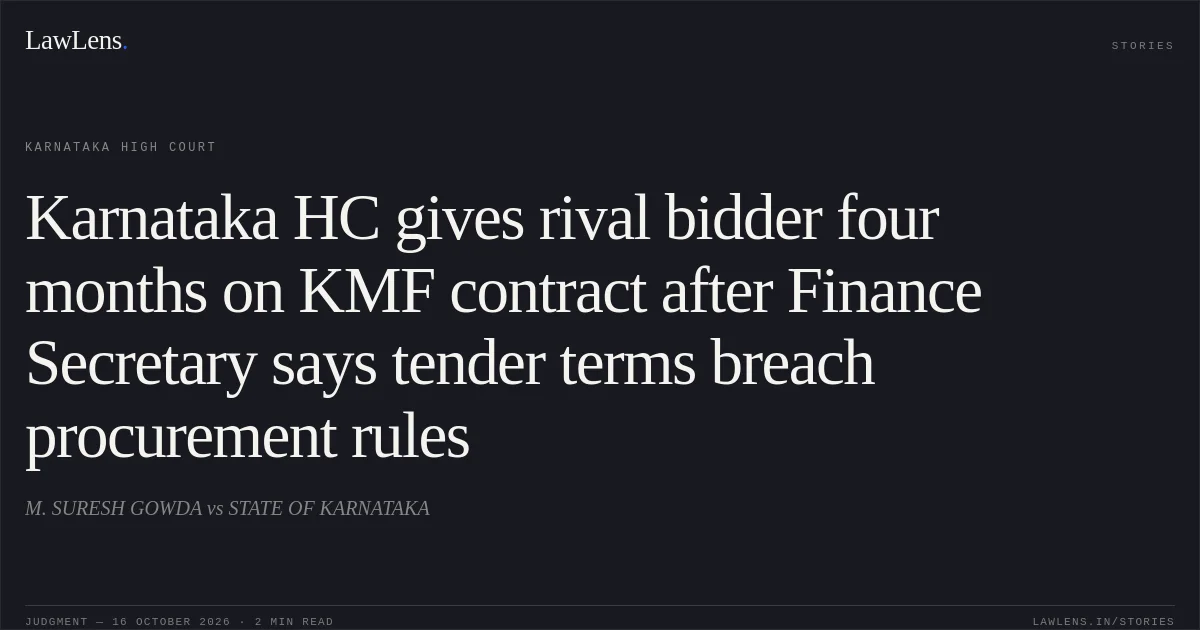
The petitioner challenged KMF’s rate acceptance letter dated 21 February 2026 in favour of respondent No. 5 and the related work order dated 1 April 2026.
Source reference: p. 1–3; para. 1He contended that clause 3.2 of the tender prevented bidders from quoting below a 2% service charge and required the tender committee to obtain the concerned bidders’ consent if more than one bidder was L-1.
Source reference: p. 4; para. 2The Finance Secretary’s affidavit stated that the tender terms were inconsistent with the Karnataka Transparency in Public Procurements Act (KTTP Act) and Finance Department instructions.
Source reference: p. 4; para. 3KMF then relied on the urgency of festival-season production, existing raw-material stocks, and the time required to conduct a fresh tender.
Source reference: pp. 6–8; paras. 5–10Issues
Whether the challenged tender terms and resulting award could stand in light of the Finance Secretary’s statement that they were inconsistent with the KTTP Act and Finance Department instructions.
Source reference: p. 4; paras. 2–4Whether, given KMF’s operational and festival-season requirements, the existing arrangement should be replaced immediately or the contract period shared temporarily while a fresh tender was conducted.
Source reference: pp. 5–8; paras. 5–11Law Applied
The Court referred to the KTTP Act and Finance Department instructions as governing the tender process, recording the Finance Secretary’s position that the tender terms did not comply with them; it did not identify a specific statutory provision or set out a detailed statutory test.
Source reference: p. 4; para. 3The Court also considered *Venu Enterprises v. State of Karnataka*, W.P. No. 32105 of 2018, in which the contract period was divided among bidders classified as L-1.
Source reference: pp. 5–6; para. 7The judgment applied that precedent as support for allocating separate periods among tenderers, rather than treating the existing award as an unqualified basis for continuing the contract.
Source reference: pp. 5–6; para. 7Reasoning
The Court noted that the Finance Secretary’s affidavit raised a compliance problem with the tender terms and stated that the tender would have to be quashed.
Source reference: p. 4; paras. 3–4However, KMF’s evidence of perishable raw milk, existing stock valued at Rs. 86.67 lakh, daily turnover of Rs. 35 lakh, and substantial festival demand showed the practical consequences of halting production while a fresh tender was completed.
Source reference: pp. 6–8; paras. 9–10Taking account of the time KMF said a new tender would require and the precedent permitting a divided contract period, the Court adopted a temporary sharing arrangement and directed KMF to proceed with a fresh tender.
Source reference: p. 8; paras. 11–12Holding
The Court disposed of the petition by permitting the petitioner to undertake the tender work for four months, from 1 October 2026 to 31 January 2027.
It directed KMF to commence the fresh tender process in December 2026 and complete it, issuing a work order in accordance with the Finance Department’s finalisation, by the end of January 2027.
Source reference: p. 9; para. 12Although the Court stated that the tender would have to be quashed, the operative order disposed of the petition through the temporary arrangement and fresh-tender directions; it did not expressly quash the challenged rate acceptance letter or work order.
Source reference: pp. 4, 9; paras. 4, 11–13Original Court PDF
M. SURESH GOWDAvsSTATE OF KARNATAKA
Click to open original judgment
Original judgment, available to read, download and summarize on LawLens.in