01Facts
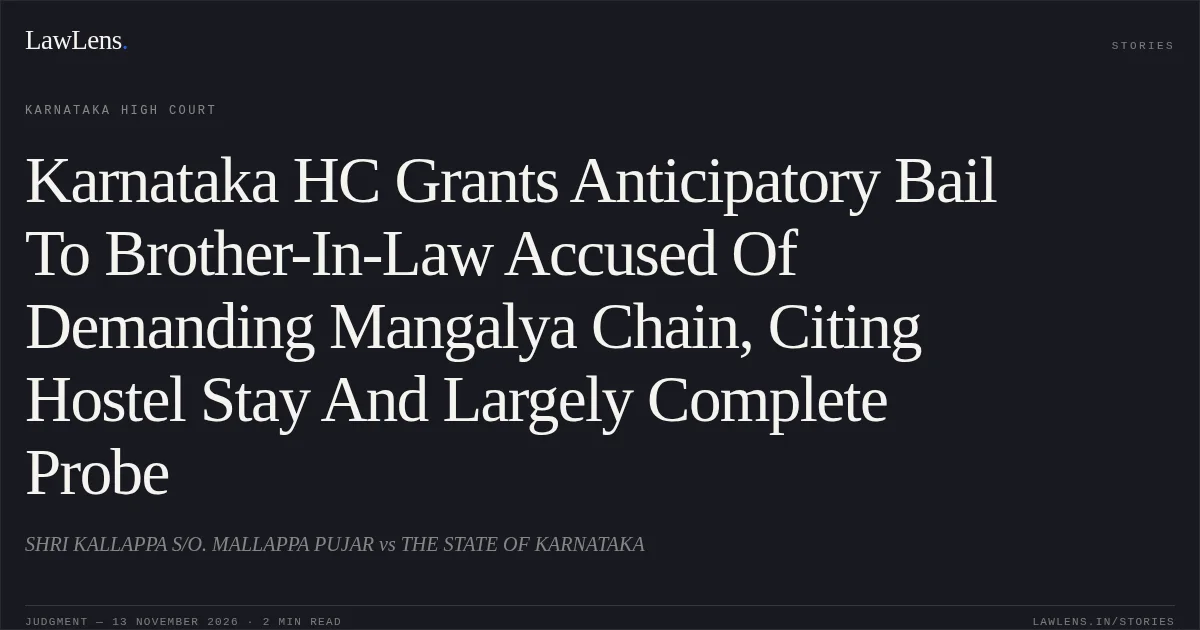
The petitioner, accused No. 2 and brother of accused No. 1, sought anticipatory bail in a case registered under Sections 80 and 85 of the Bharatiya Nyaya Sanhita, 2023 (BNS), and Sections 3 and 4 of the Dowry Prohibition Act, 1961.
¶ 2The prosecution alleged that, after the deceased’s marriage to accused No. 1 on 1 May 2026, the petitioner and accused No. 1 harassed her and demanded that she obtain a mangalya chain from her parental home. The deceased consumed poison on 21 August 2026 and died on 27 August 2026; her mother’s complaint led to registration of the FIR.
¶ 3The petitioner submitted that he was a law student living in a hostel, had no criminal antecedents, and was not involved in the deceased’s household. The State opposed bail, contending that he was required for investigation.
¶ 5–602Issues
i.1. Whether the petitioner was entitled to anticipatory bail in Crime No. 68/2026, given the allegation that he demanded dowry and harassed the deceased.
¶ 7–9ii.2. Whether anticipatory bail could be granted subject to conditions addressing the petitioner’s cooperation with the investigation and the risk of interference with witnesses.
¶ 903Law Applied
The petition was considered under Section 482 of the Bharatiya Nagarik Suraksha Sanhita, 2023 (BNSS), which the judgment identifies as corresponding to Section 438 of the Code of Criminal Procedure. The alleged offences were under Sections 80 and 85 of the BNS and Sections 3 and 4 of the Dowry Prohibition Act, 1961.
¶ 2In deciding whether to grant anticipatory bail, the Court considered the nature and gravity of the allegations, likely punishment, the possibility of absconding or fleeing justice, the petitioner’s character and antecedents, and the possibility of witness tampering.
¶ 9Provisions in the judgment · 6 · Linked ones open on LawLens
Bharatiya Nagarik Suraksha Sanhita, 2023 Section 482
Bharatiya Nyaya Sanhita, 2023 Section 80Section 85
Dowry Prohibition Act, 1961 Section 3Section 4
Code of Criminal Procedure, 1973 Section 438
04Reasoning
The Court noted that the allegation against the petitioner was a demand for a mangalya chain and harassment, but found that the deceased lived with her husband and in-laws while the petitioner studied law and resided in a hostel.
¶ 7–9It also considered that no serious allegation beyond the dowry-demand allegation was made against him, that a major portion of the investigation had been completed, that he undertook to cooperate, and that he had no criminal antecedents. The Court further observed that the alleged offences were not punishable with death or life imprisonment. On the circumstances as a whole, it held that anticipatory bail was appropriate, subject to conditions.
¶ 7–905Holding
The Court allowed the petition and ordered that, in the event of arrest in Crime No. 68/2026, the petitioner be released on anticipatory bail on executing a personal bond of ₹2,00,000 with one surety for the like amount.
p. 6Conditions included surrendering to the SHO/IO within 15 days; monthly attendance for six months or until filing of the final report, whichever was earlier; not tampering with or threatening witnesses; regularly appearing before the Court; and not committing offences in future. Breach of the conditions may lead the prosecution to seek cancellation of bail.
pp. 6–7Original Court PDF
SHRI KALLAPPA S/O. MALLAPPA PUJARvsTHE STATE OF KARNATAKA
Click to open original judgment
Original judgment, available to read, download and summarize on LawLens.in