01Facts
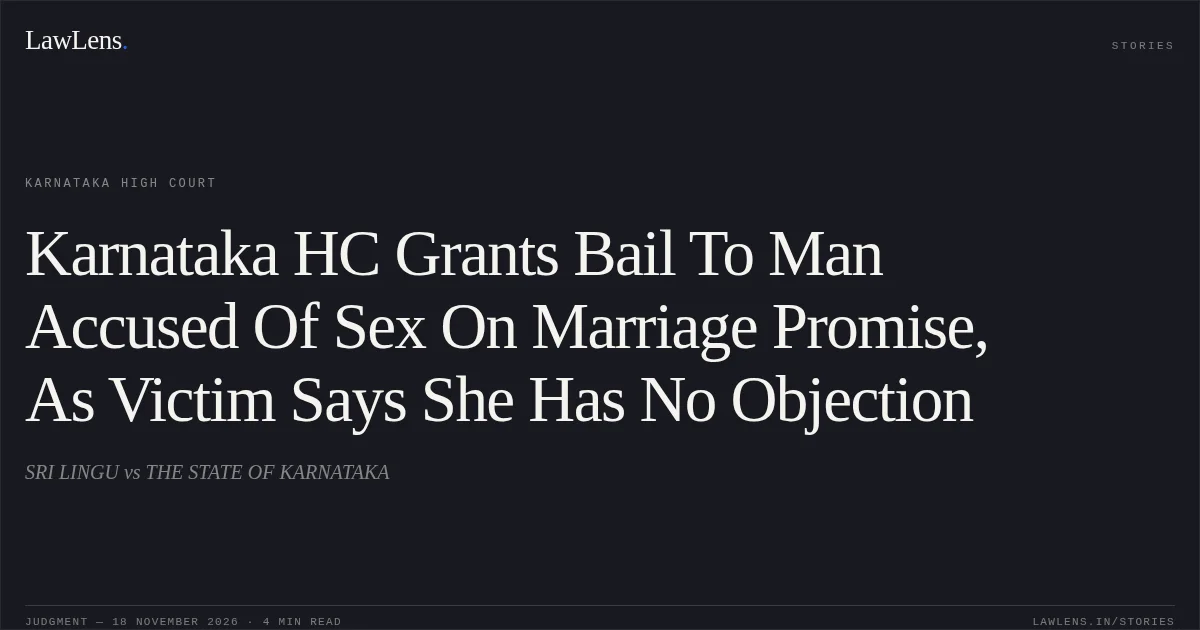
The petitioner (Accused No. 1, a driver) sought regular bail in Crime No. 129/2026 registered at Women Police Station, Vijayapur, for offences under ss. 69, 351(2) and 352 r/w s. 3(5) of the BNS.
¶ 2The prayer clause refers to s. 39 instead of s. 69, a discrepancy the order does not address.
The prosecution alleges that the complainant (the victim, aged 25) met the petitioner on Instagram about three years earlier. He proposed marriage, which she initially declined, and she later reciprocated.
¶ 4Between April and August 2026, the petitioner allegedly had physical relations with her at lodges and at a rented room on the pretext of marriage. He allegedly refused to marry her after she asked.
¶ 4After she complained to the police, the petitioner allegedly assaulted and criminally intimidated her on 02.09.2026.
¶ 4The State objected that the investigation was at an initial stage, that there was a prima facie case under s. 69 BNS, and that the petitioner might tamper with witnesses.
¶ 3The petitioner was arrested on 24.09.2026 and had been in judicial custody for about one and a half months.
¶ 10The victim, through counsel, stated she had no objection to bail and that the petitioner was now willing to marry her.
¶ 7, 1202Issues
i.1. Whether the petitioner is entitled to regular bail under s. 483 BNSS, despite the State's contention of a prima facie case under s. 69 BNS and the pendency of investigation, where the maximum punishment is ten years' imprisonment.
¶ 3, 5, 8, 9ii.2. Whether the victim's consent to bail, her acknowledgement of a prior consensual relationship, and the petitioner's offer of marriage are relevant considerations warranting bail.
¶ 6, 7, 1203Law Applied
The court applied s. 483 BNSS, which empowers the High Court and Sessions Court to grant bail.
¶ 9The court applied the principle that "bail is rule and jail is an exception," under which an accused should not remain in pre-trial custody as punishment.
¶ 9The court considered the gravity of the offence, noting that s. 69 BNS is not punishable with death or life imprisonment and carries a maximum of ten years, even though it is exclusively triable by the Sessions Judge.
¶ 8The court relied on the absence of antecedents of the petitioner.
¶ 9The court relied on the petitioner's permanent residence within the jurisdiction of the trial court, which reduces flight risk.
¶ 10The court relied on the power to impose conditions that address the risk of witness tampering and interference with investigation.
¶ 11The judgment cites no precedent.
Provisions in the judgment · 6 · Linked ones open on LawLens
Bharatiya Nagarik Suraksha Sanhita, 2023 Section 483
Bharatiya Nyaya Sanhita, 2023 Section 39Section 69Section 351Section 352Section 3
04Reasoning
The court accepted for argument that a prima facie case existed, but held that the offence's maximum punishment of ten years and the absence of any special ground or antecedents meant that custody could not be justified at the pre-trial stage.
¶ 8, 9The court rejected the petitioner's plea of innocence as a ground for bail, since such disputes are for trial.
¶ 5The court treated the prior consensual relationship and the victim's stated willingness to permit bail as relevant, in that the complaint arose from the refusal to marry.
¶ 6The court reasoned that the victim's no-objection and the petitioner's offer to marry her removed any likelihood of witness tampering.
¶ 12The court considered that the State's concerns about witness tampering and investigation could be met by conditions requiring the petitioner's cooperation with the investigation and trial.
¶ 11The court did not address whether the victim's stated consent could be treated as a substitute for an assessment of the allegation under s. 69 BNS, and it did not examine the marriage offer in relation to the deceit element of that section.
05Holding
The court held that no special ground had been shown to deny bail, that the petitioner had made out sufficient grounds for release, and that the risks raised by the State could be addressed through conditions.
¶ 9, 11, 12The petition was allowed. The petitioner (Accused No. 1) is to be enlarged on bail in Crime No. 129/2026 on executing a personal bond of ₹2,00,000 with two sureties for the like sum, to the satisfaction of the trial court.
¶ 13(i)–(ii)Bail is subject to the following conditions: (a) appearance before the Magistrate and trial court and assistance in trial; (b) appearance before the Investigating Officer until the final report and assistance in further investigation; (c) no tampering with prosecution witnesses and no hampering of investigation; and (d) no similar offence during pendency of the case.
¶ 13(a)–(d)The State or victim may move the trial court for cancellation of bail on breach.
¶ 13Original Court PDF
SRI LINGUvsTHE STATE OF KARNATAKA
Click to open original judgment
Original judgment, available to read, download and summarize on LawLens.in