01Facts
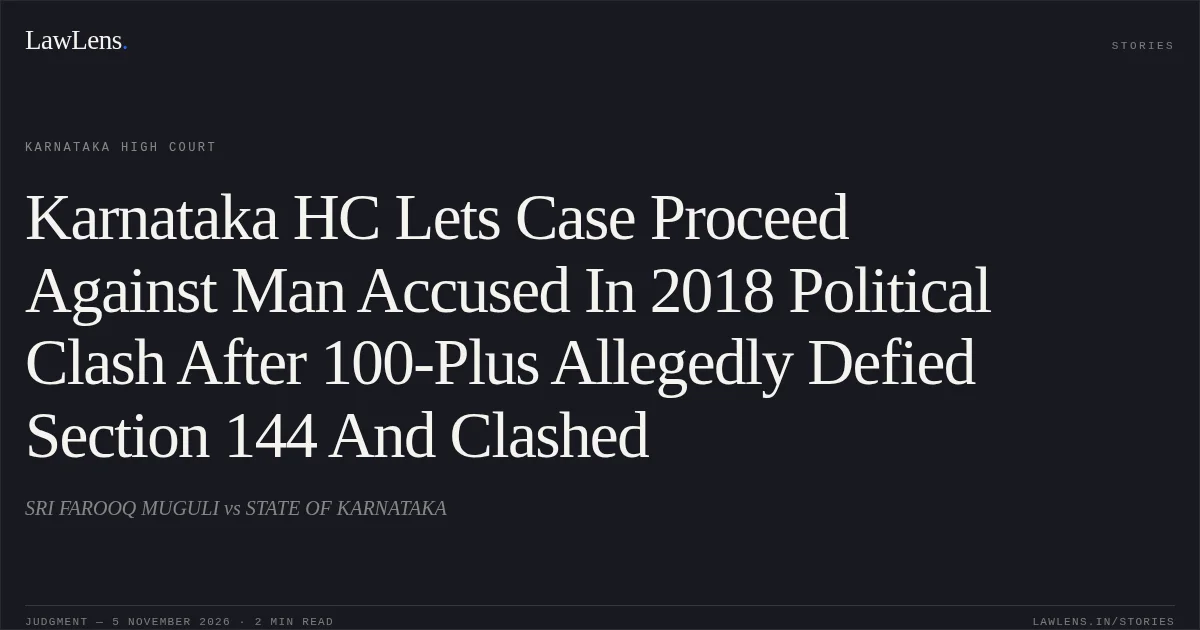
Following a complaint by a police constable, Vitla Police registered Crime No. 190/2018 concerning an incident on 19 May 2018, when rival political groups allegedly assembled despite prohibitory orders under Section 144 Cr.P.C., refused police directions to disperse, and engaged in violence.
¶ 2–3, 5–6A charge-sheet was filed invoking Sections 143, 147, 148, 323, 353, 504 read with Section 149 IPC.
¶ 2–3, 5–6The petitioner sought to quash the resulting proceedings in C.C. No. 1320/2020, contending that the materials did not establish a common object or his membership of an unlawful assembly.
¶ 2–3, 5–602Issues
i.Whether the complaint and charge-sheet materials prima facie disclosed an unlawful assembly with a common object under Sections 141 and 149 IPC, such that the prosecution should proceed.
¶ 19–23, 27ii.Whether the petitioner’s alleged lack of an individual overt act, or the absence of material specifically establishing his shared common object, warranted quashing the proceedings under Section 482 Cr.P.C.
¶ 24–2803Law Applied
Section 141 IPC defines an unlawful assembly as an assembly of five or more persons whose common object falls within one or more of its specified categories, including resisting the execution of law or legal process.
¶ 13–18, 24Under Section 149 IPC, a member of an unlawful assembly may be liable for an offence committed in prosecution of its common object, or one the members knew was likely to be committed in prosecution of that object; proof of a separate overt act by each member is not indispensable.
¶ 13–18, 24Mere presence at a gathering, however, is insufficient without membership of an assembly having a qualifying common object.
¶ 13–18, 24The Court applied these principles from Charan Singh v. State of Uttar Pradesh, (2004) 4 SCC 205.
¶ 13–18, 24It also applied the limitation on the High Court’s inherent jurisdiction under Section 482 Cr.P.C.: the Court considers whether the allegations and investigation materials disclose a prima facie basis for prosecution, without conducting a mini-trial or conclusively assessing guilt.
¶ 26Provisions in the judgment · 14 · Linked ones open on LawLens
Indian Penal Code, 1860 10 provisions
Section 141Section 143Section 147Section 148Section 149Section 188Section 323Section 334Section 353Section 504Code of Criminal Procedure, 1973 Section 134Section 144Section 482
Bharatiya Nagarik Suraksha Sanhita, 2023 Section 528
04Reasoning
The Court distinguished the cited Mohammed Noufal decision, where the assembly and circumstances had not disclosed a common object under Section 141 IPC.
¶ 20–23Here, the prosecution alleged that more than 100 persons gathered despite the prohibitory order, refused police directions to disperse, and thereafter resisted police intervention and engaged in violence.
¶ 20–23Taken together, those allegations could prima facie raise the question whether the assembly’s object included resisting the execution of law, and whether the alleged offences were committed in prosecution of that object or were known to be likely.
¶ 20–23The petitioner’s asserted lack of an individual overt act did not, by itself, defeat Section 149 liability; his membership, awareness of the common object, and the connection between that object and the alleged offences required examination at trial.
¶ 24–27The Court therefore declined to determine those factual questions in quashing proceedings.
¶ 25–2805Holding
The Court held that the petitioner had not established a basis for quashing the prosecution.
¶ 28–29It dismissed the criminal petition, reserving the petitioner’s right to raise all defences at trial, and clarified that its observations were not to influence the Trial Court on the merits.
¶ 28–29Original Court PDF
SRI FAROOQ MUGULIvsSTATE OF KARNATAKA
Click to open original judgment
Original judgment, available to read, download and summarize on LawLens.in